


Security News
Deno 2.6 + Socket: Supply Chain Defense In Your CLI
Deno 2.6 introduces deno audit with a new --socket flag that plugs directly into Socket to bring supply chain security checks into the Deno CLI.
By Sarah Gooding - Dec 12, 2025
sqlmongoose
Advanced tools
A SQLite ORM that works like Mongoose, bringing MongoDB/Mongoose syntax to SQLite. Join our community: https://discord.gg/hzWuQH869R
npm install sqlmongoose
const sqlmongoose = require('sqlmongoose');

// Connect to database
await sqlmongoose.connect('database.db');

// Define Schema
const userSchema = new Schema({
  name: { type: 'STRING', required: true },
  email: { type: 'STRING', unique: true },
  balance: { type: 'NUMBER', default: 0 },
  isActive: { type: 'BOOLEAN', default: true },
  lastLogin: { type: 'DATE' }
});

// Create Model
const User = sqlmongoose.model('User', userSchema);

// Use it like Mongoose!
const user = await User.create({
  name: 'John',
  email: 'john@example.com'
});
const economySchema = new Schema({
  userId: {
    type: 'STRING',
    required: true,
    unique: true
  },
  money: {
    type: 'NUMBER',
    default: 0,
    validate: value => value >= 0
  },
  inventory: {
    type: 'STRING', // Stored as JSON
    default: JSON.stringify({
      items: [],
      lastUpdated: new Date()
    })
  }
});

// Pre-save hook example
economySchema.pre('save', async function(data) {
  if (typeof data.inventory === 'object') {
    data.inventory = JSON.stringify(data.inventory);
  }
});

// Post-save hook example
economySchema.post('save', async function(data) {
  if (typeof data.inventory === 'string') {
    data.inventory = JSON.parse(data.inventory);
  }
});

// Create and export model
const Economy = sqlmongoose.model('Economy', economySchema);
module.exports = Economy;
// In your command file
const Economy = sqlmongoose.model('Economy');

async function createUser(userId) {
  const economy = await Economy.create({
    userId: userId,
    money: 1000 // Starting balance
  });
  return economy;
}
// Find one
const user = await Economy.findOne({ userId: '123' });

// Find many with conditions
const richUsers = await Economy.find({
  money: { gt: 10000 }
}, {
  limit: 10,
  orderBy: { money: 'DESC' }
});

// Advanced queries
const users = await Economy.find({
  money: { gt: 1000, lte: 5000 },
  lastLogin: { gt: new Date('2024-01-01') },
  name: { like: 'John' }
});
// Regular update
await Economy.update(
  { userId: '123' },
  { money: 5000 }
);

// Using operators like Mongoose
await Economy.update(
  { userId: '123' },
  { $inc: { money: 100 } }
);

// Multiple operators
await Economy.update(
  { userId: '123' },
  {
    $inc: { money: -50 },
    $set: { lastTransaction: new Date() }
  }
);
const { SlashCommandBuilder } = require('discord.js');
const Economy = require('../schemas/EconomySchema');

module.exports = {
  data: new SlashCommandBuilder()
    .setName('balance')
    .setDescription('Check your balance'),

  async execute(interaction) {
    let user = await Economy.findOne({
      userId: interaction.user.id
    });

    if (!user) {
      user = await Economy.create({
        userId: interaction.user.id,
        money: 1000, // Starting money
        bank: 0
      });
    }

    await interaction.reply(
      `Balance: ${user.money}\nBank: ${user.bank}`
    );
  }
};
const sqlmongoose = require('sqlmongoose');

async function transferMoney(fromId, toId, amount) {
  await sqlmongoose.transaction(async () => {
    const [from, to] = await Promise.all([
      Economy.findOne({ userId: fromId }),
      Economy.findOne({ userId: toId })
    ]);

    if (from.money < amount) {
      throw new Error('Insufficient funds');
    }

    await Economy.update(
      { userId: fromId },
      { $inc: { money: -amount } }
    );

    await Economy.update(
      { userId: toId },
      { $inc: { money: amount } }
    );
  });
}
SQLMongoose supports these MongoDB-like operators:
// $inc - Increment/decrement
await Economy.update(
  { userId },
  { $inc: { money: 100, xp: 50 } }
);

// $set - Set values
await Economy.update(
  { userId },
  { $set: { lastLogin: new Date() } }
);

// $unset - Remove fields
await Economy.update(
  { userId },
  { $unset: { temporaryBuff: 1 } }
);
// Comparison
eq: Equal
ne: Not Equal
gt: Greater Than
gte: Greater Than or Equal
lt: Less Than
lte: Less Than or Equal
in: In Array
like: Like (SQL LIKE)

// Examples
await Economy.find({
  level: { gte: 10 },
  name: { like: 'John%' },
  status: { in: ['active', 'premium'] }
});
interface UserDocument {
  id?: number;
  userId: string;
  money: number;
  bank: number;
  inventory: string;
}

const User = sqlmongoose.model<UserDocument>('User', userSchema);
SQLite Schemas supports the following data types:
STRING (stored as TEXT)NUMBER (stored as NUMERIC)BOOLEAN (stored as INTEGER)DATE (stored as TEXT)interface SchemaField {
type: 'STRING' | 'NUMBER' | 'BOOLEAN' | 'DATE';
required?: boolean;
default?: any;
validate?: (value: any) => boolean | Promise<boolean>;
index?: boolean;
unique?: boolean;
ref?: string; // For relationships
}
// Example schema with all features
const userSchema = new Schema({
name: {
type: 'STRING',
required: true,
validate: (value) => value.length >= 2
},
email: {
type: 'STRING',
unique: true,
index: true
},
age: {
type: 'NUMBER',
validate: (value) => value >= 0
},
departmentId: {
type: 'NUMBER',
ref: 'departments' // Relationship
}
});
// Advanced query operators
const results = await UserModel.find({
  age: { gt: 18, lte: 65 },
  name: { like: 'John' },
  status: { in: ['active', 'pending'] }
}, {
  populate: ['departmentId'],
  limit: 10,
  offset: 0,
  orderBy: {
    name: 'ASC',
    age: 'DESC'
  }
});

// Update operations
await UserModel.update(
  { age: { lt: 18 } },
  { status: 'underage' }
);

// Delete operations
await UserModel.delete({ status: 'inactive' });
// Pre-save hook
userSchema.pre('save', async function(data) {
  data.createdAt = new Date();
  data.password = await hashPassword(data.password);
});

// Post-save hook
userSchema.post('save', async function(data) {
  await sendWelcomeEmail(data.email);
});

// Pre-update hook
userSchema.pre('update', async function(data) {
  data.updatedAt = new Date();
});
const connection = createConnection('example.db');

await connection.transaction(async (db) => {
  const UserModel = new Model(db, 'users', userSchema);
  const OrderModel = new Model(db, 'orders', orderSchema);

  const user = await UserModel.create({ /* user data */ });
  const order = await OrderModel.create({
    userId: user.id,
    /* order data */
  });

  // If any operation fails, the entire transaction is rolled back
});
// Define related schemas
const departmentSchema = new Schema({
  name: { type: 'STRING', required: true }
});

const userSchema = new Schema({
  name: { type: 'STRING', required: true },
  departmentId: { type: 'NUMBER', ref: 'departments' }
});

// Query with population
const users = await UserModel.find(
  { age: { gt: 25 } },
  { populate: ['departmentId'] }
);
// Users will include full department objects
const productSchema = new Schema({
  name: {
    type: 'STRING',
    required: true,
    validate: (value) => value.length >= 3
  },
  price: {
    type: 'NUMBER',
    validate: (value) => value > 0
  },
  sku: {
    type: 'STRING',
    unique: true,
    validate: (value) => /^[A-Z]{2}-\d{6}$/.test(value)
  }
});

// Validation runs automatically on create and update
try {
  await ProductModel.create({
    name: 'A', // Will throw validation error
    price: -10 // Will throw validation error
  });
} catch (error) {
  console.error('Validation failed:', error.message);
}
const userSchema = new Schema({
  email: {
    type: 'STRING',
    unique: true, // Creates unique index
    index: true   // Creates regular index
  },
  name: {
    type: 'STRING',
    index: true   // Creates regular index
  }
});
new Schema(definition: SchemaDefinition)
new Model<T>(db: Database, tableName: string, schema: Schema)
find(query?: Partial<T>): Promise<T[]>
findOne(query: Partial<T>): Promise<T | null>
create(data: T): Promise<T>
import { createConnection, Schema, Model } from 'sqlite-schemas';

interface User {
  id?: number;
  name: string;
  email: string;
  age: number;
  active: boolean;
}

const db = createConnection('users.db');

const userSchema = new Schema({
  name: { type: 'STRING', required: true },
  email: { type: 'STRING', required: true },
  age: { type: 'NUMBER', required: true },
  active: { type: 'BOOLEAN', default: true }
});

const UserModel = new Model<User>(db, 'users', userSchema);

async function userExample() {
  // Create users
  await UserModel.create({
    name: 'John Doe',
    email: 'john@example.com',
    age: 25,
    active: true
  });

  // Find active users
  const activeUsers = await UserModel.find({ active: true });

  // Find specific user
  const john = await UserModel.findOne({ email: 'john@example.com' });
}
// index.js
const sqlmongoose = require('sqlmongoose');

async function init() {
  await sqlmongoose.connect('database.db');
  require('./schemas/UserSchema');
  require('./schemas/EconomySchema');
}

init().catch(console.error);
// schemas/EconomySchema.js
const sqlmongoose = require('sqlmongoose');
const { Schema } = sqlmongoose;

const economySchema = new Schema({
  userId: {
    type: 'STRING',
    required: true,
    unique: true
  },
  money: {
    type: 'NUMBER',
    default: 0,
    validate: value => value >= 0
  },
  bank: {
    type: 'NUMBER',
    default: 0
  },
  inventory: {
    type: 'STRING',
    default: JSON.stringify({
      items: [],
      lastUpdated: new Date()
    })
  },
  dailyStreak: {
    type: 'NUMBER',
    default: 0
  },
  lastDaily: {
    type: 'DATE',
    default: null
  }
});

// Hooks example
economySchema.pre('save', async function(data) {
  // Convert objects to JSON strings
  if (typeof data.inventory === 'object') {
    data.inventory = JSON.stringify(data.inventory);
  }
});

economySchema.post('save', async function(data) {
  // Parse JSON strings back to objects
  if (typeof data.inventory === 'string') {
    data.inventory = JSON.parse(data.inventory);
  }
});

module.exports = sqlmongoose.model('Economy', economySchema);
// commands/balance.js
const { SlashCommandBuilder } = require('discord.js');
const Economy = require('../schemas/EconomySchema');

module.exports = {
  data: new SlashCommandBuilder()
    .setName('balance')
    .setDescription('Check your or someone else\'s balance')
    .addUserOption(option =>
      option.setName('user')
        .setDescription('User to check')
        .setRequired(false)),

  async execute(interaction) {
    const target = interaction.options.getUser('user') || interaction.user;

    let userData = await Economy.findOne({ userId: target.id });

    if (!userData) {
      userData = await Economy.create({
        userId: target.id,
        money: 1000, // Starting money
        bank: 0
      });
    }

    const embed = {
      title: `💰 ${target.username}'s Balance`,
      fields: [
        { name: 'Cash', value: `$${userData.money}`, inline: true },
        { name: 'Bank', value: `$${userData.bank}`, inline: true },
        { name: 'Total', value: `$${userData.money + userData.bank}` }
      ],
      color: 0x0099FF
    };

    await interaction.reply({ embeds: [embed] });
  }
};

// commands/daily.js
const Economy = require('../schemas/EconomySchema');
const ONE_DAY = 24 * 60 * 60 * 1000;

module.exports = {
  data: new SlashCommandBuilder()
    .setName('daily')
    .setDescription('Collect your daily reward'),

  async execute(interaction) {
    const user = await Economy.findOne({ userId: interaction.user.id });
    const now = new Date();

    if (user.lastDaily && (now - new Date(user.lastDaily)) < ONE_DAY) {
      const timeLeft = ONE_DAY - (now - new Date(user.lastDaily));
      const hoursLeft = Math.floor(timeLeft / (60 * 60 * 1000));
      return interaction.reply(
        `You can collect your daily reward in ${hoursLeft} hours!`
      );
    }

    const reward = 100 * (user.dailyStreak + 1);

    await Economy.update(
      { userId: interaction.user.id },
      {
        $inc: {
          money: reward,
          dailyStreak: 1
        },
        $set: { lastDaily: now }
      }
    );

    await interaction.reply(
      `You collected $${reward}! 🎉\nDaily streak: ${user.dailyStreak + 1}`
    );
  }
};
// economy/transactions.js
const Economy = require('../schemas/EconomySchema');

async function transfer(fromId, toId, amount) {
  return await sqlmongoose.transaction(async () => {
    const [from, to] = await Promise.all([
      Economy.findOne({ userId: fromId }),
      Economy.findOne({ userId: toId })
    ]);

    if (!from || !to) throw new Error('User not found');
    if (from.money < amount) throw new Error('Insufficient funds');

    await Promise.all([
      Economy.update(
        { userId: fromId },
        { $inc: { money: -amount } }
      ),
      Economy.update(
        { userId: toId },
        { $inc: { money: amount } }
      )
    ]);

    return { from, to, amount };
  });
}

async function addItem(userId, item) {
  const user = await Economy.findOne({ userId });
  const inventory = JSON.parse(user.inventory);

  inventory.items.push({
    ...item,
    obtainedAt: new Date()
  });

  await Economy.update(
    { userId },
    {
      $set: {
        inventory: JSON.stringify(inventory)
      }
    }
  );
}

// economy/shop.js
async function buyItem(userId, itemId) {
  const user = await Economy.findOne({ userId });
  const item = SHOP_ITEMS[itemId];

  if (!item) throw new Error('Item not found');
  if (user.money < item.price) throw new Error('Insufficient funds');

  await Economy.update(
    { userId },
    { $inc: { money: -item.price } }
  );

  await addItem(userId, item);
  return item;
}
// queries/leaderboard.js
async function getLeaderboard() {
  return await Economy.find(
    {
      money: { gt: 0 },
      lastDaily: {
        gt: new Date(Date.now() - 7 * 24 * 60 * 60 * 1000)
      }
    },
    {
      orderBy: { money: 'DESC' },
      limit: 10
    }
  );
}

async function getActiveUsers() {
  return await Economy.find({
    lastDaily: { gt: new Date(Date.now() - 24 * 60 * 60 * 1000) },
    money: { gt: 1000 }
  });
}

async function searchUsers(query) {
  return await Economy.find({
    $or: [
      { username: { like: `%${query}%` } },
      { userId: { eq: query } }
    ]
  });
}
const { createConnection, Schema, Model } = require('sqlmongoose');

// Create database connection
const db = createConnection('example.db');

// Define schema
const userSchema = new Schema({
  name: { type: 'STRING', required: true },
  email: { type: 'STRING', unique: true },
  age: { type: 'NUMBER' },
  isActive: { type: 'BOOLEAN', default: true }
});

// Create model
const UserModel = new Model(db, 'users', userSchema);

// Example usage with Promise chains
UserModel.create({
  name: 'John Doe',
  email: 'john@example.com',
  age: 30
})
  .then(user => console.log('User created:', user))
  .catch(err => console.error('Error:', err));

// Example with async/await
async function findUsers() {
  try {
    // Find users with advanced queries
    const users = await UserModel.find({
      age: { gt: 18, lt: 65 },
      isActive: true
    }, {
      limit: 10,
      orderBy: { name: 'ASC' }
    });

    console.log('Active users:', users);

    // Update users
    const updated = await UserModel.update(
      { age: { lt: 18 } },
      { isActive: false }
    );
    console.log('Updated records:', updated);

  } catch (error) {
    console.error('Error:', error);
  }
}

// Transactions example
async function createUserWithOrder() {
  const connection = createConnection('store.db');

  try {
    await connection.transaction(async (db) => {
      const UserModel = new Model(db, 'users', userSchema);
      const OrderModel = new Model(db, 'orders', orderSchema);

      const user = await UserModel.create({
        name: 'Jane Doe',
        email: 'jane@example.com'
      });

      await OrderModel.create({
        userId: user.id,
        total: 99.99,
        status: 'pending'
      });
    });
    console.log('Transaction completed successfully');
  } catch (error) {
    console.error('Transaction failed:', error);
  }
}

// Hooks example in JavaScript
userSchema.pre('save', async function(data) {
  data.createdAt = new Date();
  if (data.password) {
    data.password = await bcrypt.hash(data.password, 10);
  }
});

// Relationships example
const orderSchema = new Schema({
  userId: { type: 'NUMBER', ref: 'users' },
  total: { type: 'NUMBER' }
});

// Find orders with populated user data
OrderModel.find(
  { total: { gt: 100 } },
  { populate: ['userId'] }
)
  .then(orders => {
    orders.forEach(order => {
      console.log(`Order total: ${order.total}`);
      console.log(`Customer: ${order.userId.name}`);
    });
  });
import { createConnection, Schema, Model } from 'sqlmongoose';

const db = createConnection('example.db');

const productSchema = new Schema({
  name: {
    type: 'STRING',
    validate: value => value.length >= 3
  },
  price: {
    type: 'NUMBER',
    required: true
  }
});

const ProductModel = new Model(db, 'products', productSchema);

// Using top-level await (Node.js 14.8+ or ES modules)
try {
  const product = await ProductModel.create({
    name: 'Test Product',
    price: 29.99
  });
  console.log('Product created:', product);

  const products = await ProductModel.find({
    price: { lt: 100 }
  });
  console.log('Affordable products:', products);
} catch (error) {
  console.error('Error:', error);
}
Contributions are welcome! Please feel free to submit a Pull Request.
MIT License - see the LICENSE file for details.
FAQs
Mongoose-like schemas and models for SQLite3
The npm package sqlmongoose receives a total of 0 weekly downloads. As such, sqlmongoose popularity was classified as not popular.
We found that sqlmongoose demonstrated a healthy version release cadence and project activity because the last version was released less than a year ago. It has 1 open source maintainer collaborating on the project.
Did you know?

Socket for GitHub automatically highlights issues in each pull request and monitors the health of all your open source dependencies. Discover the contents of your packages and block harmful activity before you install or update your dependencies.
Security News
Deno 2.6 introduces deno audit with a new --socket flag that plugs directly into Socket to bring supply chain security checks into the Deno CLI.
Security News
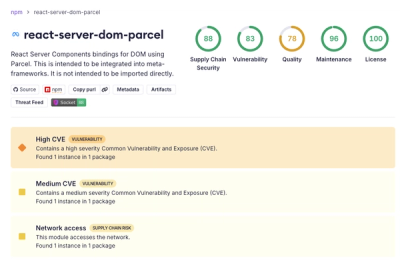
New DoS and source code exposure bugs in React Server Components and Next.js: what’s affected and how to update safely.

Security News
Socket CEO Feross Aboukhadijeh joins Software Engineering Daily to discuss modern software supply chain attacks and rising AI-driven security risks.