

Product
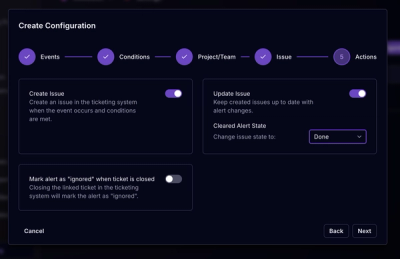
Socket for Jira Is Now Available
Socket for Jira lets teams turn alerts into Jira tickets with manual creation, automated ticketing rules, and two-way sync.
By Jeppe Hasseriis - Apr 20, 2026






A flexible and powerful SQL query string builder for JavaScript and TypeScript.
Full guide and API documentation at https://hiddentao.github.io/squel.
SELECT, UPDATE, INSERT, DELETE.Warning: Do not ever pass queries generated on the client side to your web server for execution. Such a configuration would make it trivial for a casual attacker to execute arbitrary queries — as with an SQL-injection vector, but much easier to exploit and practically impossible to protect against.
Squel is suitable for production use. If you want richer ORM features you may also want to consider Knex.
# npm
npm install squel

# bun
bun add squel

# yarn
yarn add squel

# pnpm
pnpm add squel
Squel requires Node.js 18 or newer.
import squel from "squel"

const query = squel.select().from("books").field("title").toString()
const squel = require("squel").default
// or: const { squel } = require("squel")

const query = squel.select().from("books").field("title").toString()
<script src="https://unpkg.com/squel/dist/browser/squel.min.js"></script>
<script>
  // `squel` is available on the global scope
  const query = squel.select().from("books").field("title").toString()
</script>
The published package contains:
dist/esm/ — ES module build (import squel from "squel").dist/cjs/ — CommonJS build (require("squel")).dist/types/ — TypeScript declaration files.dist/browser/squel.min.js — minified IIFE bundle for <script> tags (exposes window.squel).// SELECT * FROM table
squel.select()
.from("table")
.toString()
// SELECT t1.id, t2.name FROM table `t1` LEFT JOIN table2 `t2` ON (t1.id = t2.id) WHERE (t2.name <> 'Mark') AND (t2.name <> 'John') GROUP BY t1.id
squel.select()
.from("table", "t1")
.field("t1.id")
.field("t2.name")
.left_join("table2", "t2", "t1.id = t2.id")
.group("t1.id")
.where("t2.name <> 'Mark'")
.where("t2.name <> 'John'")
.toString()
// SELECT `t1`.`id`, `t1`.`name` as "My name", `t1`.`started` as "Date" FROM table `t1` WHERE age IN (RANGE(1, 1.2)) ORDER BY id ASC LIMIT 20
squel.select({ autoQuoteFieldNames: true })
.from("table", "t1")
.field("t1.id")
.field("t1.name", "My name")
.field("t1.started", "Date")
.where("age IN ?", squel.str('RANGE(?, ?)', 1, 1.2))
.order("id")
.limit(20)
.toString()
You can build parameterized queries:
/*
{
    text: "SELECT `t1`.`id`, `t1`.`name` as \"My name\", `t1`.`started` as \"Date\" FROM table `t1` WHERE age IN (RANGE(?, ?)) ORDER BY id ASC LIMIT 20",
    values: [1, 1.2]
}
*/
squel.select({ autoQuoteFieldNames: true })
    .from("table", "t1")
    .field("t1.id")
    .field("t1.name", "My name")
    .field("t1.started", "Date")
    .where("age IN ?", squel.str('RANGE(?, ?)', 1, 1.2))
    .order("id")
    .limit(20)
    .toParam()
You can use nested queries:
// SELECT s.id FROM (SELECT * FROM students) `s` INNER JOIN (SELECT id FROM marks) `m` ON (m.id = s.id)
squel.select()
    .from(squel.select().from("students"), "s")
    .field("id")
    .join(squel.select().from("marks").field("id"), "m", "m.id = s.id")
    .toString()
// UPDATE test SET f1 = 1
squel.update()
    .table("test")
    .set("f1", 1)
    .toString()

// UPDATE test, test2, test3 AS `a` SET test.id = 1, test2.val = 1.2, a.name = "Ram", a.email = NULL, a.count = a.count + 1
squel.update()
    .table("test")
    .set("test.id", 1)
    .table("test2")
    .set("test2.val", 1.2)
    .table("test3", "a")
    .setFields({
        "a.name": "Ram",
        "a.email": null,
        "a.count = a.count + 1": undefined,
    })
    .toString()
// INSERT INTO test (f1, f2) VALUES (1, 1.2)
squel.insert()
    .into("test")
    .set("f1", 1)
    .set("f2", 1.2)
    .toString()
// DELETE FROM test WHERE (f1 = 2) ORDER BY f2 LIMIT 1
squel.delete()
    .from("test")
    .where("f1 = 2")
    .order("f2")
    .limit(1)
    .toString()
// test = 3 OR test = 4
squel.expr()
    .or("test = 3")
    .or("test = 4")
    .toString()

// test = 3 AND (inner = 1 OR inner = 2) OR (inner = 3 AND inner = 4 OR (inner IN ('str1, 'str2', NULL)))
squel.expr()
    .and("test = 3")
    .and(
        squel.expr()
            .or("inner = 1")
            .or("inner = 2")
    )
    .or(
        squel.expr()
            .and("inner = ?", 3)
            .and("inner = ?", 4)
            .or(
                squel.expr()
                    .and("inner IN ?", ["str1", "str2", null])
            )
    )
    .toString()

// SELECT * FROM test INNER JOIN test2 ON (test.id = test2.id) WHERE (test = 3 OR test = 4)
squel.select()
    .join("test2", null, squel.expr().and("test.id = test2.id"))
    .where(squel.expr().or("test = 3").or("test = 4"))
    .toString()
By default Squel does not support the use of object instances as field values. Instead it lets you tell it how you want specific object types to be handled:
// handler for objects of type Date
squel.registerValueHandler(Date, (date) => {
    return `${date.getFullYear()}/${date.getMonth() + 1}/${date.getDate()}`
})

squel.update()
    .table("students")
    .set("start_date", new Date(2013, 5, 1))
    .toString()

// UPDATE students SET start_date = '2013/6/1'
Custom value handlers can also be overridden on a per-instance basis (see the docs).
Squel lets you extend the built-in query builders or create entirely new kinds of queries:
class CommandBlock extends squel.cls.Block {
    command(command, arg) {
        this._command = command
        this._arg = arg
    }
    compress(level) {
        this.command("compress", level)
    }
    _toParamString(options) {
        let text = this._command.toUpperCase()
        const values = []
        if (options.buildParameterized) {
            text += " ?"
            values.push(this._arg)
        } else {
            text += ` ${this._arg}`
        }
        return { text, values }
    }
}

class PragmaQuery extends squel.cls.QueryBuilder {
    constructor(options) {
        super(options, [
            new squel.cls.StringBlock(options, "PRAGMA"),
            new CommandBlock(options),
        ])
    }
}

squel.pragma = (options) => new PragmaQuery(options)

squel.pragma().compress(9).toString()
// 'PRAGMA COMPRESS 9'

squel.pragma().compress(9).toParam()
// { text: 'PRAGMA COMPRESS ?', values: [9] }
Squel supports the standard SQL commands and reserved words. A number of database engines provide their own non-standard commands; Squel makes it easy to load different "flavours" of SQL that augment the core builders with engine-specific features.
Available flavours: mysql, mssql, postgres (e.g. INSERT ... RETURNING for Postgres, ON DUPLICATE KEY UPDATE for MySQL).
import squel from "squel"

const pg = squel.useFlavour("postgres")
const mysql = squel.useFlavour("mysql")
const mssql = squel.useFlavour("mssql")
For browser use:
<script src="https://unpkg.com/squel/dist/browser/squel.min.js"></script>
<script>
  const pg = squel.useFlavour("postgres")
</script>
See the API docs for a full reference.
v6.0.0 is a modernization release. The public API is unchanged — all your existing squel.select(), squel.useFlavour('postgres'), and related calls continue to work.
The breaking changes are all about package shape:
engines.node is now >=18. If you need support for older runtimes, stay on v5.squel.js / squel.min.js / squel-basic.js / squel-basic.min.js UMD bundles have been replaced. Consumers now import from dist/esm/, dist/cjs/, or the IIFE at dist/browser/squel.min.js (see the Package layout section).squel.min.js via <script>, switch to dist/browser/squel.min.js (same global window.squel).bun install # install dependencies
bun run check # lint & format check (biome)
bun run typecheck # TypeScript type checking
bun test # run the test suite
bun run build # produce dist/esm, dist/cjs, dist/types, dist/browser
Releases are automated. Landing a conventional commit on master triggers the release workflow, which bumps the version, updates CHANGELOG.md, creates a tag, and publishes to npm with provenance. See RELEASE.md for details.
Contributions are welcome! Please see CONTRIBUTING.md.
MIT — see LICENSE.md.
FAQs
SQL query string builder
The npm package squel receives a total of 11,490 weekly downloads. As such, squel popularity was classified as popular.
We found that squel demonstrated a healthy version release cadence and project activity because the last version was released less than a year ago. It has 1 open source maintainer collaborating on the project.
Did you know?

Socket for GitHub automatically highlights issues in each pull request and monitors the health of all your open source dependencies. Discover the contents of your packages and block harmful activity before you install or update your dependencies.
Product
Socket for Jira lets teams turn alerts into Jira tickets with manual creation, automated ticketing rules, and two-way sync.
Company News
Socket won two 2026 Reppy Awards from RepVue, ranking in the top 5% of all sales orgs. AE Alexandra Lister shares what it's like to grow a sales career here.

Security News
NIST will stop enriching most CVEs under a new risk-based model, narrowing the NVD's scope as vulnerability submissions continue to surge.