

Product
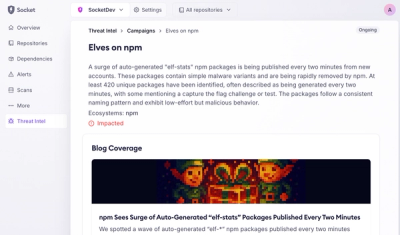
Introducing Supply Chain Attack Campaigns Tracking in the Socket Dashboard
Campaign-level threat intelligence in Socket now shows when active supply chain attacks affect your repositories and packages.
By Philipp Burckhardt - Jan 21, 2026
ssh-deploy env-get <remote> [options] Get the value of an environment variable for a given host.
options:
--host The host is the domain name that an application is made accessible at
--name The name of the environment variable
ssh-deploy env-list <remote> [options] Get the value of all environment variables for a given host.
options:
--host The host is the domain name that an application is made accessible at
ssh-deploy env-set <remote> [options] Set the value of an environment variables for a given host.
options:
--host The host is the domain name that an application is made accessible at
--name The name of the environment variable
--value The value of the environment variable
ssh-deploy prepare <remote> Prepare a server to be used for ssh-deploy
ssh-deploy publish <remote> [options] Publish a new version of an application.
options:
--directory The directory of the application, defaults to the current working directory
--app The name of the application (defaults to name, read from package.json)
--version The version of teh application (default to version, read from package.json)
ssh-deploy restart-agent <remote> Restarts the bouncy proxy that is responsible for mapping hosts onto ports
ssh-deploy start <remote> [options] Start or restart an application at a given host and version.
options:
--app The name of the application (defaults to name, read from package.json)
--version The version of teh application (default to version, read from package.json)
--host The host is the domain name that an application is made accessible at
Each command can also be accessed programatically by calling deploy[command](remote, options), and will return a promise. e.g.
var deploy = require('ssh-deploy');
deploy.publish('root:password@127.0.0.1', {directory: process.cwd}).then(function () {
  return deploy.start('root:password@127.0.0.1', {directory: process.cwd, host: 'example.com'});
}).done(function () {
  console.log('updated deployment');
});
To configure a .ssh/config file see http://nerderati.com/2011/03/17/simplify-your-life-with-an-ssh-config-file/
FAQs
Deploy node.js apps over ssh
The npm package ssh-deploy receives a total of 1 weekly downloads. As such, ssh-deploy popularity was classified as not popular.
We found that ssh-deploy demonstrated a not healthy version release cadence and project activity because the last version was released a year ago. It has 1 open source maintainer collaborating on the project.
Did you know?

Socket for GitHub automatically highlights issues in each pull request and monitors the health of all your open source dependencies. Discover the contents of your packages and block harmful activity before you install or update your dependencies.
Product
Campaign-level threat intelligence in Socket now shows when active supply chain attacks affect your repositories and packages.

Research
Malicious PyPI package sympy-dev targets SymPy users, a Python symbolic math library with 85 million monthly downloads.

Security News
Node.js 25.4.0 makes require(esm) stable, formalizing CommonJS and ESM compatibility across supported Node versions.