

Product
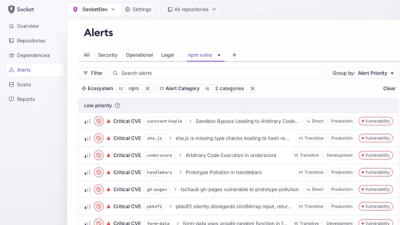
Introducing Custom Tabs for Org Alerts
Create and share saved alert views with custom tabs on the org alerts page, making it easier for teams to return to consistent, named filter sets.
By André Staltz - Jan 20, 2026
static-rewrite
Advanced tools
Easily generate destination paths or static URLs by mapping user-friendly patterns to server-side build paths.




Easily generate destination paths or static URLs by mapping user-friendly patterns to server-side build paths.
Install with npm:
$ npm install --save static-rewrite
This module does something similar to URL rewriting, but for static paths at build-time. The goal is consistently and easily generate correct destination paths during development, regardless of the source paths.
Examples
Let's say we have a blog, and we want to:
title from front-matter as the folder name (for "pretty" permalinks)/index.html to the path (also for "pretty" permalinks)In other words, we want this source path:
src/content/posts/2017-02-14.md
To be written to a destination path that looks something like:
blog/how-to-create-effective-permalinks/index.html
You can either manually parse and reformat your destination paths, or use this library with simple rewrite rules.
Example rewrite rule
The following rule(s) will match any files in the posts directory, and rewrite the path using the given structure.
rewriter.rule(/posts\//, 'blog/:slugify(title)/index.html');
// add extra validation if necessary
rewriter.rule(/posts\//, 'blog/:slugify(title)/index.html', function(file) {
  return file.extname === '.md';
});
For example, when a user enters a URL like the following to go to a page on wikipedia:
https://en.wikipedia.org/wiki/Business
The URL might be rewritten by wikipedia to something like:
https://en.wikipedia.org/w/index.php?title=Business
Add this library to your JavaScript application with the following line of code:
var Rewriter = require('static-rewrite');
Create an instance of Rewriter with the given options.
Params
options {Object}Example
var rewriter = new Rewriter()
  .rule(/posts/, 'blog/:stem/index.html')
  .rule(/docs/, 'docs/:stem/index.html')

console.log(rewriter.rewrite({path: 'content/posts/first-post.md'}));
//=> 'blog/first-post/index.html'

console.log(rewriter.rewrite({path: 'content/posts/other-post.md'}));
//=> 'blog/other-post/index.html'

console.log(rewriter.rewrite({path: 'content/docs/api.md'}));
//=> 'docs/api/index.html'
Register a rewrite rule with a regex to use for matching paths, a structure to use for the replacement patter, and an optional validation fn to supplement the regex when matching.
Params
regex {RegExp}structure {String}fn {Function}: Optionally pass a function to do further validation on the file (return false if the rule shouldn't be used) and/or to update the context to be used for resolving placeholders in the rule structure.returns {Object}: Returns the Rewriter instance for chaining.Example
rewriter.rule(':folder/([^\\/]+)/(.*)', ':dirname/:foo/:stem.html');
rewriter.rule(/([^\\/]+)\/*\.hbs$/, ':dirname/:foo/:stem.html');
rewriter.rule(/\.hbs$/, ':dirname/:stem.html');
rewriter.rule(/\.md$/, 'blog/:stem/index.html', function(file) {
  return file.dirname !== 'foo/bar';
});
Run rewrite rules on the given file. If a rule matches
the file, the file.path will be rewritten using locals, and values
from the file and file.data.
Params
file {Object}locals {Object}returns {String}: Returns the formatted path or the original file.path if no rewrite rules match the file.Calls RegExp.exec() on file.path, using the regex from the given rewrite rule. If the file matches, the match arguments are returned, otherwise null.
Params
rule {Object}file {Object}returns {Boolean}Example
var fileA = new File({path: 'blog/drafts/about.hbs'});
var fileB = new File({path: 'blog/content/about.hbs'});

var ruleA = new rewriter.Rule(/blog\//, ':stem/index.html');
var ruleB = new rewriter.Rule(/blog\//, ':stem/index.html', function(file) {
  return !/drafts/.test(file.path);
});

console.log(rewriter.match(ruleA, fileA)); //<= true
console.log(rewriter.match(ruleB, fileA)); //<= false

console.log(rewriter.match(ruleA, fileB)); //<= true
console.log(rewriter.match(ruleB, fileB)); //<= true
Create a new Rule with the given pattern, structure and optional function for validating or adding data to the context
Params
pattern {String}structure {String}fn {Function}Example
var rule = new Rule(/posts/, 'blog/:stem/index.html');
var rule = new Rule(/posts/, 'blog/:stem/index.html', function(file) {
  return file.extname !== '.foo';
});
var rule = new Rule(/posts/, 'blog/:stem/index.html', function(file, params) {
  file.data = Object.assign({}, file.data, params);
});
Pull requests and stars are always welcome. For bugs and feature requests, please create an issue.
Please read the contributing guide for advice on opening issues, pull requests, and coding standards.
(This project's readme.md is generated by verb, please don't edit the readme directly. Any changes to the readme must be made in the .verb.md readme template.)
To generate the readme, run the following command:
$ npm install -g verbose/verb#dev verb-generate-readme && verb
Running and reviewing unit tests is a great way to get familiarized with a library and its API. You can install dependencies and run tests with the following command:
$ npm install && npm test
Jon Schlinkert
Copyright © 2017, Jon Schlinkert. MIT
This file was generated by verb-generate-readme, v0.4.2, on February 18, 2017.
FAQs
Easily generate destination paths or static URLs by mapping user-friendly patterns to server-side build paths.
The npm package static-rewrite receives a total of 11 weekly downloads. As such, static-rewrite popularity was classified as not popular.
We found that static-rewrite demonstrated a not healthy version release cadence and project activity because the last version was released a year ago. It has 1 open source maintainer collaborating on the project.
Did you know?

Socket for GitHub automatically highlights issues in each pull request and monitors the health of all your open source dependencies. Discover the contents of your packages and block harmful activity before you install or update your dependencies.
Product
Create and share saved alert views with custom tabs on the org alerts page, making it easier for teams to return to consistent, named filter sets.

Product
Socket’s Rust and Cargo support is now generally available, providing dependency analysis and supply chain visibility for Rust projects.

Security News
Chrome 144 introduces the Temporal API, a modern approach to date and time handling designed to fix long-standing issues with JavaScript’s Date object.