

Product
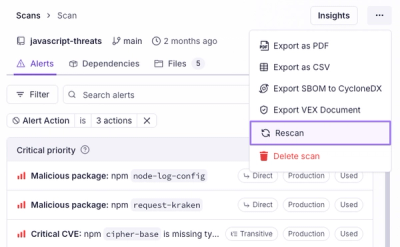
Introducing Immutable Scans
Scan results now load faster and remain consistent over time, with stable URLs and on-demand rescans for fresh security data.
By Nolan Lawson - Jan 23, 2026
#Steply
asynchronous promise-like function sequencing for dummies
this is very much a 0.x project. I write examples instead of tests, I document features I'm still in the process of implementing (and really, I only document at all as a brain-storming exercise), I knowingly push broken code, and I change my mind about what this project even is for daily... when that's no longer true I'll replace this terrifying paragraph with some salesy piece about how much better food tastes with this module in your project (and I'll move to 1.x)
##Installation
$ npm install steply
##Overview
Promises are awesome, I love promises... but I'm not an academic and sometimes I'd find myself having naive thoughts like "I just want to call a() and then when that's done, b()"... or I'd find myself reading wikipedia pages on monads when all I really wanted was to call the next custom function with values calculated in the current custom function.
Basically when the Stepper executes a method it returns its self. every method called on Stepper is used to create a list of functions to be sequenced. there are 5 basic Stepper methods:
this the next function will use)Once the Stepper is chain called to setup the steps the stack is executed
##Core Methods
###execute, exec
calling exec() will push any targets, functions, and arguments to their respective stacks (hopefully that will make sense later)
###setFunction, fun
sets the function to be pushed onto the list of steps
Stepply().fun(foo).exec() //execute foo
         .fun(bar).exec(); //once foo is done, execute bar

function foo() {...}
function bar() {...}
###setArguments, args
for when functions alone won't do it
Stepply().args(1, 2, 3).fun(foo).exec() //execute foo(1, 2, 3)
         .args
         (4, 5, 6).exec();         //once foo is done, call it again with (4, 5, 6)

function foo(a, b, c) {...}
###setArgumentsArray, arr
very similar to args...
Stepply().args([1, 2, 3]).fun(foo).exec() //execute foo(1, 2, 3)
         .args([4, 5, 6]).exec();         //once foo is done, call it again with (4, 5, 6)

function foo(a, b, c) {...}
###setThis, obj
set the target any functions will refer to as this
var thing1 = {bar:"thing1's bar"};
var thing2 = {bar:"thing2's bar"};

Stepply().fun(foo)
    .obj(thing1).exec()  //logs "thing1's bar"
    .obj(thing2).exec(); //logs "thing2's bar"

function foo() {
    console.log(this.bar);
}
###setErrorHandler, err
set function for handling any thrown errors
Stepply().fun(throwy).exec() //error thrown...
    .fun(foo).exec()         //skipped
    .fun(bar).exec()         //skipped
    .err(catchy)             //catches and handles error
    .fun(baz).exec();        //runs

function throwy() {
    throw new Error(...);
}

function catchy(error) {
    ...
}
##Combination Methods
###then
depending on the signature: sets target, sets arguments, sets function, and/or executes
Stepply().then(target1, method1, 1, 2, 3)
         .then(target2, method2, 4, 5)
for more information see ... (TODO: deep dive into then signatures)
###log
logs the current arguments in the stack. if it's called with an argument, the argument is used as a label
Stepply().args(1, 2).log() //logs "1, 2"
         .args(3).log('a');//logs "a: 3"
###all
passes current arguments to every function in the paramaters. next step is called after all functions complete
Stepply().all(foo, bar, baz) // calls foo(), bar(), and baz() simultaneously
         .log("results");    // logs "results: [foo()'s results...], [bar()'s results...], [baz()'s results...]"
###wait
calls next step after some number of milliseconds
Stepply().then(doSomething) //do something
         .wait(2000)        //do nothing for 2 seconds
         .then(doSomething) //do something again
###node
wrap node style function so that callbacks go to next step and errors are thrown
Stepply().args("some.filepath").node(fs.stat).log(); //logs stat object for some.filepath
###nodeNoErr
like node, but for node functions who's callbacks don't ever error
Stepply().args("some.filepath").nodeNoErr(fs.exists).log(); //logs if some.filepath exists
##Extending
TODO: figure out if this is something that doesn't require a pull request
FAQs
asynchronous promise-like function sequencing for dummies (like me)
We found that steply demonstrated a not healthy version release cadence and project activity because the last version was released a year ago. It has 1 open source maintainer collaborating on the project.
Did you know?

Socket for GitHub automatically highlights issues in each pull request and monitors the health of all your open source dependencies. Discover the contents of your packages and block harmful activity before you install or update your dependencies.
Product
Scan results now load faster and remain consistent over time, with stable URLs and on-demand rescans for fresh security data.
Product
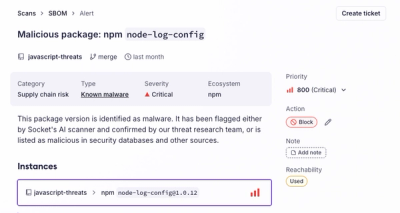
Socket's new Alert Details page is designed to surface more context, with a clearer layout, reachability dependency chains, and structured review.
Product
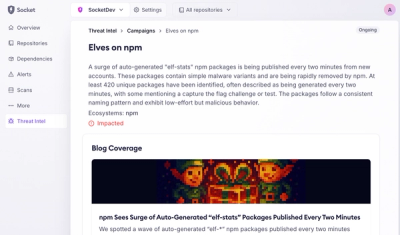
Campaign-level threat intelligence in Socket now shows when active supply chain attacks affect your repositories and packages.