

Security News
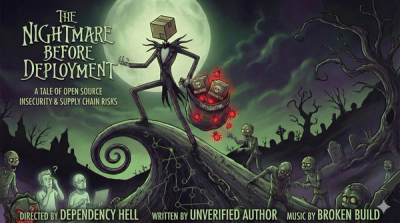
The Nightmare Before Deployment
Season’s greetings from Socket, and here’s to a calm end of year: clean dependencies, boring pipelines, no surprises.
By Ahmad Nassri - Dec 16, 2025
swagger-chunk
Advanced tools
Build and maintain large swagger API documentation files from small manageable chunks. Output yaml or json format. Instal skeleton swagger-chunk & scripts via command line --init
Table of Contents generated with DocToc
Swagger is becoming the defacto api documentation tool, swagger files though do have a tendency of growing wildly large and hard to maintain.
Swagger-chunk allows you to build and maintain large swagger API documentation files from small manageable chunks, importing and re-using. Perfect for Documentation-Driven Development, and when used in conjunction with swagger-codegen makes for a powerful methodology to both start and maintain any project.
Before writing the compiled swagger file to disk the object is validated using openapi-schema-validation, any validation issues are written to the terminal and the process halted. You may bypass validation, please see the available command line arguments.
The base paths are now relative to the input file. If you are using this tool and upgrade to v2 ensure the main entry point uses files relative to itself unlike relative to the package.json file as in v1.
For a full example please view the example folder within the swagger-chunk repo.: https://github.com/jdcrecur/swagger-chunk/tree/master/src
Using a combination of json-refs and js-yaml, swagger-chunk combines multiple YAML files to output a single JSON or YAML file.
Swagger-chunk will automatically extract the swagger version number from the parsed yml and append to the file name produced, helping ensure little confusion when publishing changes to your API swagger documentation.
If you are familiar with Swagger then you will likely be familiar with the concept of definitions (or components in v3/OpenAPI) and referencing them with $ref with the value in single quotes prefixed with a # for example:
$ref: "#/definitions/Weather"
Using swagger-chunk you can use the $ref feature's value as a path to another yml file, swagger-chunk will try to fetch the contents of the path and inject into the file. This technique allows you to break up what would otherwise be potentially 1000's of lines into smaller re-usable chunks. For example:
$ref: ./definitions/Weather.yml
Installing:
npm i --save swagger-chunk
Running swagger-chunk and outputting the compiled contents to file (typically you would add this to a script in your package.json file):
node node_modules/swagger-chunk -o yaml -e yml -i ./src/index.yml -D ./build/ -d weather_app_s2jsonapi
The following options are available, made easily possible by commander
Usage: swagger-chunk [options]

Options:
  -v, --version                  output the version number
  --init                         Inject a skeleton yml structure to the current directory named /src/...
  -c, --clean_leaf               This will strip all trailing "," from all values
  -d, --destination_name [name]  Base name of the file eg "weather_api". The version number from the swagger file will be appended automatically unless instructed otherwise.
  -D, --destination [path]       Path to the target eg "./build". If no destination directory is passed the output will be outputted in the terminal.
  -e, --extension [ext]          The output extension, defaults to the output format if not provided.
  -h, --host_replacement [name]  (swagger2 specific only) A host name string to replace the one found in the source
  -i, --input [path]             The relative path to the input file
  -o, --output_format [format]   The output format yaml, yml or json. If not provided it will assume the format of the input file.
  -V, --validate_off             Do not validate the swagger output
  -x, --exclude_version          Exclude the swagger version from the generated output file.
  -h, --help                     output usage information
An example use via a package.json file:
{
    "name": "gateway_swagger",
    "version": "1.0.0",
    "description": "",
    "main": "index.js",
    "scripts": {
        "build:json": "swagger-chunk -i ./src/index.yml -o json -D ./build/ -d swagger2_api",
        "build:yaml": "swagger-chunk -i ./src/index.yml -e yaml -D ./build/ -d swagger2_api",
        "build:all": "npm run build:json && npm run build:yaml"
    },
    "author": "",
    "license": "ISC",
    "dependencies": {
        "swagger-chunk": "2.3.2"
    }
}
In conjunction with the aforementioned https://github.com/jdcrecur/swagger-chunk/tree/master/src it can be seen how to hold an api contract within an own git repo and built using swagger-chunk.
You can kick start your swagger documentation code base by running the below command. The command will result in a new sub directory from the current working directory the command is run from:
From locally installed:
node node_modules/swagger-chunk --init
Swagger/OpenAPI definition does not allow paths to be merged from an array using the allOf keywords. For example the folowoing will fail:
/event/{eventId}/contests/:

  allOf:

    - $ref: ./contests/index.read.yml

    - $ref: ./contests/index.write.yml
However, using swagger-chunk you can. The above will automatically fetch and inject the contents into paths leaving the above looking like:
/event/{eventId}/contests/:
    get:
        .... content
    post:
        .... content
    put:
        .... content
    delete:
        .... content
This allows you to share resource in your swagger-chunk repo.
Swagger 2 only offers the option to insert a single host, unlike OpenApi3. To bypass the restriction you can override the host using swagger-chunk by passing in the -h flag. This will replace the host found in the swagger source with that passed.
On occasion you may find yourself importing yaml from a 3rd party converter which can sometimes result in trialing commas. You can automatically strip these from the final output by passing the -c flag for --clean_leaf
Command line use is essentially an abstraction to the actual SwaggerChunk class, all the parameters available for cli are available via methods.
You have the option to import the es6 class or the es5 commonJS module.
For an example use of the pragmatical use, please view the example package.json file.
FAQs
Build and maintain large swagger API documentation files from small manageable chunks. Output yaml or json format. Instal skeleton swagger-chunk & scripts via command line --init
The npm package swagger-chunk receives a total of 4 weekly downloads. As such, swagger-chunk popularity was classified as not popular.
We found that swagger-chunk demonstrated a not healthy version release cadence and project activity because the last version was released a year ago. It has 2 open source maintainers collaborating on the project.
Did you know?

Socket for GitHub automatically highlights issues in each pull request and monitors the health of all your open source dependencies. Discover the contents of your packages and block harmful activity before you install or update your dependencies.
Security News
Season’s greetings from Socket, and here’s to a calm end of year: clean dependencies, boring pipelines, no surprises.

Research
/Security News
Impostor NuGet package Tracer.Fody.NLog typosquats Tracer.Fody and its author, using homoglyph tricks, and exfiltrates Stratis wallet JSON/passwords to a Russian IP address.

Security News
Deno 2.6 introduces deno audit with a new --socket flag that plugs directly into Socket to bring supply chain security checks into the Deno CLI.