

Product
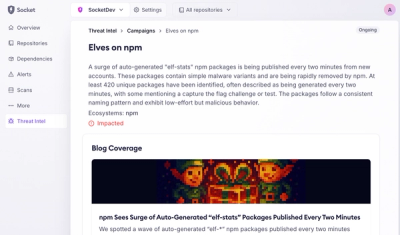
Introducing Supply Chain Attack Campaigns Tracking in the Socket Dashboard
Campaign-level threat intelligence in Socket now shows when active supply chain attacks affect your repositories and packages.
By Philipp Burckhardt - Jan 21, 2026
testarmada-locks
Advanced tools
Locks is a virtual machine traffic control service for SauceLabs users.
It ensures a test is never waiting to acquire a virtual machine. This allows orchestration software to avoid killing tests early for reasons unrelated to failure (i.e. a test should never be punished for running too long if it was merely waiting for a VM to become available).
The preferred method for installing locks is as a global module:
npm install -g testarmada-locks
export SAUCE_ACCESS_KEY='xxxxxxxxxxxxxxxxxxxxxxxxxxxxxx'
export SAUCE_USERNAME='xxxxxxxxxxxx'

# optionally configure statsd
export LOCKS_STATSD_URL=hostname.of.statsd.server.com
export LOCKS_STATSD_PREFIX=locks

# optionally configure locks' listener port (default 4765)
export LOCKS_PORT=4567

locks
Check out our Dockerfile here
# docker build . -t testarmada/locks

# docker run -e SAUCE_ACCESS_KEY='YOUR_KEY' \
-e SAUCE_USERNAME='YOUR_USER' \
--restart=always \
--publish=4765:4765 \
--detach=true \
--name=locks \
-d testarmada/locks
To communicate with locks, open a websocket to your locks URL and use the claim and release API, outlined below:
Send the following to locks to attempt to claim a VM:
{
  "type": "claim"
}
If locks accepts your claim, you will eventually receive the following message:
{
  "accepted": true,
  "token": <string>
}
The locks websocket API will always try to satisfy as many claims as you've recently made until it runs out of capacity. If this happens, your client will receive a rejection. If a claim is rejected, the return message will look like this:
{
  "accepted": false
}
If your claim is rejected, locks is no longer attempting to claim a VM for you, and your client must poll again.
To more accurately track VM supply, your client can send a courtesy message informing locks that you are no longer using a recently-claimed VM. Simply send a release message along with the token of the claim. Note that this is a safe operation even if locks has already expired the corresponding claim token.
{
  "type": "release",
  "token": <string>
}
FAQs
VM provisioning for automated testing
The npm package testarmada-locks receives a total of 0 weekly downloads. As such, testarmada-locks popularity was classified as not popular.
We found that testarmada-locks demonstrated a not healthy version release cadence and project activity because the last version was released a year ago. It has 3 open source maintainers collaborating on the project.
Did you know?

Socket for GitHub automatically highlights issues in each pull request and monitors the health of all your open source dependencies. Discover the contents of your packages and block harmful activity before you install or update your dependencies.
Product
Campaign-level threat intelligence in Socket now shows when active supply chain attacks affect your repositories and packages.

Research
Malicious PyPI package sympy-dev targets SymPy users, a Python symbolic math library with 85 million monthly downloads.

Security News
Node.js 25.4.0 makes require(esm) stable, formalizing CommonJS and ESM compatibility across supported Node versions.