


Security News
Deno 2.6 + Socket: Supply Chain Defense In Your CLI
Deno 2.6 introduces deno audit with a new --socket flag that plugs directly into Socket to bring supply chain security checks into the Deno CLI.
By Sarah Gooding - Dec 12, 2025
Paginate a document by breaking one or more containers vertically into multiple fragments.
 vfrag
vfragPaginate a document by breaking one or more containers vertically into multiple fragments. This is a bare-bones DIY alternative to Paged.js.
Paged.js is an impressive piece of work, but it did not work for our use cases:
Furthermore, I wanted to do things CSS cannot currently express, such as:
<figure>) earlier or later to minimize empty space at the bottom of pages.This is written with different requirements which likely make it unsuitable for many use cases. It is not a drop-in replacement for Paged.js, you will almost certainly need to do more work to get it working for your use case.
.pagination-root *).
and page-break-* or break-* CSS properties should be specified on screen media as well
(they have no effect so there is no reason to scope them to print media).At a high level, all that vfrag does is break down containers into fragments (fragmentation)
that best fit within a given height (hence the name vfrag = vertical fragmentation).
A pagination root is provided as an element (defaults to document.documentElement),
and sections to be paginated are specified by a CSS selector (default .page, .vfrag-page).
Each section is assumed to be a separate part of the book (e.g. chapter, appendix, etc.), with separate heading hierarchy. Sections are fragmented in parallel, and page numbers are assigned in a continuous sequence at the end.
The page size is specified as an aspect ratio (defaults to 8.5/11, i.e. US letter) rather than a width and height to be independent from sizing.
Using that and the element’s computed style, a target content height is calculated.
Then, nodes are progressively consumed until the target height is met, and the container is split into fragments.
Nodes that do not fit whole are fragmented (unless they have page-break-inside: avoid or widows and orphans values that add up to more than their height).
In general, CSS page-break-*, break-*, widows, orphans CSS properties are respected.
Fragments are created by shallow cloning of the source element, then inserted before it. Certain element types need fixup or different styling based on the fragment index:
ol: The start attribute is used to ensure the numbering remains correct.details: The summary element is also cloned (deeply) to avoid having the browser default of Details and styled in a faded way.li: Any non-first fragment has its list-style-type set to none.code: Empty lines are trimmed from the beginning of non-first fragments and the end of non-last fragments.Certain nodes (by default figure, .shiftable) can be shifted earlier or later to reduce empty space,
but they can never be shifted to another section or past another shiftable
(eliminating a common LaTeX pain point where figures can end up in seemingly random places).
Assuming your containers to be paginated have a class of .section:
import vfrag from "node_modules/vfrag/src/index.js";

vfrag(".section");
Or with a named argument, which also allows you to specify options:
vfrag({ sections: ".section", aspectRatio: 210/297 /* A4 */ });
Named imports are also available (the default export is the same as paginateAll()):
import { paginate, paginateAll } from "node_modules/vfrag/src/index.js";

paginateAll({ sections: ".section", aspectRatio: 210/297 /* A4 */ });
To also add a data-target-page attribute to all local links (for TOC generation, cross-references etc):
import vfrag, { computeTargets } from "node_modules/vfrag/src/index.js";
paginateAll(/* … */).then(computeTargets);
You can optionally specify a root element for computeTargets(), but it’s not worth it for performance,
as it’s a pretty fast operation (processing ~2K links takes about 16 ms on my 2021 MBP).
You can also optionally specify options as a second argument of any main function (paginate(), paginateAll(), consumeUntil()).
The available options are:
paginateAll() (default export)| Option | Type | Default | Description |
|---|---|---|---|
sections | string | ".page" | CSS selector for which container(s) to paginate. |
root | Element | document.documentElement | The root element to query for fragmentation containers and to apply the .paginated class to. |
paginate() and paginateAll()| Option | Type | Default | Description |
|---|---|---|---|
aspectRatio | number | 8.5/11 | Aspect ratio of the pages. This will be used to determine the target height (width will be unaffected). |
startAt | number | 1 | The index of the first page to start at. |
renderEvery | number | 20 | If greater than 0, render incremental results every renderEvery pages within a section. |
askEvery | number | 200 | If greater than 0, will ask the user every askEvery pages if they want to continue. |
consumeUntil() and paginate() and paginateAll()| Option | Type | Default | Description |
|---|---|---|---|
shiftables | string | "figure:not(unshiftable)" | Children that are allowed to be shifted down, after some of their siblings to the next page to minimize empty space at the bottom of pages. Shiftables do not shift in a way that would move them to another section, or after other shiftables. |
debug | boolean | false | If true will output elements with class=placeholder that can be rendered to show empty space on each page. |
verbose | boolean | false | If true, will output additional info messages to the console. Note that this may slow things down a fair bit. |
consumeUntil() only| Option | Type | Default | Description |
|---|---|---|---|
startAtIndex | number | 0 | The index of the first child node to start at. |
stopAt | function | - | Stop at a node that passes a given test |
:first-child).| Name | On | Value | Description |
|---|---|---|---|
data-fragment | * | Number | The index of the fragment, starting from 1. |
data-page | * | Number | The index of the page, starting from 1. |
| Class | On | Description |
|---|---|---|
.pagination-root | Root | Added to the root element. |
.vfrag-page | Page | Added to each page if the sections option is different than .page, .vfrag-page. |
.whole | Section | Fragmentation has not yet started. |
.paginating | Section | Fragmentation is in progress. |
.paginated | Section | Fragmentation is complete. |
.fragment | * | Elements that have been fragmented (including pages) |
.last | Fragments | Added to the last fragment. |
.page-number | Page numbers | Added to page number elements. |
.running-header | Page headers | Added to running headers. |
| Name | On | Type | Description |
|---|---|---|---|
--page-number | Page | <integer> | The page number. |
--pages | Pagination Root | <integer> | The total number of pages. |
--pages-left | Pagination Root | <integer> | The (approx.) number of pages left to paginate. |
--empty-lines | Non-last Page | <number> | The number of empty lines at the bottom of the page. |
FAQs
Paginate a document by breaking one or more containers vertically into multiple fragments.
We found that vfrag demonstrated a not healthy version release cadence and project activity because the last version was released a year ago. It has 0 open source maintainers collaborating on the project.
Did you know?

Socket for GitHub automatically highlights issues in each pull request and monitors the health of all your open source dependencies. Discover the contents of your packages and block harmful activity before you install or update your dependencies.
Security News
Deno 2.6 introduces deno audit with a new --socket flag that plugs directly into Socket to bring supply chain security checks into the Deno CLI.
Security News
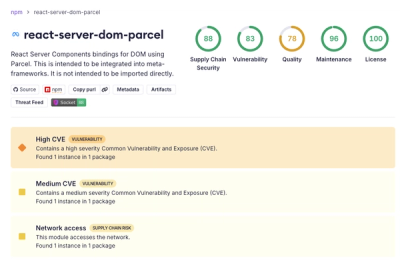
New DoS and source code exposure bugs in React Server Components and Next.js: what’s affected and how to update safely.

Security News
Socket CEO Feross Aboukhadijeh joins Software Engineering Daily to discuss modern software supply chain attacks and rising AI-driven security risks.