


Security News
Deno 2.6 + Socket: Supply Chain Defense In Your CLI
Deno 2.6 introduces deno audit with a new --socket flag that plugs directly into Socket to bring supply chain security checks into the Deno CLI.
By Sarah Gooding - Dec 12, 2025


YAKV is very simple storage that can be used inside application or as a standalone redis-like storage.
YAKV consists of two modules:
maxStorageSize: Optional. Max number of key/values. Default value is 1000000.
defaultTTL: Optional. TTL for values if not set on create. Default value is 60000. Value is in milliseconds.
To create new storage with default parameters
const store = new KVStore();
Set max number of key/values to 1000
const store = new KVStore(1000);
Set max number of key/values to 1000 and default TTL to 5 seconds
const store = new KVStore(1000, 5000);
ttl is optional parameter
const res1 = store.set('key1', { someData: 'test data' });
console.log(res1); // prints `true`, value added

const res2 = store.set('key1', { someData: 'new data' });
console.log(res2); // prints `false`, value not added as current values TTL is not expired yet

// wait TTL to expire

const res3 = store.set('key1', { someData: 'new data' });
console.log(res3); // prints `true`, value overridden because TTL expired
const res1 = store.get('key1');
console.log(res1); // prints value `{ someData: 'test data' }`

const res2 = store.get('key2');
console.log(res2); // prints `undefined`, because key not found in storage
const store = new KVStore();
const res1 = store.set('key1', 'foo');
store.getSize(); // returns 1
const store = new KVStore(1000);
store.getMaxStorageSize(); // returns 100
const store = new KVStore(1000, 5000);
store.getDefaultTTL(); // returns 5000
const store = new KVStore();
store.cleanUp();
When new instance is created it also creates in-memory storage with the same parameters passed to the HTTP server.
maxStorageSize: (Optional) Max number of key/values. Default value is 1000000.
defaultTTL: (Optional) TTL for values if not set on create. Default value is 60000. Value is in milliseconds.
port: (Optional) Port for a RESTful API server. Default value is 8080.
To create new storage with default parameters:
const server = new KVServer();
Once server is created it can be started, so it will start listening for requests
server.start();
Some parameters can be passed to change server defaults, as per example below server is created with a storage size 10, 10 seconds TTL and will be listening on port 8081.
To create a new storage with the maximum storage size of 10, a default TTL of 10 seconds, and to listen on port 8081:

```typescript
const server = new KVServer(10, 10000, 8081);
In cases when a server should be gracefully stopped it has async stop method
await server.stop();
There is a getinstance method to get access to the express instance
server.getInstance();
There is a cleanUp method that can be called to clean up expired items when used as an in-memory storage.
server.cleanUp();
Server can start internal clean up task to periodically delete expired key/value pairs.
To start clean up task with the default interval (30 seconds)
server.startCleanupTask();
To start clean up task with the custom interval (in milliseconds)
server.startCleanupTask(2000);
To stop task
server.stopCleanupTask();
To get current storage state
GET /kv/v1/health
Example response:
{
    "defaultTTL": 60000,
    "maxStorageSize": 1000000,
    "storageUsed": 0
}
To read value by key
GET /kv/v1/get/:key
If key exists then response will contain value
{
    "data": "foo"
}
Otherwise value will be null
{
    "data": null
}
PUT /kv/v1/put/:key
If value successfully added or overridden because TTL expired then response will be
{
    "created": true
}
otherwise false
{
    "created": false
}
PUT /kv/v1/put/:key/:ttl
FAQs
Yet another lightweight in-memory key-value storage
We found that yakv demonstrated a healthy version release cadence and project activity because the last version was released less than a year ago. It has 1 open source maintainer collaborating on the project.
Did you know?

Socket for GitHub automatically highlights issues in each pull request and monitors the health of all your open source dependencies. Discover the contents of your packages and block harmful activity before you install or update your dependencies.
Security News
Deno 2.6 introduces deno audit with a new --socket flag that plugs directly into Socket to bring supply chain security checks into the Deno CLI.
Security News
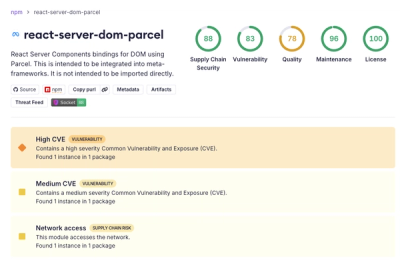
New DoS and source code exposure bugs in React Server Components and Next.js: what’s affected and how to update safely.

Security News
Socket CEO Feross Aboukhadijeh joins Software Engineering Daily to discuss modern software supply chain attacks and rising AI-driven security risks.