



Security News
Deno 2.6 + Socket: Supply Chain Defense In Your CLI
Deno 2.6 introduces deno audit with a new --socket flag that plugs directly into Socket to bring supply chain security checks into the Deno CLI.
By Sarah Gooding - Dec 12, 2025
android-sms-gateway
Advanced tools
A client library for sending and managing SMS messages via the SMS Gateway for Android API







A modern Python client for seamless integration with the SMSGate API. Send SMS messages programmatically through your Android devices with this powerful yet simple-to-use library.
The Python client for SMSGate provides a clean, type-safe interface to interact with the SMSGate API. It's designed specifically for Python developers who need to integrate SMS functionality into their applications with minimal setup and maximum reliability.
Key value propositions:
This client abstracts away the complexities of the underlying HTTP API while providing all the necessary functionality to send and track SMS messages through Android devices.
APIClient) and asynchronous (AsyncAPIClient) interfacesrequests, aiohttp, and httpxOptional Dependencies:
pip install android-sms-gateway
# Choose an HTTP client:
pip install android-sms-gateway[requests]    # For synchronous use
pip install android-sms-gateway[aiohttp]     # For asynchronous use
pip install android-sms-gateway[httpx]       # For both synchronous and asynchronous use
# For encrypted messages:
pip install android-sms-gateway[encryption]

# Or install everything:
pip install android-sms-gateway[requests,encryption]
Configure your credentials:
export ANDROID_SMS_GATEWAY_LOGIN="your_username"
export ANDROID_SMS_GATEWAY_PASSWORD="your_password"
Basic usage example:
import asyncio
import os

from android_sms_gateway import client, domain

# Configuration
login = os.getenv("ANDROID_SMS_GATEWAY_LOGIN")
password = os.getenv("ANDROID_SMS_GATEWAY_PASSWORD")

# Create message
message = domain.Message(
    "Hello! This is a test message.",
    ["+1234567890"],
    with_delivery_report=True
)

# Synchronous Client
def sync_example():
    with client.APIClient(login, password) as c:
        # Send message
        state = c.send(message)
        print(f"Message sent with ID: {state.id}")

        # Check status
        status = c.get_state(state.id)
        print(f"Status: {status.state}")

# Asynchronous Client
async def async_example():
    async with client.AsyncAPIClient(login, password) as c:
        # Send message
        state = await c.send(message)
        print(f"Message sent with ID: {state.id}")

        # Check status
        status = await c.get_state(state.id)
        print(f"Status: {status.state}")

if __name__ == "__main__":
    print("=== Synchronous Example ===")
    sync_example()

    print("\n=== Asynchronous Example ===")
    asyncio.run(async_example())
from android_sms_gateway import client, domain, Encryptor

# Encryption setup
encryptor = Encryptor("my-super-secure-secret-passphrase")

# Encrypted message
message = domain.Message(
    "This message will be encrypted!",
    ["+1234567890"],
    is_encrypted=True
)

# Client with encryption
with client.APIClient(login, password, encryptor=encryptor) as c:
    state = c.send(message)
    print(f"Encrypted message sent: {state.id}")
import os
from android_sms_gateway import client, domain

# Option 1: Using an existing JWT token
jwt_token = os.getenv("ANDROID_SMS_GATEWAY_JWT_TOKEN")

# Create client with JWT token
with client.APIClient(login=None, password=jwt_token) as c:
    message = domain.Message(
        phone_numbers=["+1234567890"],
        text_message=domain.TextMessage(
            text="Hello from JWT authenticated client!",
        ),
    )

# Option 2: Generate a new JWT token with Basic Auth
login = os.getenv("ANDROID_SMS_GATEWAY_LOGIN")
password = os.getenv("ANDROID_SMS_GATEWAY_PASSWORD")

with client.APIClient(login, password) as c:
    # Generate a new JWT token with specific scopes and TTL
    token_request = domain.TokenRequest(
        scopes=["sms:send", "sms:read"],
        ttl=3600  # Token expires in 1 hour
    )
    token_response = c.generate_token(token_request)
    print(f"New JWT token: {token_response.access_token}")
    print(f"Token expires at: {token_response.expires_at}")

    # Use the new token for subsequent requests
    with client.APIClient(login=None, password=token_response.access_token) as jwt_client:
        message = domain.Message(
            phone_numbers=["+1234567890"],
            text_message=domain.TextMessage(
                text="Hello from newly generated JWT token!",
            ),
        )
        state = jwt_client.send(message)
        print(f"Message sent with new JWT token: {state.id}")

        # Revoke the token when no longer needed
        jwt_client.revoke_token(token_response.id)
        print(f"Token {token_response.id} has been revoked")
Both clients (APIClient and AsyncAPIClient) support these parameters:
| Parameter | Type | Description | Default |
|---|---|---|---|
login | str | API username | Required (for Basic Auth) |
password | str | API password or JWT token | Required |
base_url | str | API base URL | "https://api.sms-gate.app/3rdparty/v1" |
encryptor | Encryptor | Encryption instance | None |
http | HttpClient/AsyncHttpClient | Custom HTTP client | Auto-detected |
Authentication Options:
Basic Authentication (traditional):
client.APIClient(login="username", password="password")
JWT Token Authentication:
# Using an existing JWT token
client.APIClient(login=None, password="your_jwt_token")

# Or generate a token using Basic Auth first
with client.APIClient(login="username", password="password") as c:
    token_request = domain.TokenRequest(scopes=["sms:send"], ttl=3600)
    token_response = c.generate_token(token_request)

    # Use the new token
    with client.APIClient(login=None, password=token_response.access_token) as jwt_client:
        # Make API calls with JWT authentication
        pass
| Method | Description | Return Type |
|---|---|---|
send(message: domain.Message) | Send SMS message | domain.MessageState |
get_state(id: str) | Check message status | domain.MessageState |
create_webhook(webhook: domain.Webhook) | Create new webhook | domain.Webhook |
get_webhooks() | List all webhooks | List[domain.Webhook] |
delete_webhook(id: str) | Delete webhook | None |
generate_token(token_request: domain.TokenRequest) | Generate JWT token | domain.TokenResponse |
revoke_token(jti: str) | Revoke JWT token | None |
class Message:
    message: str                       # Message text
    phone_numbers: List[str]           # List of phone numbers
    with_delivery_report: bool = True  # Delivery report
    is_encrypted: bool = False         # Whether message is encrypted

    # Optional fields
    id: Optional[str] = None         # Message ID
    ttl: Optional[int] = None        # Time-to-live in seconds
    sim_number: Optional[int] = None # SIM number
class MessageState:
    id: str                          # Unique message ID
    state: ProcessState              # Current state (SENT, DELIVERED, etc.)
    recipients: List[RecipientState] # Per-recipient status
    is_hashed: bool                  # Whether message was hashed
    is_encrypted: bool               # Whether message was encrypted
class Webhook:
    id: Optional[str]               # Webhook ID
    url: str                        # Callback URL
    event: WebhookEvent             # Event type
class TokenRequest:
    scopes: List[str]               # List of scopes for the token
    ttl: Optional[int] = None       # Time to live for the token in seconds
class TokenResponse:
    access_token: str               # The JWT access token
    token_type: str                 # The type of the token (e.g., 'Bearer')
    id: str                         # The unique identifier of the token (jti)
    expires_at: str                 # The expiration time of the token in ISO format
For more details, see domain.py.
The library automatically detects installed HTTP clients with this priority:
| Client | Sync | Async |
|---|---|---|
| aiohttp | ❌ | 1️⃣ |
| requests | 1️⃣ | ❌ |
| httpx | 2️⃣ | 2️⃣ |
from android_sms_gateway import client, http

# Force httpx usage
client.APIClient(..., http=http.HttpxHttpClient())

# Force requests usage
client.APIClient(..., http=http.RequestsHttpClient())

# Force aiohttp (async only)
async with client.AsyncAPIClient(..., http_client=http.AiohttpHttpClient()) as c:
    # ...
Implement your own HTTP client following the http.HttpClient (sync) or ahttp.AsyncHttpClient (async) protocols.
⚠️ IMPORTANT: Always follow these security practices:
When using JWT authentication, follow these additional security practices:
revoke_token()import os
from dotenv import load_dotenv
# Load environment variables
load_dotenv()
# Secure configuration
login = os.getenv("ANDROID_SMS_GATEWAY_LOGIN")
password = os.getenv("ANDROID_SMS_GATEWAY_PASSWORD")
if not login or not password:
raise ValueError("Credentials not configured!")
For complete API documentation including all available methods, request/response schemas, and error codes, visit: 📘 Official API Documentation
Contributions are very welcome! 🎉
git checkout -b feature/NewFeature)git commit -m 'feat: add new feature')git push origin feature/NewFeature)# Clone repository
git clone https://github.com/android-sms-gateway/client-py.git
cd client-py
# Create virtual environment
pipenv install --dev --categories encryption,requests
pipenv shell
This project is licensed under the Apache License 2.0 - see LICENSE for details.
Note: Android is a trademark of Google LLC. This project is not affiliated with or endorsed by Google.
FAQs
A client library for sending and managing SMS messages via the SMS Gateway for Android API
We found that android-sms-gateway demonstrated a healthy version release cadence and project activity because the last version was released less than a year ago. It has 1 open source maintainer collaborating on the project.
Did you know?

Socket for GitHub automatically highlights issues in each pull request and monitors the health of all your open source dependencies. Discover the contents of your packages and block harmful activity before you install or update your dependencies.
Security News
Deno 2.6 introduces deno audit with a new --socket flag that plugs directly into Socket to bring supply chain security checks into the Deno CLI.
Security News
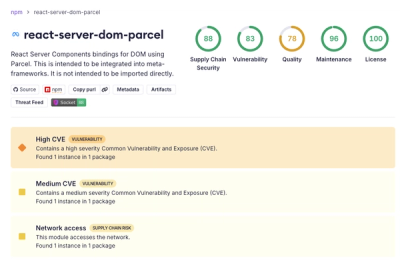
New DoS and source code exposure bugs in React Server Components and Next.js: what’s affected and how to update safely.

Security News
Socket CEO Feross Aboukhadijeh joins Software Engineering Daily to discuss modern software supply chain attacks and rising AI-driven security risks.