Charset Detection, for Everyone 👋
The Real First Universal Charset Detector



Featured Packages


In other language (unofficial port - by the community)

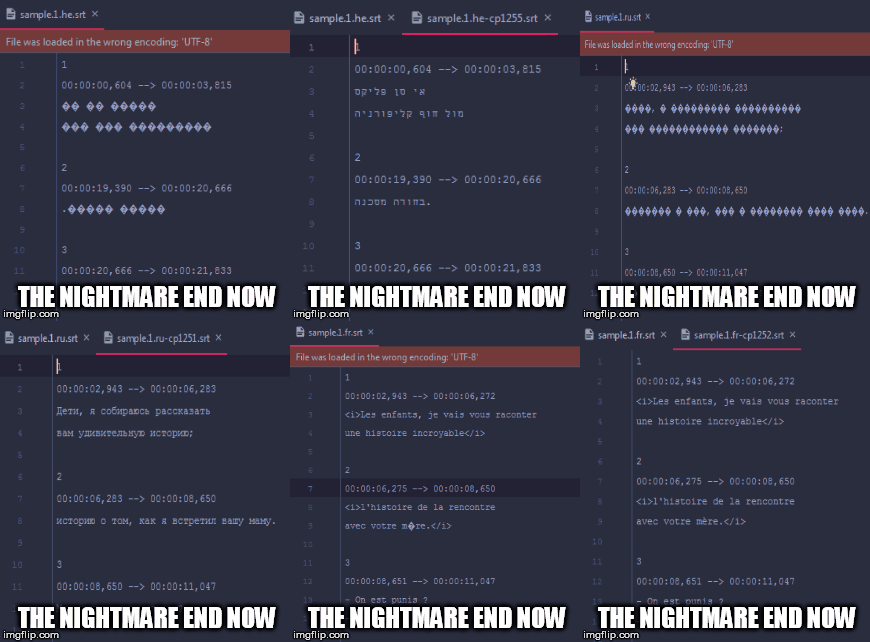
A library that helps you read text from an unknown charset encoding.
Motivated by chardet,
I'm trying to resolve the issue by taking a new approach.
All IANA character set names for which the Python core library provides codecs are supported.
You can also register your own set of codecs, and yes, it would work as-is.
>>>>> 👉 Try Me Online Now, Then Adopt Me 👈 <<<<<
This project offers you an alternative to Universal Charset Encoding Detector, also known as Chardet.
Fast | ✅ | ✅ | ✅ |
Universal1 | ❌ | ✅ | ❌ |
Reliable without distinguishable standards | ✅ | ✅ | ✅ |
Reliable with distinguishable standards | ✅ | ✅ | ✅ |
License | Disputed2
restrictive | MIT | MPL-1.1
restrictive |
Native Python | ✅ | ✅ | ❌ |
Detect spoken language | ✅ | ✅ | N/A |
UnicodeDecodeError Safety | ✅ | ✅ | ❌ |
Whl Size (min) | 500 kB | 150 kB | ~200 kB |
Supported Encoding | 99 | 99 | 40 |
Can register custom encoding | ❌ | ✅ | ❌ |

⚡ Performance
This package offer better performances (99th, and 95th) against Chardet. Here are some numbers.
| chardet 7.1 | 89 % | 3 ms | 333 file/sec |
| charset-normalizer | 97 % | 3 ms | 333 file/sec |
| chardet 7.1 | 32 ms | 17 ms | < 1 ms |
| charset-normalizer | 16 ms | 10 ms | 1 ms |
updated as of March 2026 using CPython 3.12, Charset-Normalizer 3.4.6, and Chardet 7.1.0
Chardet's performance on larger file (1MB+) are very poor. Expect huge difference on large payload. No longer the case since Chardet 7.0+
Stats are generated using 400+ files using default parameters. More details on used files, see GHA workflows.
And yes, these results might change at any time. The dataset can be updated to include more files.
The actual delays heavily depends on your CPU capabilities. The factors should remain the same.
Chardet claims on his documentation to have a greater accuracy than us based on the dataset they trained Chardet on(...)
Well, it's normal, the opposite would have been worrying. Whereas charset-normalizer don't train on anything, our solution
is based on a completely different algorithm, still heuristic through, it does not need weights across every encoding tables.
✨ Installation
Using pip:
pip install charset-normalizer -U
🚀 Basic Usage
CLI
This package comes with a CLI.
usage: normalizer [-h] [-v] [-a] [-n] [-m] [-r] [-f] [-t THRESHOLD]
                  file [file ...]

The Real First Universal Charset Detector. Discover originating encoding used
on text file. Normalize text to unicode.

positional arguments:
  files                 File(s) to be analysed

optional arguments:
  -h, --help            show this help message and exit
  -v, --verbose         Display complementary information about file if any.
                        Stdout will contain logs about the detection process.
  -a, --with-alternative
                        Output complementary possibilities if any. Top-level
                        JSON WILL be a list.
  -n, --normalize       Permit to normalize input file. If not set, program
                        does not write anything.
  -m, --minimal         Only output the charset detected to STDOUT. Disabling
                        JSON output.
  -r, --replace         Replace file when trying to normalize it instead of
                        creating a new one.
  -f, --force           Replace file without asking if you are sure, use this
                        flag with caution.
  -t THRESHOLD, --threshold THRESHOLD
                        Define a custom maximum amount of chaos allowed in
                        decoded content. 0. <= chaos <= 1.
  --version             Show version information and exit.
normalizer ./data/sample.1.fr.srt
or
python -m charset_normalizer ./data/sample.1.fr.srt
🎉 Since version 1.4.0 the CLI produce easily usable stdout result in JSON format.
{
    "path": "/home/default/projects/charset_normalizer/data/sample.1.fr.srt",
    "encoding": "cp1252",
    "encoding_aliases": [
        "1252",
        "windows_1252"
    ],
    "alternative_encodings": [
        "cp1254",
        "cp1256",
        "cp1258",
        "iso8859_14",
        "iso8859_15",
        "iso8859_16",
        "iso8859_3",
        "iso8859_9",
        "latin_1",
        "mbcs"
    ],
    "language": "French",
    "alphabets": [
        "Basic Latin",
        "Latin-1 Supplement"
    ],
    "has_sig_or_bom": false,
    "chaos": 0.149,
    "coherence": 97.152,
    "unicode_path": null,
    "is_preferred": true
}
Python
Just print out normalized text
from charset_normalizer import from_path

results = from_path('./my_subtitle.srt')

print(str(results.best()))
Upgrade your code without effort
from charset_normalizer import detect
The above code will behave the same as chardet. We ensure that we offer the best (reasonable) BC result possible.
See the docs for advanced usage : readthedocs.io
😇 Why
When I started using Chardet, I noticed that it was not suited to my expectations, and I wanted to propose a
reliable alternative using a completely different method. Also! I never back down on a good challenge!
I don't care about the originating charset encoding, because two different tables can
produce two identical rendered string.
What I want is to get readable text, the best I can.
In a way, I'm brute forcing text decoding. How cool is that ? 😎
Don't confuse package ftfy with charset-normalizer or chardet. ftfy goal is to repair Unicode string whereas charset-normalizer to convert raw file in unknown encoding to unicode.
🍰 How
- Discard all charset encoding table that could not fit the binary content.
- Measure noise, or the mess once opened (by chunks) with a corresponding charset encoding.
- Extract matches with the lowest mess detected.
- Additionally, we measure coherence / probe for a language.
Wait a minute, what is noise/mess and coherence according to YOU ?
Noise : I opened hundred of text files, written by humans, with the wrong encoding table. I observed, then
I established some ground rules about what is obvious when it seems like a mess (aka. defining noise in rendered text).
I know that my interpretation of what is noise is probably incomplete, feel free to contribute in order to
improve or rewrite it.
Coherence : For each language there is on earth, we have computed ranked letter appearance occurrences (the best we can). So I thought
that intel is worth something here. So I use those records against decoded text to check if I can detect intelligent design.
⚡ Known limitations
- Language detection is unreliable when text contains two or more languages sharing identical letters. (eg. HTML (english tags) + Turkish content (Sharing Latin characters))
- Every charset detector heavily depends on sufficient content. In common cases, do not bother run detection on very tiny content.
⚠️ About Python EOLs
If you are running:
- Python >=2.7,<3.5: Unsupported
- Python 3.5: charset-normalizer < 2.1
- Python 3.6: charset-normalizer < 3.1
Upgrade your Python interpreter as soon as possible.
👤 Contributing
Contributions, issues and feature requests are very much welcome.
Feel free to check issues page if you want to contribute.
📝 License
Copyright © Ahmed TAHRI @Ousret.
This project is MIT licensed.
Characters frequencies used in this project © 2012 Denny Vrandečić
💼 For Enterprise
Professional support for charset-normalizer is available as part of the Tidelift
Subscription. Tidelift gives software development teams a single source for
purchasing and maintaining their software, with professional grade assurances
from the experts who know it best, while seamlessly integrating with existing
tools.
Changelog
All notable changes to charset-normalizer will be documented in this file. This project adheres to Semantic Versioning.
The format is based on Keep a Changelog.
3.4.7 (2026-04-02)
Changed
- Pre-built optimized version using mypy[c] v1.20.
- Relax
setuptools constraint to setuptools>=68,<82.1.
Fixed
- Correctly remove SIG remnant in utf-7 decoded string. (#718) (#716)
3.4.6 (2026-03-15)
Changed
- Flattened the logic in
charset_normalizer.md for higher performance. Removed eligible(..) and feed(...)
in favor of feed_info(...).
- Raised upper bound for mypy[c] to 1.20, for our optimized version.
- Updated
UNICODE_RANGES_COMBINED using Unicode blocks v17.
Fixed
- Edge case where noise difference between two candidates can be almost insignificant. (#672)
- CLI
--normalize writing to wrong path when passing multiple files in. (#702)
Misc
- Freethreaded pre-built wheels now shipped in PyPI starting with 3.14t. (#616)
3.4.5 (2026-03-06)
Changed
- Update
setuptools constraint to setuptools>=68,<=82.
- Raised upper bound of mypyc for the optional pre-built extension to v1.19.1
Fixed
- Add explicit link to lib math in our optimized build. (#692)
- Logger level not restored correctly for empty byte sequences. (#701)
- TypeError when passing bytearray to from_bytes. (#703)
Misc
- Applied safe micro-optimizations in both our noise detector and language detector.
- Rewrote the
query_yes_no function (inside CLI) to avoid using ambiguous licensed code.
- Added
cd.py submodule into mypyc optional compilation to reduce further the performance impact.
3.4.4 (2025-10-13)
Changed
- Bound
setuptools to a specific constraint setuptools>=68,<=81.
- Raised upper bound of mypyc for the optional pre-built extension to v1.18.2
Removed
setuptools-scm as a build dependency.
Misc
- Enforced hashes in
dev-requirements.txt and created ci-requirements.txt for security purposes.
- Additional pre-built wheels for riscv64, s390x, and armv7l architectures.
- Restore
multiple.intoto.jsonl in GitHub releases in addition to individual attestation file per wheel.
3.4.3 (2025-08-09)
Changed
- mypy(c) is no longer a required dependency at build time if
CHARSET_NORMALIZER_USE_MYPYC isn't set to 1. (#595) (#583)
- automatically lower confidence on small bytes samples that are not Unicode in
detect output legacy function. (#391)
Added
- Custom build backend to overcome inability to mark mypy as an optional dependency in the build phase.
- Support for Python 3.14
Fixed
- sdist archive contained useless directories.
- automatically fallback on valid UTF-16 or UTF-32 even if the md says it's noisy. (#633)
Misc
- SBOM are automatically published to the relevant GitHub release to comply with regulatory changes.
Each published wheel comes with its SBOM. We choose CycloneDX as the format.
- Prebuilt optimized wheel are no longer distributed by default for CPython 3.7 due to a change in cibuildwheel.
3.4.2 (2025-05-02)
Fixed
- Addressed the DeprecationWarning in our CLI regarding
argparse.FileType by backporting the target class into the package. (#591)
- Improved the overall reliability of the detector with CJK Ideographs. (#605) (#587)
Changed
- Optional mypyc compilation upgraded to version 1.15 for Python >= 3.8
3.4.1 (2024-12-24)
Changed
- Project metadata are now stored using
pyproject.toml instead of setup.cfg using setuptools as the build backend.
- Enforce annotation delayed loading for a simpler and consistent types in the project.
- Optional mypyc compilation upgraded to version 1.14 for Python >= 3.8
Added
- pre-commit configuration.
- noxfile.
Removed
build-requirements.txt as per using pyproject.toml native build configuration.bin/integration.py and bin/serve.py in favor of downstream integration test (see noxfile).setup.cfg in favor of pyproject.toml metadata configuration.- Unused
utils.range_scan function.
Fixed
- Converting content to Unicode bytes may insert
utf_8 instead of preferred utf-8. (#572)
- Deprecation warning "'count' is passed as positional argument" when converting to Unicode bytes on Python 3.13+
3.4.0 (2024-10-08)
Added
- Argument
--no-preemptive in the CLI to prevent the detector to search for hints.
- Support for Python 3.13 (#512)
Fixed
- Relax the TypeError exception thrown when trying to compare a CharsetMatch with anything else than a CharsetMatch.
- Improved the general reliability of the detector based on user feedbacks. (#520) (#509) (#498) (#407) (#537)
- Declared charset in content (preemptive detection) not changed when converting to utf-8 bytes. (#381)
3.3.2 (2023-10-31)
Fixed
- Unintentional memory usage regression when using large payload that match several encoding (#376)
- Regression on some detection case showcased in the documentation (#371)
Added
- Noise (md) probe that identify malformed arabic representation due to the presence of letters in isolated form (credit to my wife)
3.3.1 (2023-10-22)
Changed
- Optional mypyc compilation upgraded to version 1.6.1 for Python >= 3.8
- Improved the general detection reliability based on reports from the community
3.3.0 (2023-09-30)
Added
- Allow to execute the CLI (e.g. normalizer) through
python -m charset_normalizer.cli or python -m charset_normalizer
- Support for 9 forgotten encoding that are supported by Python but unlisted in
encoding.aliases as they have no alias (#323)
Removed
- (internal) Redundant utils.is_ascii function and unused function is_private_use_only
- (internal) charset_normalizer.assets is moved inside charset_normalizer.constant
Changed
- (internal) Unicode code blocks in constants are updated using the latest v15.0.0 definition to improve detection
- Optional mypyc compilation upgraded to version 1.5.1 for Python >= 3.8
Fixed
- Unable to properly sort CharsetMatch when both chaos/noise and coherence were close due to an unreachable condition in __lt__ (#350)
3.2.0 (2023-06-07)
Changed
- Typehint for function
from_path no longer enforce PathLike as its first argument
- Minor improvement over the global detection reliability
Added
- Introduce function
is_binary that relies on main capabilities, and optimized to detect binaries
- Propagate
enable_fallback argument throughout from_bytes, from_path, and from_fp that allow a deeper control over the detection (default True)
- Explicit support for Python 3.12
Fixed
- Edge case detection failure where a file would contain 'very-long' camel cased word (Issue #289)
3.1.0 (2023-03-06)
Added
- Argument
should_rename_legacy for legacy function detect and disregard any new arguments without errors (PR #262)
Removed
- Support for Python 3.6 (PR #260)
Changed
- Optional speedup provided by mypy/c 1.0.1
3.0.1 (2022-11-18)
Fixed
- Multi-bytes cutter/chunk generator did not always cut correctly (PR #233)
Changed
- Speedup provided by mypy/c 0.990 on Python >= 3.7
3.0.0 (2022-10-20)
Added
- Extend the capability of explain=True when cp_isolation contains at most two entries (min one), will log in details of the Mess-detector results
- Support for alternative language frequency set in charset_normalizer.assets.FREQUENCIES
- Add parameter
language_threshold in from_bytes, from_path and from_fp to adjust the minimum expected coherence ratio
normalizer --version now specify if current version provide extra speedup (meaning mypyc compilation whl)
Changed
- Build with static metadata using 'build' frontend
- Make the language detection stricter
- Optional: Module
md.py can be compiled using Mypyc to provide an extra speedup up to 4x faster than v2.1
Fixed
- CLI with opt --normalize fail when using full path for files
- TooManyAccentuatedPlugin induce false positive on the mess detection when too few alpha character have been fed to it
- Sphinx warnings when generating the documentation
Removed
- Coherence detector no longer return 'Simple English' instead return 'English'
- Coherence detector no longer return 'Classical Chinese' instead return 'Chinese'
- Breaking: Method
first() and best() from CharsetMatch
- UTF-7 will no longer appear as "detected" without a recognized SIG/mark (is unreliable/conflict with ASCII)
- Breaking: Class aliases CharsetDetector, CharsetDoctor, CharsetNormalizerMatch and CharsetNormalizerMatches
- Breaking: Top-level function
normalize
- Breaking: Properties
chaos_secondary_pass, coherence_non_latin and w_counter from CharsetMatch
- Support for the backport
unicodedata2
Added
- Extend the capability of explain=True when cp_isolation contains at most two entries (min one), will log in details of the Mess-detector results
- Support for alternative language frequency set in charset_normalizer.assets.FREQUENCIES
- Add parameter
language_threshold in from_bytes, from_path and from_fp to adjust the minimum expected coherence ratio
Changed
- Build with static metadata using 'build' frontend
- Make the language detection stricter
Fixed
- CLI with opt --normalize fail when using full path for files
- TooManyAccentuatedPlugin induce false positive on the mess detection when too few alpha character have been fed to it
Removed
- Coherence detector no longer return 'Simple English' instead return 'English'
- Coherence detector no longer return 'Classical Chinese' instead return 'Chinese'
Added
normalizer --version now specify if current version provide extra speedup (meaning mypyc compilation whl)
Removed
- Breaking: Method
first() and best() from CharsetMatch
- UTF-7 will no longer appear as "detected" without a recognized SIG/mark (is unreliable/conflict with ASCII)
Fixed
- Sphinx warnings when generating the documentation
Changed
- Optional: Module
md.py can be compiled using Mypyc to provide an extra speedup up to 4x faster than v2.1
Removed
- Breaking: Class aliases CharsetDetector, CharsetDoctor, CharsetNormalizerMatch and CharsetNormalizerMatches
- Breaking: Top-level function
normalize
- Breaking: Properties
chaos_secondary_pass, coherence_non_latin and w_counter from CharsetMatch
- Support for the backport
unicodedata2
2.1.1 (2022-08-19)
Deprecated
- Function
normalize scheduled for removal in 3.0
Changed
- Removed useless call to decode in fn is_unprintable (#206)
Fixed
- Third-party library (i18n xgettext) crashing not recognizing utf_8 (PEP 263) with underscore from @aleksandernovikov (#204)
2.1.0 (2022-06-19)
Added
- Output the Unicode table version when running the CLI with
--version (PR #194)
Changed
- Re-use decoded buffer for single byte character sets from @nijel (PR #175)
- Fixing some performance bottlenecks from @deedy5 (PR #183)
Fixed
- Workaround potential bug in cpython with Zero Width No-Break Space located in Arabic Presentation Forms-B, Unicode 1.1 not acknowledged as space (PR #175)
- CLI default threshold aligned with the API threshold from @oleksandr-kuzmenko (PR #181)
Removed
- Support for Python 3.5 (PR #192)
Deprecated
- Use of backport unicodedata from
unicodedata2 as Python is quickly catching up, scheduled for removal in 3.0 (PR #194)
2.0.12 (2022-02-12)
Fixed
- ASCII miss-detection on rare cases (PR #170)
2.0.11 (2022-01-30)
Added
- Explicit support for Python 3.11 (PR #164)
Changed
- The logging behavior have been completely reviewed, now using only TRACE and DEBUG levels (PR #163 #165)
2.0.10 (2022-01-04)
Fixed
- Fallback match entries might lead to UnicodeDecodeError for large bytes sequence (PR #154)
Changed
- Skipping the language-detection (CD) on ASCII (PR #155)
2.0.9 (2021-12-03)
Changed
- Moderating the logging impact (since 2.0.8) for specific environments (PR #147)
Fixed
- Wrong logging level applied when setting kwarg
explain to True (PR #146)
2.0.8 (2021-11-24)
Changed
- Improvement over Vietnamese detection (PR #126)
- MD improvement on trailing data and long foreign (non-pure latin) data (PR #124)
- Efficiency improvements in cd/alphabet_languages from @adbar (PR #122)
- call sum() without an intermediary list following PEP 289 recommendations from @adbar (PR #129)
- Code style as refactored by Sourcery-AI (PR #131)
- Minor adjustment on the MD around european words (PR #133)
- Remove and replace SRTs from assets / tests (PR #139)
- Initialize the library logger with a
NullHandler by default from @nmaynes (PR #135)
- Setting kwarg
explain to True will add provisionally (bounded to function lifespan) a specific stream handler (PR #135)
Fixed
- Fix large (misleading) sequence giving UnicodeDecodeError (PR #137)
- Avoid using too insignificant chunk (PR #137)
Added
- Add and expose function
set_logging_handler to configure a specific StreamHandler from @nmaynes (PR #135)
- Add
CHANGELOG.md entries, format is based on Keep a Changelog (PR #141)
2.0.7 (2021-10-11)
Added
- Add support for Kazakh (Cyrillic) language detection (PR #109)
Changed
- Further, improve inferring the language from a given single-byte code page (PR #112)
- Vainly trying to leverage PEP263 when PEP3120 is not supported (PR #116)
- Refactoring for potential performance improvements in loops from @adbar (PR #113)
- Various detection improvement (MD+CD) (PR #117)
Removed
- Remove redundant logging entry about detected language(s) (PR #115)
Fixed
- Fix a minor inconsistency between Python 3.5 and other versions regarding language detection (PR #117 #102)
2.0.6 (2021-09-18)
Fixed
- Unforeseen regression with the loss of the backward-compatibility with some older minor of Python 3.5.x (PR #100)
- Fix CLI crash when using --minimal output in certain cases (PR #103)
Changed
- Minor improvement to the detection efficiency (less than 1%) (PR #106 #101)
2.0.5 (2021-09-14)
Changed
- The project now comply with: flake8, mypy, isort and black to ensure a better overall quality (PR #81)
- The BC-support with v1.x was improved, the old staticmethods are restored (PR #82)
- The Unicode detection is slightly improved (PR #93)
- Add syntax sugar __bool__ for results CharsetMatches list-container (PR #91)
Removed
- The project no longer raise warning on tiny content given for detection, will be simply logged as warning instead (PR #92)
Fixed
- In some rare case, the chunks extractor could cut in the middle of a multi-byte character and could mislead the mess detection (PR #95)
- Some rare 'space' characters could trip up the UnprintablePlugin/Mess detection (PR #96)
- The MANIFEST.in was not exhaustive (PR #78)
2.0.4 (2021-07-30)
Fixed
- The CLI no longer raise an unexpected exception when no encoding has been found (PR #70)
- Fix accessing the 'alphabets' property when the payload contains surrogate characters (PR #68)
- The logger could mislead (explain=True) on detected languages and the impact of one MBCS match (PR #72)
- Submatch factoring could be wrong in rare edge cases (PR #72)
- Multiple files given to the CLI were ignored when publishing results to STDOUT. (After the first path) (PR #72)
- Fix line endings from CRLF to LF for certain project files (PR #67)
Changed
- Adjust the MD to lower the sensitivity, thus improving the global detection reliability (PR #69 #76)
- Allow fallback on specified encoding if any (PR #71)
2.0.3 (2021-07-16)
Changed
- Part of the detection mechanism has been improved to be less sensitive, resulting in more accurate detection results. Especially ASCII. (PR #63)
- According to the community wishes, the detection will fall back on ASCII or UTF-8 in a last-resort case. (PR #64)
2.0.2 (2021-07-15)
Fixed
- Empty/Too small JSON payload miss-detection fixed. Report from @tseaver (PR #59)
Changed
- Don't inject unicodedata2 into sys.modules from @akx (PR #57)
2.0.1 (2021-07-13)
Fixed
- Make it work where there isn't a filesystem available, dropping assets frequencies.json. Report from @sethmlarson. (PR #55)
- Using explain=False permanently disable the verbose output in the current runtime (PR #47)
- One log entry (language target preemptive) was not show in logs when using explain=True (PR #47)
- Fix undesired exception (ValueError) on getitem of instance CharsetMatches (PR #52)
Changed
- Public function normalize default args values were not aligned with from_bytes (PR #53)
Added
- You may now use charset aliases in cp_isolation and cp_exclusion arguments (PR #47)
2.0.0 (2021-07-02)
Changed
- 4x to 5 times faster than the previous 1.4.0 release. At least 2x faster than Chardet.
- Accent has been made on UTF-8 detection, should perform rather instantaneous.
- The backward compatibility with Chardet has been greatly improved. The legacy detect function returns an identical charset name whenever possible.
- The detection mechanism has been slightly improved, now Turkish content is detected correctly (most of the time)
- The program has been rewritten to ease the readability and maintainability. (+Using static typing)+
- utf_7 detection has been reinstated.
Removed
- This package no longer require anything when used with Python 3.5 (Dropped cached_property)
- Removed support for these languages: Catalan, Esperanto, Kazakh, Baque, Volapük, Azeri, Galician, Nynorsk, Macedonian, and Serbocroatian.
- The exception hook on UnicodeDecodeError has been removed.
Deprecated
- Methods coherence_non_latin, w_counter, chaos_secondary_pass of the class CharsetMatch are now deprecated and scheduled for removal in v3.0
Fixed
- The CLI output used the relative path of the file(s). Should be absolute.
1.4.1 (2021-05-28)
Fixed
- Logger configuration/usage no longer conflict with others (PR #44)
1.4.0 (2021-05-21)
Removed
- Using standard logging instead of using the package loguru.
- Dropping nose test framework in favor of the maintained pytest.
- Choose to not use dragonmapper package to help with gibberish Chinese/CJK text.
- Require cached_property only for Python 3.5 due to constraint. Dropping for every other interpreter version.
- Stop support for UTF-7 that does not contain a SIG.
- Dropping PrettyTable, replaced with pure JSON output in CLI.
Fixed
- BOM marker in a CharsetNormalizerMatch instance could be False in rare cases even if obviously present. Due to the sub-match factoring process.
- Not searching properly for the BOM when trying utf32/16 parent codec.
Changed
- Improving the package final size by compressing frequencies.json.
- Huge improvement over the larges payload.
Added
- CLI now produces JSON consumable output.
- Return ASCII if given sequences fit. Given reasonable confidence.
1.3.9 (2021-05-13)
Fixed
- In some very rare cases, you may end up getting encode/decode errors due to a bad bytes payload (PR #40)
1.3.8 (2021-05-12)
Fixed
- Empty given payload for detection may cause an exception if trying to access the
alphabets property. (PR #39)
1.3.7 (2021-05-12)
Fixed
- The legacy detect function should return UTF-8-SIG if sig is present in the payload. (PR #38)
1.3.6 (2021-02-09)
Changed
- Amend the previous release to allow prettytable 2.0 (PR #35)
1.3.5 (2021-02-08)
Fixed
- Fix error while using the package with a python pre-release interpreter (PR #33)
Changed
- Dependencies refactoring, constraints revised.
Added
- Add python 3.9 and 3.10 to the supported interpreters
MIT License
Copyright (c) 2025 TAHRI Ahmed R.
Permission is hereby granted, free of charge, to any person obtaining a copy
of this software and associated documentation files (the "Software"), to deal
in the Software without restriction, including without limitation the rights
to use, copy, modify, merge, publish, distribute, sublicense, and/or sell
copies of the Software, and to permit persons to whom the Software is
furnished to do so, subject to the following conditions:
The above copyright notice and this permission notice shall be included in all
copies or substantial portions of the Software.
THE SOFTWARE IS PROVIDED "AS IS", WITHOUT WARRANTY OF ANY KIND, EXPRESS OR
IMPLIED, INCLUDING BUT NOT LIMITED TO THE WARRANTIES OF MERCHANTABILITY,
FITNESS FOR A PARTICULAR PURPOSE AND NONINFRINGEMENT. IN NO EVENT SHALL THE
AUTHORS OR COPYRIGHT HOLDERS BE LIABLE FOR ANY CLAIM, DAMAGES OR OTHER
LIABILITY, WHETHER IN AN ACTION OF CONTRACT, TORT OR OTHERWISE, ARISING FROM,
OUT OF OR IN CONNECTION WITH THE SOFTWARE OR THE USE OR OTHER DEALINGS IN THE
SOFTWARE.