ciscoconfparse2





Introduction: What is ciscoconfparse2?
Summary
ciscoconfparse2 is the next generation of ciscoconfparse, which was the primary development package
from 2007 until 2023.
ciscoconfparse2 is similar to an advanced grep and diff that
handles multi-vendor network configuration files (such as those from
Arista, Cisco, F5, Juniper, Palo Alto, etc).
Example - Find shutdown interfaces
Assume you have a bunch of interfaces in a configuration. How do you find which ones are shutdown?
One way is manually reading the whole Cisco IOS-XE configuration. Another option is ciscoconfparse2
>>> from ciscoconfparse2 import CiscoConfParse
>>>
>>> parse = CiscoConfParse("/path/to/config/file")
>>> intf_cmds = parse.find_parent_objects(["interface", "shutdown"])
>>>
>>> shut_intf_names = [" ".join(cmd.split()[1:]) for cmd in intf_cmds]
>>>
>>> shut_intf_names
['GigabitEthernet1/5', 'TenGigabitEthernet2/2', 'TenGigabitEthernet2/3']
>>>
Example - Find EBGP peer addresses and AS Numbers
Assume you have this IOS-XR bgp configuration:
router bgp 65534
  bgp router-id 10.0.0.100
  address-family ipv4 unicast
  !
  neighbor 10.0.0.37
    remote-as 64000
    route-policy EBGP_IN in
    route-policy EBGP_OUT out
  !
  neighbor 10.0.0.1
    remote-as 65534
    update-source Loopback0
    route-policy MANGLE_IN in
    route-policy MANGLE_OUT out
      next-hop-self
  !
  neighbor 10.0.0.34
    remote-as 64000
    route-policy EBGP_IN in
    route-policy EBGP_OUT out
You can generate the list of EBGP peers pretty quickly with this script:
from ciscoconfparse2 import CiscoConfParse
parse = CiscoConfParse(
"/path/to/config/file"
)
branches = parse.find_object_branches(("router bgp", "neighbor", "remote-as"))
bgp_cmd = branches[0][0]
local_asn = bgp_cmd.split()[-1]
for branch in branches:
neighbor_obj = branch[1]
remote_asn_obj = branch[2]
neighbor_addr = neighbor_obj.split()[-1]
remote_asn = remote_asn_obj.split()[-1]
if local_asn != remote_asn:
print(f"EBGP NEIGHBOR {neighbor_addr}, ASN {remote_asn}")
When you run that, you'll see:
$ python example.py
EBGP NEIGHBOR 10.0.0.37, ASN 64000
EBGP NEIGHBOR 10.0.0.34, ASN 64000
$
Tutorial
Many things are possible; see the tutorial.
CLI Tool
ciscoconfparse2 distributes a CLI tool that will diff and grep various
network configuration or text files.
API Examples
The API examples are documented on the web
Why
ciscoconfparse2 is a Python library
that helps you quickly search for questions like these in your
router / switch / firewall / load-balancer / wireless text
configurations:
- What interfaces are shutdown?
- Which interfaces are in trunk mode?
- What address and subnet mask is assigned to each interface?
- Which interfaces are missing a critical command?
- Is this configuration missing a standard config line?
It can help you:
- Audit existing router / switch / firewall / wlc configurations
- Modify existing configurations
- Build new configurations
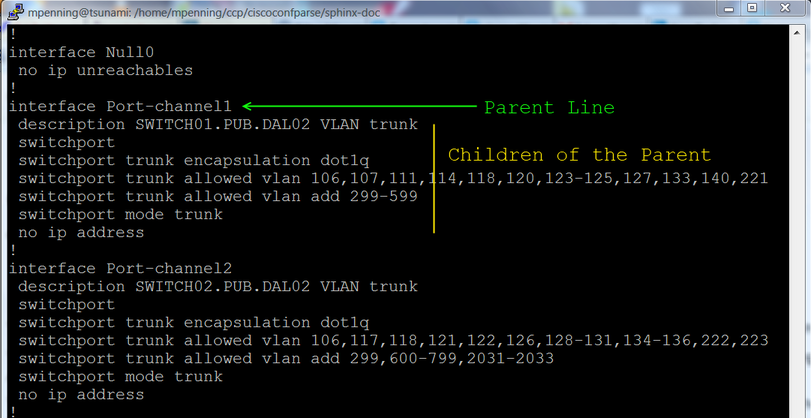
Speaking generally, the library examines a text network config and breaks
it into a set of linked parent / child relationships. You can perform
complex queries about these relationships.
What changed in ciscoconfparse2?
In late 2023, I started a rewrite because ciscoconfparse is too large
and has some defaults that I wish it didn't have. I froze
ciscoconfparse PYPI releases at version 1.9.52; there will be no
more ciscoconfparse PYPI releases.
I recommend that you upgrade to ciscoconfparse2.
Here's why, it:
- Streamlines the API towards a simpler user interface.
- Removes legacy and flawed methods from the original (this could be a breaking change for old scripts).
- Can search for parents and children using an arbitrary list of ancestors
- Is better at handling multiple-child-level configurations (such as IOS XR and JunOS)
- Adds string methods to
BaseCfgLine() objects
- Defaults
ignore_blank_lines=False (this could be a breaking change for old scripts).
- Includes a CLI command (which can grep for mac addresses and IPv4 / IPv6 subnets in text files)
- Adds the concept of change commits; this is a config-modification performance feature that ciscoconfparse lacks
- Adds an
auto_commit keyword, which defaults True
- Documents much more of the API
- Intentionally requires a different import statement to minimize confusion between the original and ciscoconfparse2
- Vastly improves Cisco IOS diffs
Cisco and Other Vendor-Specific factory parsers
Years ago, I introduced a beta-quality feature called factory, where
I built vendor-specific syntax parsers to extract values from Cisco and other
vendor configs.
This feature turned out to be a bad design decision; however, it's also much
more popular than I imagined.
Going forward I strongly discourage people from using factory features. There
will be no further development on vendor-specific factory parsers (such as
models_cisco.py).
I truly apologize for any disappointment.
Docs, Installation, and Dependencies
Installation and Downloads
Dependencies
Pre-requisites
The ciscoconfparse2 python package requires Python versions 3.10+.
What is the pythonic way of handling script credentials?
Other Resources
Are you releasing licensing besides GPLv3?
I will not. however, if it's truly a problem for your company, there are commercial solutions available (to include purchasing the project, or hiring me).
Bug Tracker and Support
- Please report any suggestions, bug reports, or annoyances with a github bug report.
- If you're having problems with general python issues, consider searching for a solution on Stack Overflow. If you can't find a solution for your problem or need more help, you can ask on Stack Overflow or reddit/r/Python.
- If you're having problems with your Cisco devices, you can contact:
License and Copyright
ciscoconfparse2 is licensed GPLv3
- Copyright (C) 2026 David Michael Pennington
The word "Cisco" is a registered trademark of Cisco Systems.
Author
ciscoconfparse2 was written by David Michael Pennington and other contributors.