



Security News
Deno 2.6 + Socket: Supply Chain Defense In Your CLI
Deno 2.6 introduces deno audit with a new --socket flag that plugs directly into Socket to bring supply chain security checks into the Deno CLI.
By Sarah Gooding - Dec 12, 2025
cleature
Advanced tools
A lightweight Python templating engine for CHTML files with includes and variable substitution support.
A lightweight, fast templating engine for .chtml files, with variable injection, file includes, and a clean CLI. Designed for making static site generation easy with partitions and variables.

Cleature is a static templating engine for .chtml files that supports:
{{ variable }}<constants(...) />.chtml and .html files –
<include("partials/footer.chtml") />cleature render srcdir distdir [options]cleature.config.json file.Use Cleature to build modular, maintainable, and portable static HTML projects with zero runtime dependencies.
You can install Cleature just by running this command:
pip install cleature
You can check the version by running:
cleature --version
Cleature provides a clean CLI powered by Python's argparse:
cleature render <srcdir> <distdir> [options]
Here,
<srcdir> should be the source directory in which there are .chtml files.<distdir> should be the output directory, where the parsed files and folders will be kept.<srcdir> and <distdir> can be anywhere on the disk and don't need to be near each other.
--refresh:
Clear the output (distdir) before rendering.
--exclude <dir1> <dir2> ...:
Skip one or more directories inside srcdir.
--debug:
Enable debug logs.
--variables a=x b=y ...:
Modify or add variables in key=value pairs that will be substituted.
Here is a simple example of using Cleature:
cleature render ./src ./out --refresh --exclude temp drafts --debug --variables sitename=Foo author=Bar
This will:
.chtml files from ./src./outtemp and drafts directories and the files inside it.Cleature can also be used as a regular Python module:
from cleature.core import render
from pathlib import Path

render(
    src_directory=Path("src"),
    dist_directory=Path("dist"),
    provided_options={
        "refresh_dist": True,
        "excluded_dirs": ["drafts", "temp"],
        "debug": True,
        "variables": {
            "title": "Hello from Python!"
        }
    }
)
Perfect for use in:
<srcdir> and <distdir> are required, and the options are optional.cleature.config.json file.cleature.config.json file, have less priority than the options provided via the CLI or Python module.cleature.config.json file and module options.<distdir> that is, the output directory) is always relative to the <srcdir> that is, the source directory.The recommended way to provide the options is through the cleature.config.json file. It should be kept at the root of the SRC directory, so that it can be detected.
{
  "variables": {
    "title": "Website Title",
    "author": "John Doe",
    "year": "2025"
  },
  "excluded_dirs": ["components/"]
}
The options are the same, as when programmatically using the module. Cleature will automatically detect and merge this config.
The .chtml files should follow this syntax, to be properly processed. The syntax is fully common HTML, as long as not any specific Cleature feature is needed.
But, for variables substitution, and includes, this is how the syntax looks:
To include a file, this line should be placed, where another file needs to be included. <include(path/to/file.chtml)/>
We can set variables, using the options in CLI, module or cleature.config.json.
Use variables by placing them wherever needed, and they’ll be automatically substituted:
{{ variable_name }}
You can also set file-level variables using the <constants(...) /> block.
These are shared by the file in which they are defined, and any files included by that file.
Place them at the top of the file like this:
<constants(
    "page_title":"Home",
    "name": "Homepage"
)/>
This block also overrides the variables set by the options, but only for the file in which it is defined.
If this is the content of index.chtml:
<constants(
    "user": "John Doe"
)/>
<include(greet.chtml)/>
<p>You are welcome to {{ site_name }}.</p>
And this is the content of greet.chtml:
<h1>Hello, {{ user }}!</h1>
And if site_name variable is set as MySite in the options, then the output index.html would be like this:
<h1>Hello, John Doe!</h1>
<p>You are welcome to MySite.</p>
Here, in the example above,
In index.chtml:
<constants(...) /> is used to define file level variables.<include(greet.chtml)/> is used to include the greet.chtml file, and evaluate it.{{ site_name }} will be evaluated to the variable named site_name from the variable list. (Here, we have assumed we provided site_name in options during rendering. Also, we could have used cleature.config.json)In greet.chtml:
{{ user }} will be evaluated to the value of user set in the index.chtml (i.e., the file in which this was included. This happens because file-level variables are shared by the includes.)The keys of some options are different in CLI from its config/module key, for simplicity purposes. Both serve the same purpose. Both version of keys are shown below:
| CLI Option | Config/Module Key |
|---|---|
| --refresh | refresh_dist |
| --exclude | excluded_dirs |
| --variables | variables |
| --debug | debug |
Cleature requires Python 3.7 and above. It doesn't need any external dependencies, or packages.
Cleature comes under MIT License — Use freely, modify, and distribute with credit.
Hey, I'm CodemasterUnited, the author of this library. I got the idea of making Cleature when I was writing the docs for ArtenoMark, which is my image watermarking API. I was struggling with the changes I had to make to all the files, just for a little theme-level change, which was very inefficient. Also, I didn't find any other simple and lightweight library that could help me in generating simple static sites. Either they were too advanced, or I didn't like their syntax.
So, I decided to make my own simple templating engine — Cleature. Cleature may not be too advanced yet, but it fulfills the task I made it for. If there is someone like me, who also had to struggle with not finding a simple templating engine, they should check out Cleature.
If anyone is interested in contributing to Cleature, they are most welcome. But still, I won't force anyone to use Cleature, or contribute to it. If you need it, use it. If you don't, then don't. 😁
Finally, happy coding! 🎉
FAQs
A lightweight Python templating engine for CHTML files with includes and variable substitution support.
We found that cleature demonstrated a healthy version release cadence and project activity because the last version was released less than a year ago. It has 1 open source maintainer collaborating on the project.
Did you know?

Socket for GitHub automatically highlights issues in each pull request and monitors the health of all your open source dependencies. Discover the contents of your packages and block harmful activity before you install or update your dependencies.
Security News
Deno 2.6 introduces deno audit with a new --socket flag that plugs directly into Socket to bring supply chain security checks into the Deno CLI.
Security News
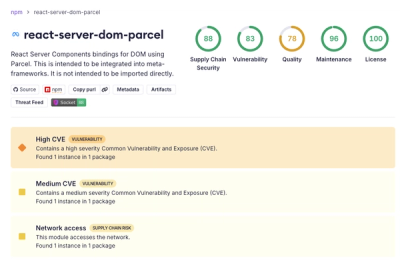
New DoS and source code exposure bugs in React Server Components and Next.js: what’s affected and how to update safely.

Security News
Socket CEO Feross Aboukhadijeh joins Software Engineering Daily to discuss modern software supply chain attacks and rising AI-driven security risks.