

Security News
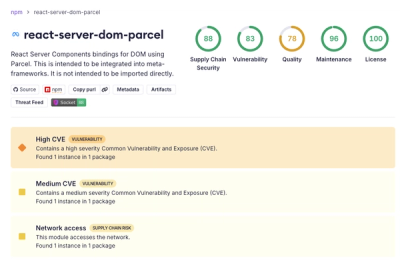
New React Server Components Vulnerabilities: DoS and Source Code Exposure
New DoS and source code exposure bugs in React Server Components and Next.js: what’s affected and how to update safely.
By Sarah Gooding - Dec 12, 2025
compressed-tensors
Advanced tools
The compressed-tensors library extends the safetensors format, providing a versatile and efficient way to store and manage compressed tensor data. This library supports various quantization and sparsity schemes, making it a unified format for handling different model optimizations like GPTQ, AWQ, SmoothQuant, INT8, FP8, SparseGPT, and more.
compressed-tensors?As model compression becomes increasingly important for efficient deployment of LLMs, the landscape of quantization and compression techniques has become increasingly fragmented.
Each method often comes with its own storage format and loading procedures, making it challenging to work with multiple techniques or switch between them.
compressed-tensors addresses this by providing a single, extensible format that can represent a wide variety of compression schemes.
This allows developers and researchers to easily experiment with composing different quantization methods, simplify model deployment pipelines, and reduce the overhead of supporting multiple compression formats in inference engines.
Stable release:
pip install compressed-tensors
Nightly release:
pip install --pre compressed-tensors
git clone https://github.com/neuralmagic/compressed-tensors
cd compressed-tensors
pip install -e .
The function save_compressed uses the compression_format argument to apply compression to tensors.
The function load_compressed reverses the process: converts the compressed weights on disk to decompressed weights in device memory.
from compressed_tensors import save_compressed, load_compressed, BitmaskConfig
from torch import Tensor
from typing import Dict

# the example BitmaskConfig method efficiently compresses
# tensors with large number of zero entries
compression_config = BitmaskConfig()

tensors: Dict[str, Tensor] = {"tensor_1": Tensor(
    [[0.0, 0.0, 0.0],
     [1.0, 1.0, 1.0]]
)}
# compress tensors using BitmaskConfig compression format (save them efficiently on disk)
save_compressed(tensors, "model.safetensors", compression_format=compression_config.format)

# decompress tensors (load_compressed returns a generator for memory efficiency)
decompressed_tensors = {}
for tensor_name, tensor in load_compressed("model.safetensors", compression_config = compression_config):
    decompressed_tensors[tensor_name] = tensor
We can apply bitmask compression to a whole model. For more detailed example see example directory.
from compressed_tensors import save_compressed_model, load_compressed, BitmaskConfig
from transformers import AutoModelForCausalLM

model_name = "neuralmagic/llama2.c-stories110M-pruned50"
model = AutoModelForCausalLM.from_pretrained(model_name, torch_dtype="auto")

original_state_dict = model.state_dict()

compression_config = BitmaskConfig()

# save compressed model weights
save_compressed_model(model, "compressed_model.safetensors", compression_format=compression_config.format)

# load compressed model weights (`dict` turns generator into a dictionary)
state_dict = dict(load_compressed("compressed_model.safetensors", compression_config))
For more in-depth tutorial on bitmask compression, refer to the notebook.
We can use compressed-tensors to run basic post training quantization (PTQ) and save the quantized model compressed on disk
model_name = "TinyLlama/TinyLlama-1.1B-intermediate-step-1431k-3T"
model = AutoModelForCausalLM.from_pretrained(model_name, device_map="cuda:0", torch_dtype="auto")

config = QuantizationConfig.parse_file("./examples/bit_packing/int4_config.json")
config.quantization_status = QuantizationStatus.CALIBRATION
apply_quantization_config(model, config)

dataset = load_dataset("ptb_text_only")["train"]
tokenizer = AutoTokenizer.from_pretrained(model_name)

def tokenize_function(examples):
    return tokenizer(examples["sentence"], padding=False, truncation=True, max_length=1024)

tokenized_dataset = dataset.map(tokenize_function, batched=True)
data_loader = DataLoader(tokenized_dataset, batch_size=1, collate_fn=DefaultDataCollator())

with torch.no_grad():
    for idx, sample in tqdm(enumerate(data_loader), desc="Running calibration"):
        sample = {key: value.to(device) for key,value in sample.items()}
        _ = model(**sample)

        if idx >= 512:
            break

model.apply(freeze_module_quantization)
model.apply(compress_quantized_weights)

output_dir = "./ex_llama1.1b_w4a16_packed_quantize"
compressor = ModelCompressor(quantization_config=config)
compressed_state_dict = compressor.compress(model)
model.save_pretrained(output_dir, state_dict=compressed_state_dict)
For more in-depth tutorial on quantization compression, refer to the notebook.
FAQs
Library for utilization of compressed safetensors of neural network models
We found that compressed-tensors demonstrated a healthy version release cadence and project activity because the last version was released less than a year ago. It has 1 open source maintainer collaborating on the project.
Did you know?

Socket for GitHub automatically highlights issues in each pull request and monitors the health of all your open source dependencies. Discover the contents of your packages and block harmful activity before you install or update your dependencies.
Security News
New DoS and source code exposure bugs in React Server Components and Next.js: what’s affected and how to update safely.

Security News
Socket CEO Feross Aboukhadijeh joins Software Engineering Daily to discuss modern software supply chain attacks and rising AI-driven security risks.
Security News
GitHub has revoked npm classic tokens for publishing; maintainers must migrate, but OpenJS warns OIDC trusted publishing still has risky gaps for critical projects.