

Product
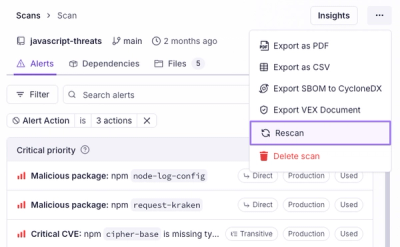
Introducing Immutable Scans
Scan results now load faster and remain consistent over time, with stable URLs and on-demand rescans for fresh security data.
By Nolan Lawson - Jan 23, 2026
dds-cli
Advanced tools
A command line tool `dds` to manage projects and data in the SciLifeLab Data Delivery System.









Links





The Data Delivery System (DDS) is a cloud-based system for all SciLifeLab platforms where data generated throughout each project can be delivered to the research groups in a fast, secure and simple way. The CLI makes requests to the API (see badge below for link) in order to use the API functionality.
The Data Delivery System is developed and maintained by the SciLifeLab Data Centre. National Genomics Infrastructure (NGI) Stockholm has been a part of the development team during 2021 and early 2022.
The dds-cli package can be installed from PyPI using pip as follows:
pip install --upgrade dds-cli
After installing, run dds (or dds --help) and verify that the output looks like this:

Executables are available for Windows, MacOS and Linux. These allow you to run the CLI without needing to install it (and the pip / Python requirements) yourself. Download them from the (bottom of the) latest release page: Latest Release
If you would like the latest development version of tools, the command is:
pip install --upgrade --force-reinstall git+https://github.com/ScilifelabDataCentre/dds_cli.git@dev
If you intend to make edits to the code, first make a fork of the repository and then clone it locally. Go to the cloned directory and install with pip (also installs development requirements):
pip install --upgrade -r requirements-dev.txt -e .
FAQs
A command line tool to manage data and projects in the SciLifeLab Data Delivery System.
We found that dds-cli demonstrated a healthy version release cadence and project activity because the last version was released less than a year ago. It has 1 open source maintainer collaborating on the project.
Did you know?

Socket for GitHub automatically highlights issues in each pull request and monitors the health of all your open source dependencies. Discover the contents of your packages and block harmful activity before you install or update your dependencies.
Product
Scan results now load faster and remain consistent over time, with stable URLs and on-demand rescans for fresh security data.
Product
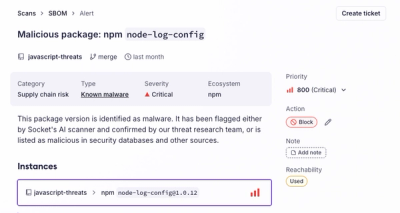
Socket's new Alert Details page is designed to surface more context, with a clearer layout, reachability dependency chains, and structured review.
Product
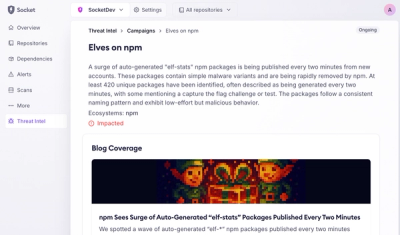
Campaign-level threat intelligence in Socket now shows when active supply chain attacks affect your repositories and packages.