

Product
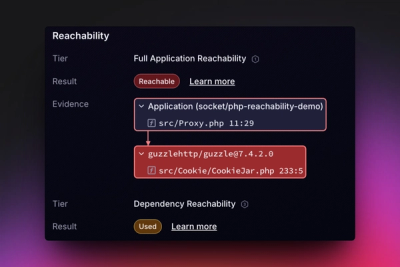
Introducing Reachability for PHP
Reachability analysis for PHP is now available in experimental, helping teams identify which vulnerabilities are actually exploitable.
By Benjamin Barslev - Apr 24, 2026
fastapi-advanced-rate-limiter
Advanced tools
High-performance, multi-algorithm rate limiting for FastAPI with Redis and in-memory backends
High-performance, production-ready rate limiting for FastAPI applications.









FastAPI Advanced Rate Limiter is a battle-tested library providing 6 different rate limiting algorithms with support for both in-memory and Redis backends. Perfect for APIs, microservices, and any FastAPI application that needs protection from abuse, overload, or DDoS attacks.
get_status(), get_wait_time(), get_retry_after() helpersRate limiting is essential for:
Without rate limiting, a single user can:
30 seconds to your first rate limiter:
from fastapi import FastAPI, Request, HTTPException
from fastapi_advanced_rate_limiter import SlidingWindowRateLimiter
import redis

app = FastAPI()

# Initialize rate limiter
redis_client = redis.Redis.from_url("redis://localhost:6379", decode_responses=True)
limiter = SlidingWindowRateLimiter(
    capacity=100,      # 100 requests
    fill_rate=10,      # per 10 seconds
    scope="user",      # per-user limits
    backend="redis",   # distributed
    redis_client=redis_client
)

@app.middleware("http")
async def rate_limit_middleware(request: Request, call_next):
    # Get user identifier (from auth, IP, etc.)
    user_id = request.headers.get("X-User-ID") or request.client.host

    # Check rate limit
    if not limiter.allow_request(user_id):
        wait_time = limiter.get_wait_time(user_id)
        raise HTTPException(
            status_code=429,
            detail=f"Rate limit exceeded. Retry after {wait_time:.0f} seconds.",
            headers={"Retry-After": str(int(wait_time))}
        )

    return await call_next(request)

@app.get("/")
async def root():
    return {"message": "Hello World!"}
Run it:
uvicorn main:app --reload
Test it:
# Make requests
curl http://localhost:8000/
# After 100 requests in 10 seconds, you'll get:
# {"detail":"Rate limit exceeded. Retry after 5 seconds."}
pip install fastapi-advanced-rate-limiter
pip install fastapi-advanced-rate-limiter redis
If you want to contribute or modify the package:
git clone https://github.com/awais7012/FastAPI-RateLimiter.git
cd FastAPI-RateLimiter
pip install -e .
For contributors who want to run tests and development tools:
pip install -e ".[dev]"
Choose the right algorithm for your use case:
How it works: Imagine a bucket that slowly fills with tokens. Each request takes a token. If the bucket is empty, requests are denied.
from fastapi_advanced_rate_limiter import TokenBucketLimiter

limiter = TokenBucketLimiter(
    capacity=10,    # Bucket holds 10 tokens (burst size)
    fill_rate=1.0,  # Refill 1 token per second
    scope="user",
    backend="memory"
)
Behavior:
capacityfill_ratePros: ✅ Flexible, allows bursts
Cons: ⚠️ Can be "drained" by burst traffic
Use when: User-triggered actions (file uploads, form submissions)
How it works: Requests fill a bucket with a hole at the bottom. The bucket leaks at a constant rate. Overflow = rejected.
from fastapi_advanced_rate_limiter import LeakyBucketLimiter

limiter = LeakyBucketLimiter(
    capacity=5,     # Bucket capacity
    fill_rate=1.0,  # Leak rate (1 req/sec)
    scope="user",
    backend="memory"
)
Behavior:
Pros: ✅ Smooth, predictable rate
Cons: ❌ Strict (can frustrate users with spiky traffic)
Use when: Calling rate-limited external APIs, message queues
How it works: Count requests in fixed time windows (e.g., per minute). Reset count at window boundaries.
from fastapi_advanced_rate_limiter import FixedWindowRateLimiter

limiter = FixedWindowRateLimiter(
    capacity=1000,  # 1000 requests
    fill_rate=100,  # per 10 seconds (capacity/fill_rate)
    scope="global",
    backend="redis"
)
Behavior:
Pros: ✅ Fastest, O(1), minimal memory
Cons: ⚠️ Boundary burst vulnerability
Use when: High-throughput internal APIs, coarse-grained limits
How it works: Combines current and previous window counts with a weighted average to smooth transitions.
from fastapi_advanced_rate_limiter import SlidingWindowRateLimiter

limiter = SlidingWindowRateLimiter(
    capacity=100,
    fill_rate=10,
    scope="user",
    backend="redis"  # Redis version performs best!
)
Behavior:
Pros: ✅ Best balance of accuracy and performance
Cons: ⚠️ Slight approximation (but negligible in practice)
Use when: Production APIs, user-facing services (RECOMMENDED for most cases)
How it works: Logs exact timestamp of each request. Prunes old timestamps outside the window.
from fastapi_advanced_rate_limiter import SlidingWindowLogRateLimiter

limiter = SlidingWindowLogRateLimiter(
    capacity=10,
    fill_rate=10/300,  # 10 per 5 minutes
    scope="ip",
    backend="redis"
)
Behavior:
Pros: ✅ Perfect accuracy, no boundary issues
Cons: ❌ Higher memory usage, not suitable for huge scale
Use when: Security-critical endpoints (login, payment), billing APIs
How it works: Maintains a queue of recent request timestamps. Similar to Sliding Window Log.
from fastapi_advanced_rate_limiter import QueueLimiter

limiter = QueueLimiter(
    capacity=50,
    fill_rate=5.0,
    scope="global",
    backend="memory"
)
Behavior:
Use when: Background job processing, task queues
Test Setup: 5 concurrent users, 10-second tests, mixed traffic patterns
| Algorithm | Memory (req/s) | Redis (req/s) | Success Rate | Best For |
|---|---|---|---|---|
| Fixed Window | 15.99 🥇 | 15.33 | 53-59% | High throughput |
| Sliding Window | 15.03 | 14.32 | 51-66% | Production (best balance) ⭐ |
| Sliding Window Log | 15.41 | 14.58 | 52-67% | Accuracy-critical |
| Token Bucket | 4.76 | 3.69 | 14-16% | Burst-friendly APIs |
| Leaky Bucket | 4.76 | 2.93 | 10-16% | Traffic shaping |
| Queue Limiter | 2.76 | 3.03 | 9-12% | Fair queuing |
Key Findings:
Winner: 🏆 Sliding Window (Redis) — Best for production APIs
from fastapi import FastAPI, Depends, HTTPException
from fastapi.security import HTTPBearer
from fastapi_advanced_rate_limiter import SlidingWindowRateLimiter

app = FastAPI()
security = HTTPBearer()
limiter = SlidingWindowRateLimiter(capacity=100, fill_rate=10, scope="user", backend="redis")

def get_current_user(token: str = Depends(security)):
    # Your auth logic here
    return {"user_id": "user_123"}

@app.get("/api/data")
async def get_data(user = Depends(get_current_user)):
    if not limiter.allow_request(user["user_id"]):
        raise HTTPException(status_code=429, detail="Rate limit exceeded")

    return {"data": "Your protected data"}
from fastapi import FastAPI, Request, HTTPException
from fastapi_advanced_rate_limiter import FixedWindowRateLimiter

app = FastAPI()
limiter = FixedWindowRateLimiter(capacity=1000, fill_rate=100, scope="ip", backend="redis")

@app.get("/public/api")
async def public_endpoint(request: Request):
    client_ip = request.client.host

    if not limiter.allow_request(client_ip):
        raise HTTPException(
            status_code=429,
            detail="Too many requests from your IP",
            headers={"Retry-After": "60"}
        )

    return {"message": "Public data"}
from fastapi_advanced_rate_limiter import LeakyBucketLimiter

# Limit total API traffic
global_limiter = LeakyBucketLimiter(
    capacity=10000,
    fill_rate=1000,  # 1000 req/sec globally
    scope="global",
    backend="redis"
)

@app.middleware("http")
async def global_rate_limit(request: Request, call_next):
    if not global_limiter.allow_request(None):  # None for global scope
        raise HTTPException(status_code=503, detail="Service temporarily unavailable")
    return await call_next(request)
# Layer 1: Global limit (protect infrastructure)
global_limiter = FixedWindowRateLimiter(capacity=100000, fill_rate=10000, scope="global", backend="redis")

# Layer 2: Per-IP limit (prevent DDoS)
ip_limiter = SlidingWindowRateLimiter(capacity=1000, fill_rate=100, scope="ip", backend="redis")

# Layer 3: Per-user limit (fair usage)
user_limiter = TokenBucketLimiter(capacity=100, fill_rate=10, scope="user", backend="redis")

@app.middleware("http")
async def layered_rate_limit(request: Request, call_next):
    # Check global limit first
    if not global_limiter.allow_request(None):
        raise HTTPException(status_code=503, detail="Service overloaded")

    # Check IP limit
    if not ip_limiter.allow_request(request.client.host):
        raise HTTPException(status_code=429, detail="IP rate limit exceeded")

    # Check user limit (if authenticated)
    user_id = request.headers.get("X-User-ID")
    if user_id and not user_limiter.allow_request(user_id):
        raise HTTPException(status_code=429, detail="User rate limit exceeded")

    return await call_next(request)
from fastapi.responses import JSONResponse

@app.exception_handler(HTTPException)
async def rate_limit_handler(request: Request, exc: HTTPException):
    if exc.status_code == 429:
        # Get wait time from limiter
        user_id = request.headers.get("X-User-ID") or request.client.host
        wait_time = limiter.get_wait_time(user_id)

        return JSONResponse(
            status_code=429,
            content={
                "error": "Rate limit exceeded",
                "retry_after_seconds": int(wait_time),
                "message": f"Please wait {int(wait_time)} seconds before retrying"
            },
            headers={"Retry-After": str(int(wait_time))}
        )
    return exc
allow_request(identifier=None) -> boolCheck if a request should be allowed.
Parameters:
identifier (str, optional): User ID, IP address, or None for global scopeReturns:
bool: True if allowed, False if rate limitedExample:
if limiter.allow_request("user_123"):
    # Process request
    pass
else:
    # Return 429
    pass
get_status(identifier=None) -> dictGet current limiter status for monitoring.
Returns:
{
    "tokens_remaining": 7.5,  # Token Bucket
    "capacity": 10,
    "fill_rate": 1.0,
    "utilization_pct": 25.0
}
Example:
status = limiter.get_status("user_123")
print(f"User has {status['tokens_remaining']} requests remaining")
get_wait_time(identifier=None) -> floatCalculate seconds until next request would be allowed.
Returns:
float: Seconds to wait (0.0 if request would be allowed immediately)Example:
wait = limiter.get_wait_time("user_123")
if wait > 0:
    print(f"Please wait {wait:.1f} seconds")
reset(identifier=None) -> NoneReset rate limit for an identifier (useful for testing or admin actions).
Example:
# Admin endpoint to reset user's rate limit
@app.post("/admin/reset-limit/{user_id}")
async def reset_user_limit(user_id: str):
    limiter.reset(user_id)
    return {"message": f"Rate limit reset for {user_id}"}
Pros:
Cons:
Use when:
Pros:
Cons:
Use when:
Setup Redis:
# Docker
docker run -d --name redis -p 6379:6379 redis

# Or use Redis Cloud (free tier)
# https://redis.com/try-free/
# For most APIs → Sliding Window
limiter = SlidingWindowRateLimiter(...)

# For burst-heavy traffic → Token Bucket
limiter = TokenBucketLimiter(...)

# For critical operations → Sliding Window Log
limiter = SlidingWindowLogRateLimiter(...)
# Authenticated users → per-user
scope="user"

# Public APIs → per-IP
scope="ip"

# Infrastructure protection → global
scope="global"
# Don't be too strict!
# Bad: 10 req/hour (users will be frustrated)
# Good: 1000 req/hour (generous but protective)

limiter = SlidingWindowRateLimiter(
    capacity=1000,
    fill_rate=1000/3600,  # 1000 per hour
    scope="user",
    backend="redis"
)
if not limiter.allow_request(user_id):
    wait_time = limiter.get_wait_time(user_id)
    raise HTTPException(
        status_code=429,
        headers={"Retry-After": str(int(wait_time))}
    )
@app.get("/metrics/rate-limits")
async def get_rate_limit_metrics():
    return {
        "global": global_limiter.get_status(None),
        "sample_user": user_limiter.get_status("user_123")
    }
# Run comprehensive test suite
python tests/all_limiter_test.py

# Or with pytest
pytest tests/
==========================================================================================
  FINAL COMPARISON SUMMARY
==========================================================================================
Limiter                   Backend       Allowed    Blocked     Rate/s   Success%
------------------------------------------------------------------------------------------
Fixed Window              memory            168        145     15.99      53.7%
Sliding Window            redis             153         80     14.32      65.7%  ⭐
Sliding Window Log        redis             155         95     14.58      62.0%
Token Bucket              memory             50        262      4.76      16.0%

🏆 Best Performance: Sliding Window (redis): 14.32 req/s with 65.7% success rate
We welcome contributions! Here's how:
git checkout -b feature/amazing-featuregit commit -m 'Add amazing feature'git push origin feature/amazing-featuregit clone https://github.com/awais7012/FastAPI-RateLimiter.git
cd FastAPI-RateLimiter
pip install -e ".[dev]"
# Problem: redis.exceptions.ConnectionError
# Solution: Ensure Redis is running

# Check Redis
docker ps | grep redis

# Or start Redis
docker run -d --name redis -p 6379:6379 redis
# Problem: Rate limits don't work across multiple app instances
# Solution: Use Redis backend, not memory

# ❌ Wrong (memory backend)
limiter = SlidingWindowRateLimiter(..., backend="memory")

# ✅ Correct (Redis backend)
limiter = SlidingWindowRateLimiter(..., backend="redis", redis_client=redis_client)
# Problem: ModuleNotFoundError: No module named 'fastapi_advanced_rate_limiter'
# Solution: Install the package from PyPI

pip install fastapi-advanced-rate-limiter

# Or if you cloned the repo
pip install -e .
MIT License - see LICENSE file for details.
Built for developers who love clean, scalable FastAPI tooling.
⭐ Star us on GitHub if you find this useful!
FAQs
High-performance, multi-algorithm rate limiting for FastAPI with Redis and in-memory backends
We found that fastapi-advanced-rate-limiter demonstrated a healthy version release cadence and project activity because the last version was released less than a year ago. It has 1 open source maintainer collaborating on the project.
Did you know?

Socket for GitHub automatically highlights issues in each pull request and monitors the health of all your open source dependencies. Discover the contents of your packages and block harmful activity before you install or update your dependencies.
Product
Reachability analysis for PHP is now available in experimental, helping teams identify which vulnerabilities are actually exploitable.
Product
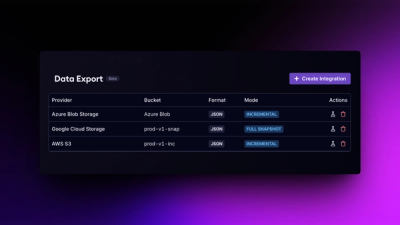
Export Socket alert data to your own cloud storage in JSON, CSV, or Parquet, with flexible snapshot or incremental delivery.
Research
/Security News
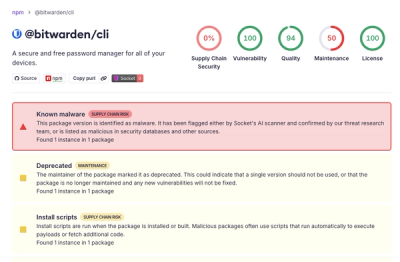
Bitwarden CLI 2026.4.0 was compromised in the Checkmarx supply chain campaign after attackers abused a GitHub Action in Bitwarden’s CI/CD pipeline.