

Security News
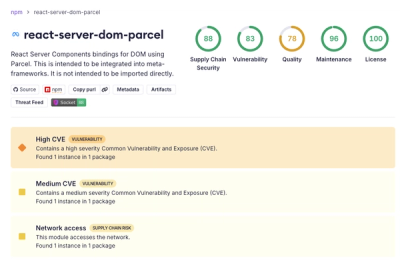
New React Server Components Vulnerabilities: DoS and Source Code Exposure
New DoS and source code exposure bugs in React Server Components and Next.js: what’s affected and how to update safely.
By Sarah Gooding - Dec 12, 2025
mcp-graphql
Advanced tools
An MCP (Model Context Protocol) server that enables interaction with GraphQL APIs.
MCP GraphQL is a tool that implements the Model Context Protocol (MCP) to provide a standardized interface for interacting with GraphQL APIs. It automatically exposes each GraphQL query as a separate MCP tool, allowing MCP-compatible clients to seamlessly communicate with GraphQL services.
When using uv no specific installation is needed. We will
use uvx to directly run mcp-graphql.
Alternatively you can install mcp-graphql via pip:
pip install mcp-graphql
git clone https://github.com/your-username/mcp_graphql.git
cd mcp_graphql
pip install .
Using uvx:
uvx mcp-graphql --api-url="https://api.example.com/graphql" --auth-token="your-token"
Using pip installation:
mcp-graphql --api-url="https://api.example.com/graphql" --auth-token="your-token"
or
python -m mcp_graphql --api-url="https://api.example.com/graphql" --auth-token="your-token"
--api-url: GraphQL API URL (required)--auth-token: Authentication token (optional, can also be set via MCP_AUTH_TOKEN environment variable)--auth-type: Authentication type, default is "Bearer" (optional)--auth-headers: Custom authentication headers in JSON format (optional)--queries-file: Path to a .gql file containing predefined GraphQL queries (optional)--queries: Predefined GraphQL queries passed directly as a string (optional)--max-depth: Maximum depth when auto-generating queries (default: 5)Example with custom headers:
mcp-graphql --api-url="https://api.example.com/graphql" --auth-headers='{"Authorization": "Bearer token", "X-API-Key": "key"}'
Example with predefined queries file:
mcp-graphql --api-url="https://api.example.com/graphql" --queries-file="./queries.gql"
Example passing queries directly as a string (use single quotes to avoid shell conflicts):
mcp-graphql --api-url="https://api.example.com/graphql" --queries='query Hello { hello }'
If neither --queries-file nor --queries is supplied, mcp-graphql will
automatically build a query by introspecting the GraphQL schema and selecting
all scalar fields up to a configurable depth. This is convenient for
quickly exploring an API, but it has two main drawbacks:
The --max-depth option mitigates the first issue by limiting the recursion
depth (default = 5). Even so, the best practice is to define the exact
queries you need through --queries-file or --queries. In doing so:
Example using --max-depth to limit the auto-generated query to depth 2:
mcp-graphql --api-url="https://api.example.com/graphql" --max-depth 2
For production workloads you should supply your own queries:
# Using a file
mcp-graphql --api-url="https://api.example.com/graphql" \
            --queries-file="./queries.gql"

# Or as a string
mcp-graphql --api-url="https://api.example.com/graphql" \
            --queries='query UserMini { viewer { id name } }'
The queries.gql file should contain one or more named operations, e.g.:
# queries.gql
query GetUser($id: ID!) {
  user(id: $id) {
    id
    name
    email
  }
}

query ListPosts {
  posts {
    id
    title
  }
}
import asyncio
from pathlib import Path
from mcp_graphql import serve

auth_headers = {"Authorization": "Bearer your-token"}
api_url = "https://api.example.com/graphql"
queries_file = Path("queries.gql")  # optional, set to None to expose all queries

asyncio.run(serve(api_url, auth_headers, queries_file=queries_file))
Passing the queries directly as a string from code:
queries_str = """
query Hello($name: String!) {
  hello(name: $name)
}
"""

asyncio.run(serve(api_url, auth_headers, queries=queries_str, max_depth=3))
Add to your Claude settings:
"mcpServers": {
  "graphql": {
    "command": "uvx",
    "args": ["mcp-graphql", "--api-url", "https://api.example.com/graphql"]
  }
}
"mcpServers": {
  "graphql": {
    "command": "docker",
    "args": ["run", "-i", "--rm", "mcp/graphql", "--api-url", "https://api.example.com/graphql"]
  }
}
"mcpServers": {
  "graphql": {
    "command": "python",
    "args": ["-m", "mcp_graphql", "--api-url", "https://api.example.com/graphql"]
  }
}
MCP GraphQL automatically:
When a tool is called, the server:
# Create virtual environment using uv
uv venv

# Install dependencies
uv sync
ruff check .
When working locally you can start the MCP GraphQL server with hot-reloading and inspect its tools using the Model Context Protocol Inspector:
npx "@modelcontextprotocol/inspector" uv run -n --project $PWD mcp-graphql --api-url http://localhost:3010/graphql
Replace http://localhost:3010/graphql with the URL of your local GraphQL endpoint if it differs.
This project is licensed under the MIT License. See the LICENSE file for details.
Contributions are welcome. Please feel free to submit a Pull Request or open an Issue.
FAQs
MCP server for GraphQL
We found that mcp-graphql demonstrated a healthy version release cadence and project activity because the last version was released less than a year ago. It has 1 open source maintainer collaborating on the project.
Did you know?

Socket for GitHub automatically highlights issues in each pull request and monitors the health of all your open source dependencies. Discover the contents of your packages and block harmful activity before you install or update your dependencies.
Security News
New DoS and source code exposure bugs in React Server Components and Next.js: what’s affected and how to update safely.

Security News
Socket CEO Feross Aboukhadijeh joins Software Engineering Daily to discuss modern software supply chain attacks and rising AI-driven security risks.
Security News
GitHub has revoked npm classic tokens for publishing; maintainers must migrate, but OpenJS warns OIDC trusted publishing still has risky gaps for critical projects.