Productivity
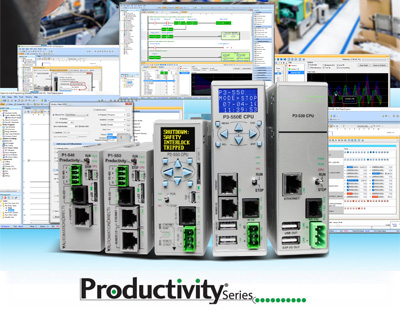
Python driver and command-line tool for AutomationDirect Productivity Series PLCs.
Installation
uv pip install productivity
Usage
PLC Configuration
This driver uses Modbus TCP/IP for communication. Unlike the ClickPLC, modbus
addresses need to be manually configured in the Productivity PLC firmware (see
manual).
To use this driver, go to Write Program → Tag Database, scroll down to the values
you care about, and double click the Mod Start cell of each value to assign an address.
Then, go to File → Export → Tags to export a csv file. The file is used here so
you don't need to remember the addresses.
Command Line
To print the tags and their values, simply call the library with the PLC IP address and the tags file.
$ productivity the-plc-ip-address path/to/tags.csv
Use --set to set values on the PLC:
$ productivity the-plc-ip-address path/to/tags.csv -s "{int_test: 4, float_test: 4.45, string_test: foo}"
The --set parameter takes YAML, a simple data format that allows you to easily set multiple tags at once.
See productivity --help for more.
Python
This driver uses Python async/await syntax to asynchronously communicate with
a Productivity2000 PLC. For example:
import asyncio
from productivity import ProductivityPLC

async def run():
    async with ProductivityPLC('the-plc-ip-address', 'path/to/tags.csv') as plc:
        print(await plc.get())

asyncio.run(run())
It is also possible to set tag values:
async def run():
    async with ProductivityPLC('the-plc-ip-address', 'path/to/tags.csv') as plc:
        await plc.set(start=True, setpoint=1.1)

asyncio.run(run())