

Company News
Socket Has Acquired Secure Annex
Socket has acquired Secure Annex to expand extension security across browsers, IDEs, and AI tools.
By Feross Aboukhadijeh - Apr 28, 2026
pydantic-client
Advanced tools




A flexible HTTP client library that leverages Pydantic models for request/response handling, supporting both synchronous and asynchronous operations.
requests, aiohttp, or httpxwith client.span(prefix="myapi"): to log timing for any API call, sync or asyncpip install pydantic-client
See the example/ directory for real-world usage of this library, including:
example_requests.py: Synchronous usage with RequestsWebClientexample_httpx.py: Async usage with HttpxWebClientexample_aiohttp.py: Async usage with AiohttpWebClientexample_tools.py: How to register and use Agno toolsexample_nested_response.py: How to extract data from nested API responsesfrom pydantic import BaseModel
from pydantic_client import RequestsWebClient, get, post
# Define your response models
class UserResponse(BaseModel):
id: int
name: str
email: str
class CreateUser(BaseModel):
name: str
email: str
# Create your API client
class MyAPIClient(RequestsWebClient):
def __init__(self):
super().__init__(
base_url="https://api.example.com",
headers={"Authorization": "Bearer token"}
)
@get("users/{user_id}")
def get_user(self, user_id: int) -> UserResponse:
pass
@post("users")
def create_user(self, user: CreateUser) -> UserResponse:
pass
@get("/users/string?name={name}")
def get_user_string(self, name: Optional[str] = None) -> dict:
# will get raw json data
...
@get("/users/{user_id}/bytes")
def get_user_bytes(self, user_id: str) -> bytes:
# will get raw content, bytes type.
...
@delete(
"/users",
agno_tool=True,
tool_description="description or use function annotation."
)
def delete_user(self, user_id: str, request_headers: Dict[str, Any]):
...
# Use the client
client = MyAPIClient(base_url="https://localhost")
user = client.get_user(user_id=123)
user_body = CreateUser(name="john", email="123@gmail.com")
user = client.create_user(user_body)
# will update the client headers.
client.delete_user("123", {"ba": "your"})
from agno.agent import Agent
agent = Agent(.....)
client.register_agno_tools(agent) # delete_user is used by tools.
RequestsWebClient: Synchronous client using the requests libraryAiohttpWebClient: Asynchronous client using aiohttpHttpxWebClient: Asynchronous client using httpxThe library provides decorators for common HTTP methods:
@get(path)@post(path)@put(path)@patch(path)@delete(path)Path parameters are automatically extracted from the URL template and matched with method arguments:
@get("users/{user_id}/posts/{post_id}")
def get_user_post(self, user_id: int, post_id: int) -> PostResponse:
    pass
# you can call signature by your self, overwrite the function `before_request`


class MyAPIClient(RequestsWebClient):
    # some code

    def before_request(self, request_params: Dict[str, Any]) -> Dict[str, Any]:
        # the request params before send: body, header, etc...
        sign = cal_signature(request_params)
        request_params["headers"].update(dict(signature=sign))
        return request_params


# will send your new request_params
user = client.get_user("123")
Many APIs return deeply nested JSON structures. Use the response_extract_path parameter to extract and parse specific data from complex API responses:
from typing import List
from pydantic import BaseModel
from pydantic_client import RequestsWebClient, get

class User(BaseModel):
    id: str
    name: str
    email: str

class MyClient(RequestsWebClient):
    @get("/users/complex", response_extract_path="$.data.users")
    def get_users_nested(self) -> List[User]:
        """
        Extracts the users list from a nested response structure

        Example response:
        {
            "status": "success",
            "data": {
                "users": [
                    {"id": "1", "name": "Alice", "email": "alice@example.com"},
                    {"id": "2", "name": "Bob", "email": "bob@example.com"}
                ],
                "total": 2
            }
        }
        """
        pass

    @get("/search", response_extract_path="$.results[0]")
    def search_first_result(self) -> User:
        """
        Get just the first search result from an array
        """
        pass
The response_extract_path parameter defines where to find the data in the response. It supports:
$.results[0] -> User$ prefix for root object: $.data.users -> list[User]You can configure the client to return mock responses instead of making actual API calls. This is useful for testing or development purposes.
from pydantic_client import RequestsWebClient, get


class UserResponse(BaseModel):
    id: int
    name: str


class MyClient(RequestsWebClient):
    @get("/users/{user_id}")
    def get_user(self, user_id: int) -> UserResponse:
        pass

# Create client and configure mocks
client = MyClient(base_url="https://api.example.com")
client.set_mock_config(mock_config=[
    {
        "name": "get_user",
        "output": {
            "id": 123,
            "name": "Mock User"
        }
    }
])

# This will return the mock response without making an actual API call
user = client.get_user(1)  # Returns UserResponse(id=123, name="Mock User")
You can also load mock configurations from a JSON file:
# Load mock data from a JSON file
client.set_mock_config(mock_config_path="path/to/mock_data.json")
The JSON file should follow this format:
[
    {
        "name": "get_user",
        "output": {
            "id": 123,
            "name": "Mock User"
        }
    },
    {
        "name": "list_users",
        "output": {
            "users": [
                {"id": 1, "name": "User 1"},
                {"id": 2, "name": "User 2"}
            ]
        }
    }
]
You can also include mock configuration when creating a client from configuration:
config = {
    "base_url": "https://api.example.com",
    "timeout": 10,
    "mock_config": [
        {
            "name": "get_user",
            "output": {
                "id": 123,
                "name": "Mock User"
            }
        }
    ]
}

client = MyClient.from_config(config)
Generate a client from an OpenAPI/Swagger specification:
# Generate a requests client from a YAML file
swagger-cli -f api.yaml -t requests -o api_client.py

# Generate an aiohttp client from a JSON file
swagger-cli -f openapi.json -t aiohttp -o async_api_client.py

# Generate an httpx client with custom output name
swagger-cli -f swagger.yaml -t httpx -o http_client.py
The CLI tool automatically handles common OpenAPI/Swagger specification issues:
Python Keyword Conflicts: Parameter/field names that conflict with Python keywords (e.g., import, from, class) are automatically renamed with an underscore suffix (e.g., import_, from_, class_)
Invalid Python Identifiers: Parameter/field names with invalid characters (e.g., hyphens, dots, special characters) are automatically converted to valid Python identifiers using underscores:
x-immich-checksum → x_immich_checksumapi-key → api_keyuser.id → user_idParameter Ordering: Required parameters (without default values) are automatically placed before optional parameters (with default values), regardless of their order in the OpenAPI specification. This ensures generated code follows Python's syntax rules.
Example generated code:
# Original OpenAPI spec with mixed parameter order and invalid identifiers
@put("/albums/{id}/assets")
async def add_assets_to_album(
    self,
    id: str,
    bulkidsdto: BulkIdsDto,  # Required - moved before optional params
    key: str | None = None,  # Optional
    slug: str | None = None  # Optional
):
    """Upload asset"""
    ...
All clients support a span context manager for simple API call timing and logging:
with client.span(prefix="fetch_user"):
    user = client.get_user_by_id("123")
# Logs the elapsed time for the API call, useful for performance monitoring.

# will send `fetch_user.elapsed` to statsd
client = MyAPIClient(base_url="https://localhost", statsd_address="localhost:8125")
with client.span(prefix="fetch_user"):
    user = client.get_user_by_id("123")
You can initialize clients with custom configurations:
client = MyAPIClient(
    base_url="https://api.example.com",
    headers={"Custom-Header": "value"},
    session=requests.Session(),  # your own session
    timeout=30  # in seconds
)

# Or using configuration dictionary
config = {
    "base_url": "https://api.example.com",
    "headers": {"Custom-Header": "value"},
    "timeout": 30
}
client = MyAPIClient.from_config(config)
FAQs
Http client base pydantic, with requests or aiohttp
We found that pydantic-client demonstrated a healthy version release cadence and project activity because the last version was released less than a year ago. It has 1 open source maintainer collaborating on the project.
Did you know?

Socket for GitHub automatically highlights issues in each pull request and monitors the health of all your open source dependencies. Discover the contents of your packages and block harmful activity before you install or update your dependencies.
Company News
Socket has acquired Secure Annex to expand extension security across browsers, IDEs, and AI tools.

Research
/Security News
Socket is tracking cloned Open VSX extensions tied to GlassWorm, with several updated from benign-looking sleepers into malware delivery vehicles.
Product
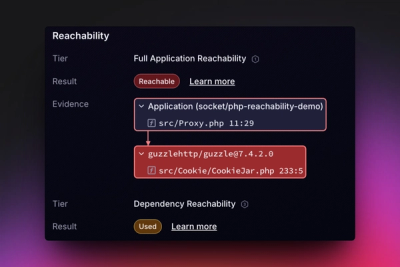
Reachability analysis for PHP is now available in experimental, helping teams identify which vulnerabilities are actually exploitable.