QRDet
QRDet is a robust QR Detector based on YOLOv8.
QRDet will detect & segment QR codes even in difficult positions or tricky images. If you are looking for a complete QR Detection + Decoding pipeline, take a look at QReader.
Installation
To install QRDet, simply run:
pip install qrdet
Usage
There is only one function you'll need to call to use QRDet, detect:
from qrdet import QRDetector
import cv2
detector = QRDetector(model_size='s')
image = cv2.imread(filename='resources/qreader_test_image.jpeg')
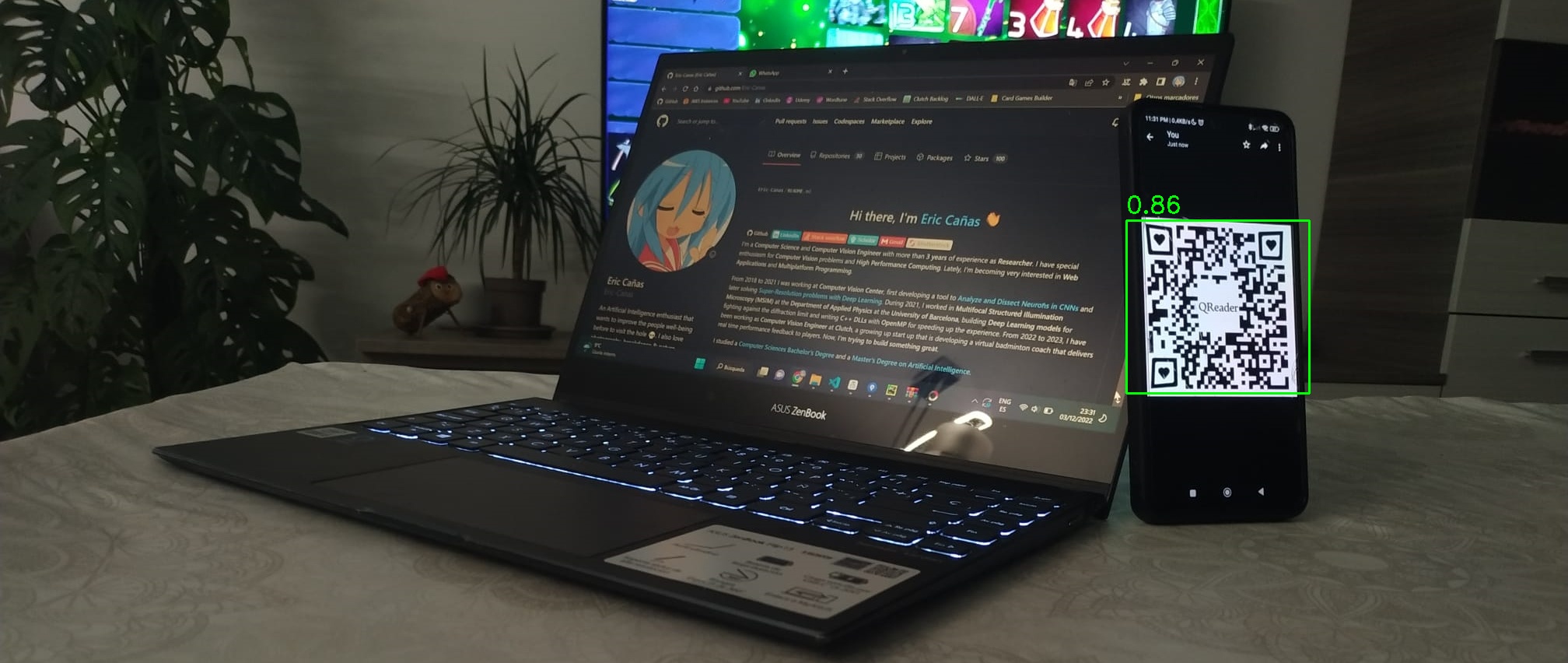
detections = detector.detect(image=image, is_bgr=True)
for detection in detections:
x1, y1, x2, y2 = detection['bbox_xyxy']
confidence = detection['confidence']
segmenation_xy = detection['quadrilateral_xy']
cv2.rectangle(image, (x1, y1), (x2, y2), color=(0, 255, 0), thickness=2)
cv2.putText(image, f'{confidence:.2f}', (x1, y1 - 10), fontFace=cv2.FONT_HERSHEY_SIMPLEX,
fontScale=1, color=(0, 255, 0), thickness=2)
cv2.imwrite(filename='resources/qreader_test_image_detections.jpeg', img=image)
API Reference
QRDetector(model_size = 's', conf_th = 0.5, nms_iou = 0.3, weights_folder = '<qrdet_package>/.model')
model_size: "n"|"s"|"m"|"l". Size of the model to load. Smaller models will be faster, while larger models will be more capable for difficult situations. Default: 's'.conf_th: float. Confidence threshold to consider that a detection is valid. Incresing this value will reduce false positives while decreasing will reduce false_negatives. Default: 0.5.nms_iou: float. Intersection over Union (IoU) threshold for Non-Maximum Suppression (NMS). NMS is a technique used to eliminate redundant bounding boxes for the same object. Increase this number if you find problems with duplicated detections. Default: 0.3weights_folder: str. Folder where detection model will be downloaded. By default, it points out to an internal folder within the package, making sure that it gets correctly removed when uninstalling. You could need to change it when working in environments like AWS Lambda where only /tmp folder is writable, as issued in #11. Default: '<qrdet_package>/.model'.
QRDetector.detect(image, is_bgr = False, **kwargs)
-
image: np.ndarray|'PIL.Image'|'torch.Tensor'|str. np.ndarray of shape (H, W, 3), PIL.Image, Tensor of shape (1, 3, H, W), or path/url to the image to predict. 'screen' for grabbing a screenshot.
-
is_bgr: bool. If True the image is expected to be in BGR. Otherwise, it will be expected to be RGB. Only used when image is np.ndarray or torch.tensor. Default: False
-
legacy: bool. If sent as kwarg, will parse the output to make it identical to 1.x versions. Not Recommended. Default: False.
-
Returns: tuple[dict[str, np.ndarray|float|tuple[float|int, float|int]]]. A tuple of dictionaries containing all the information of every detection. Contains the following keys.
confidence | Detection confidence | float | conf. |
bbox_xyxy | Bounding box | np.ndarray (4) | [x1, y1, x2, y2] |
cxcy | Center of bounding box | tuple[float, float] | (x, y) |
wh | Bounding box width and height | tuple[float, float] | (w, h) |
polygon_xy | Precise polygon that segments the QR | np.ndarray (N, 2) | [[x1, y1], [x2, y2], ...] |
quad_xy | Four corners polygon that segments the QR | np.ndarray (4, 2) | [[x1, y1], ..., [x4, y4]] |
padded_quad_xy | quad_xy padded to fully cover polygon_xy | np.ndarray (4, 2) | [[x1, y1], ..., [x4, y4]] |
image_shape | Shape of the input image | tuple[float, float] | (h, w) |
NOTE:
- All
np.ndarray values are of type np.float32
- All keys (except
confidence and image_shape) have a normalized ('n') version. For example,bbox_xyxy represents the bbox of the QR in image coordinates [[0., im_w], [0., im_h]], while bbox_xyxyn contains the same bounding box in normalized coordinates [0., 1.].
bbox_xyxy[n] and polygon_xy[n] are clipped to image_shape. You can use them for indexing without further management
Acknowledgements
This library is based on the following projects: