

Product
Socket for Jira Is Now Available
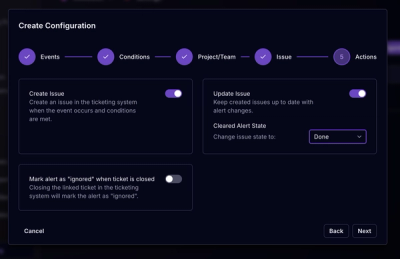
Socket for Jira lets teams turn alerts into Jira tickets with manual creation, automated ticketing rules, and two-way sync.
By Jeppe Hasseriis - Apr 20, 2026
wids
Advanced tools


%matplotlib inline
import matplotlib.pyplot as plt
import torch.utils.data
import torch.nn
from random import randrange
import os
os.environ["WDS_VERBOSE_CACHE"] = "1"
os.environ["GOPEN_VERBOSE"] = "0"
WebDataset format files are tar files, with two conventions:
something-000000.tar to something-012345.tar, usually specified using brace notation something-{000000..012345}.tarYou can find a longer, more detailed specification of the WebDataset format in the WebDataset Format Specification
WebDataset can read files from local disk or from any pipe, which allows it to access files using common cloud object stores. WebDataset can also read concatenated MsgPack and CBORs sources.
The WebDataset representation allows writing purely sequential I/O pipelines for large scale deep learning. This is important for achieving high I/O rates from local storage (3x-10x for local drives compared to random access) and for using object stores and cloud storage for training.
The WebDataset format represents images, movies, audio, etc. in their native file formats, making the creation of WebDataset format data as easy as just creating a tar archive. Because of the way data is aligned, WebDataset works well with block deduplication as well and aligns data on predictable boundaries.
Standard tools can be used for accessing and processing WebDataset-format files.
bucket = "https://storage.googleapis.com/webdataset/testdata/"
dataset = "publaynet-train-{000000..000009}.tar"

url = bucket + dataset
!curl -s {bucket}publaynet-train-000000.tar | dd count=5000 2> /dev/null | tar tf - 2> /dev/null | sed 10q
PMC4991227_00003.json
PMC4991227_00003.png


PMC4537884_00002.json


PMC4537884_00002.png


PMC4323233_00003.json
PMC4323233_00003.png


PMC5429906_00004.json
PMC5429906_00004.png


PMC5592712_00002.json
PMC5592712_00002.png
Note that in these .tar files, we have pairs of .json and .png files; each such pair makes up a training sample.
There are several libraries supporting the WebDataset format:
webdataset for Python3 (includes the wids library), this repositoryThe webdataset library can be used with PyTorch, Tensorflow, and Jax.
wids Library for Indexed WebDatasetsInstalling the webdataset library installs a second library called wids. This library provides fully indexed/random access to the same datasets that webdataset accesses using iterators/streaming.
Like the webdataset library, wids is high scalable and provides efficient access to very large datasets. Being indexed, it is easily backwards compatible with existing data pipelines based on indexed dataset, including precise epochs for multinode training. The library comes with its own ChunkedSampler and DistributedChunkedSampler classes, which provided shuffling accross nodes while still preserving enough locality of reference for efficient training.
Internally, the library uses a mmap-based tar file reader implementation; this allows very fast access without precomputed indexes, and it also means that shard and the equivalet of "shuffle buffers" are shared in memory between workers on the same machine.
This additional power comes at some cost: the library requires a small metadata file that lists all the shards in a dataset and the number of samples contained in each, the library requires local storage for as many shards as there are I/O workers on a node, it uses shared memory and mmap, and the availability of indexing makes it easy to accidentally use inefficient access patterns.
Generally, the recommendation is to use webdataset for all data generation, data transformation, and training code, and to use wids only if you need fully random access to datasets (e.g., for browing or sparse sampling), need an indexed-based sampler, or are converting tricky legacy code.
import wids

train_url = "https://storage.googleapis.com/webdataset/fake-imagenet/imagenet-train.json"

dataset = wids.ShardListDataset(train_url)

sample = dataset[1900]

print(sample.keys())
print(sample[".txt"])
plt.imshow(sample[".jpg"])
dict_keys(['.cls', '.jpg', '.txt', '__key__', '__dataset__', '__index__', '__shard__', '__shardindex__'])
a high quality color photograph of a dog


https://storage.googleapis.com/webdataset/fake-ima base: https://storage.googleapis.com/webdataset/fake-imagenet name: imagenet-train nfiles: 1282 nbytes: 31242280960 samples: 128200 cache: /tmp/_wids_cache
/home/tmb/proj/wids/src/wids/wids.py:316: UserWarning: String specifications for transformations are deprecated. Use functions instead.
  warnings.warn("String specifications for transformations are deprecated. Use functions instead.")


<matplotlib.image.AxesImage at 0x7187ffd119d0>

There are several examples of how to use wids in the examples directory.
widsNote that the APIs between webdataset and wids are not fully consistent:
wids keeps the extension's "." in the keys, while webdataset removes it (".txt" vs "txt")wids doesn't have a fully fluid interface, and add_transformation just adds to a list of transformationswebdataset currently can't read the wids JSON specifications$ pip install wids
For the Github version:
$ pip install git+https://github.com/tmbdev/wids.git
Here are some videos talking about WebDataset and large scale deep learning:
The wids library only requires PyTorch, NumPy, and a small library called braceexpand.
The wids library loads a few additional libraries dynamically only when they are actually needed and only in the decoder:
torchvision, torchvideo, torchaudio for image/video/audio decodingmsgpack for MessagePack decodingcurl command line tool for accessing HTTP serversLoading of one of these libraries is triggered by configuring a decoder that attempts to decode content in the given format and encountering a file in that format during decoding. (Eventually, the torch... dependencies will be refactored into those libraries.)
FAQs
High performance storage and I/O for deep learning and data processing.
We found that wids demonstrated a healthy version release cadence and project activity because the last version was released less than a year ago. It has 1 open source maintainer collaborating on the project.
Did you know?

Socket for GitHub automatically highlights issues in each pull request and monitors the health of all your open source dependencies. Discover the contents of your packages and block harmful activity before you install or update your dependencies.
Product
Socket for Jira lets teams turn alerts into Jira tickets with manual creation, automated ticketing rules, and two-way sync.
Company News
Socket won two 2026 Reppy Awards from RepVue, ranking in the top 5% of all sales orgs. AE Alexandra Lister shares what it's like to grow a sales career here.

Security News
NIST will stop enriching most CVEs under a new risk-based model, narrowing the NVD's scope as vulnerability submissions continue to surge.