


Company News
Socket Has Acquired Secure Annex
Socket has acquired Secure Annex to expand extension security across browsers, IDEs, and AI tools.
By Feross Aboukhadijeh - Apr 28, 2026
Questions? Call us at (844) SOCKET-0
Quickly evaluate the security and health of any open source package.
@agile-vibe-coding/avc
0.7.2
by GitHub Actions
Live on npm
Blocked by Socket
High security risk. This module is an LLM-driven worktree automation framework with explicit primitives to execute arbitrary shell commands (/bin/bash -c) and to write/edit/delete files, plus git and docker-compose side effects, all steered by untrusted LLM outputs and tool-call arguments. While no clear malware payload or external exfil endpoint is evident in the excerpt, the capability set is sufficient for sabotage or credential/data exposure if any attacker can influence inputs (prompt injection, malicious project contents, compromised model/provider, or weak enforcement bypass). It should not be used as an untrusted dependency without strong isolation and strict allowlisting of commands and file operations.
forge-jsx
1.0.35
by johnceballos0716
Live on npm
Blocked by Socket
This module provides automated periodic desktop screenshot capture and exfiltrates the resulting image content to external systems (Discord webhook endpoints obtained at runtime, or a relay via JSON containing base64 screenshot data). While it includes operational guardrails (interval/queue/size bounds) and basic input validation plus memory-clearing attempts, the core functionality is high-risk for privacy/data exfiltration. No classic malware primitives (eval/Function, shelling out, filesystem writes) are visible here, so intent is not provable from this fragment alone, but the implemented capability is strongly aligned with spyware/exfiltration patterns.
zettabrain-rag
0.1.8
Live on pypi
Blocked by Socket
This module is a RAG FastAPI service with ingestion via subprocess and chat via Ollama + persistent Chroma. The most critical issue is highly suspicious destructive logic in the WebSocket chat handler: it deletes the entire Chroma collection ('zettabrain_docs') and overwrites the ingestion log ('{}'), effectively wiping RAG state. There is no authentication/authorization guarding these actions, and additional signs of snippet corruption/misplaced prompt text further increase the likelihood of tampering. Treat the package as severely compromised/sabotage-capable until the full source (including indentation/trigger conditions) is verified and the destructive behavior is removed/guarded behind authenticated admin controls.
omniroute
3.7.3
by diegosouza.pw
Live on npm
Blocked by Socket
This module is high-risk: it exposes an SSE endpoint that performs a privileged installation-like workflow using a sudoPassword supplied via request data, streaming progress/status back to the caller. The combination of request-controlled elevated credential handling and inclusion of host/network/system capabilities strongly suggests potential for misuse or malicious installation behavior if authentication/authorization and input validation are not robust. Full confirmation requires reviewing the implementation of the helpers invoked with `sudoPassword` (e.g., `(0, f.A1)` and data extraction `(0, g.kQ)/(0, g.sO)`).
koppa-lang
3.0.0
Live on pypi
Blocked by Socket
This dependency is a programmable execution engine that exposes highly dangerous native primitives: arbitrary OS command execution (shell=True, unsanitized command construction), outbound network probing/HTTP, and unrestricted filesystem read/write. It further increases risk by evaluating embedded expressions inside string interpolation and by dynamically loading/executing imported code from local stdlib or resolved packages without visible sandboxing. While no explicit credential-stealing routine is shown here, the provided capability surface makes the package a plausible sabotage/backdoor/agent enabler if untrusted input can reach interpret() or interpolation/import paths.
mintcat-code
1.8.6
by iriscat
Live on npm
Blocked by Socket
This fragment is mostly consistent with sharp’s native module loader and image-processing option validation, but it also includes a macOS-only clipboard image extraction capability implemented via AppleScript (`osascript`). It reads user clipboard PNG data, writes it to `/tmp`, reads it back into memory, deletes the file, and returns the clipboard image bytes to the caller—an inherently privacy-sensitive behavior that can enable clipboard harvesting. No network exfiltration is shown in the provided code, so maliciousness depends on how the returned data is used by the importing application, but the capability itself is a significant security concern.
@gadzzmodss/libsignal-node
2.2.0
by gadzzmodss
Live on npm
Blocked by Socket
This module is highly suspicious and likely malicious: it patches an installed Baileys dependency in-place (node_modules) by overwriting newsletter.js with a bundled modified payload, persists install state via a cache marker, and the modified code fetches remote channel IDs from a public raw GitHub URL to repeatedly execute follow actions. The combination of supply-chain tampering, remote-controlled automation, and process termination after patching is consistent with an implant/dropper rather than benign functionality.
apple-app-store-server-library-poc
134.0.32
by cketol
Live on npm
Blocked by Socket
This preinstall script is malicious: it harvests environment variables, process/container environment, and likely secret files from the host, then transmits them to an external webhook. Installing this package would expose credentials and sensitive data and should be treated as a high-severity supply chain compromise. Do not run npm install for this package; remove any systems where it executed and rotate exposed secrets.
@memori.ai/memori-react
8.35.0
by andrepat0
Live on npm
Blocked by Socket
This module contains a severe, high-confidence remote-code-execution mechanism: it conditionally executes session-provided “text/javascript” snippets via new Function(s.content)() when an executable flag is present. If an attacker can influence dialog/media payloads, this becomes arbitrary JavaScript execution in the hosting page context (enabling token theft, data exfiltration, and persistence). Additional moderate risks include dangerouslySetInnerHTML style injection from configuration, token extraction from DOM attributes, and propagation of state via CustomEvents, but the dynamic execution path is the primary critical finding.
@link-assistant/hive-mind
1.58.0
by GitHub Actions
Live on npm
Blocked by Socket
The module is primarily model-mapping/validation logic, but it contains a critical supply-chain red flag: it downloads JavaScript from a public CDN at runtime and executes it via eval to create globalThis.use. This provides full code-execution capability to any party that can alter that remote resource (or intercept traffic), making the package unsafe under typical threat models. Secondary risks include reliance on an unpinned local `codex` binary from PATH and outbound network calls for model metadata.
@link-assistant/hive-mind
1.58.0
by GitHub Actions
Live on npm
Blocked by Socket
This module contains a critical supply-chain / remote code execution mechanism: it fetches JavaScript at runtime from an external CDN and executes it with eval to install globalThis.use. Since the rest of the file relies on use('command-stream') and filesystem/path primitives obtained from this eval-loaded trust root, a compromised remote script (or MITM) would fully control command execution and filesystem/network side effects. Secondary capabilities (stream JSON parsing into handlers, session log renaming, optional git commit/push and PR comment posting) further increase blast radius. Treat this package as extremely high risk until the runtime eval+fetch bootstrap is removed or replaced with deterministic, integrity-verified local dependencies.
neoagent
2.3.1-beta.22
by neo_original_
Live on npm
Blocked by Socket
Best report: Report 3. It is more convincing because it identifies multiple high-suspicion primitives in the fragment (eval, document.cookie, and DOM-manipulation/document.write, plus many external http/src loads and inline event/script execution markers). Due to severe corruption, exact behavior cannot be fully proven, but the evidence strongly warrants treating this artifact as highly suspicious malicious web payload material in a supply-chain context.
@builder.io/dev-tools
1.49.0-beta.202604281443.f974ac7
by manucorporat
Live on npm
Blocked by Socket
This module’s proxy layer injects an inline browser script into proxied HTML that implements a postMessage-triggered remote code execution mechanism (new Function(text) over message-provided code) and relays results back to the parent via wildcard postMessage. This is a critical security red flag consistent with a backdoor/evaluation channel. Additional server-side risk is raised by execSync command execution, /etc/hosts manipulation, local env capture, and TLS certificate verification being disabled in proxy HTTPS handling. Treat as high-risk and perform immediate security review and containment; the presence of these sinks is sufficient to prevent safe trust in typical supply-chain scenarios.
neoagent
2.3.1-beta.21
Live on npm
Blocked by Socket
This module is strongly consistent with surveillance/spyware behavior: it repeatedly captures the macOS screen, performs OCR on the resulting images, and persists the extracted text and frontmost app name to a database. There is no visible exfiltration in this snippet, but the persistent collection of sensitive on-screen content is itself a major privacy and security risk. Parameterized SQL reduces injection risk, but sensitive-data handling, user attribution via a static/earliest user selection, and the overall continuous capture capability warrant urgent review, consent/audit requirements, and strict access controls.
@wavoip/wavoip-webphone
1.3.2
by xandfcosta
Live on npm
Blocked by Socket
This module is high-risk from a supply-chain and runtime-execution perspective: it dynamically loads and executes JavaScript worklet code via both a public CDN and an embedded base64 data: URI, and it also captures microphone audio and can transmit binary audio frames over a WebSocket session authenticated by a token in the URL. While classic malware behaviors are not directly evidenced in the snippet, the capability for arbitrary worklet behavior plus audio egress makes the module materially dangerous and warrants strict provenance pinning, integrity controls, and review of the exact worklet scripts and trust boundaries before use.
apple-app-store-server-library-poc
134.0.30
by cketol
Live on npm
Blocked by Socket
This is malicious: it actively harvests potentially sensitive credentials and configuration from the environment and running processes and exfiltrates them to an attacker-controlled endpoint. Installing this package would likely leak secrets (cloud credentials, DB connection info, Kubernetes secrets) and should be treated as a high-severity supply-chain compromise. Do not run or install this package; investigate any systems where it was installed and rotate exposed credentials.
hyuiauto
3.0.1
Live on pypi
Blocked by Socket
This fragment is a local Android/OCR tooling server but contains a severe vulnerability: it uses eval() on an untrusted HTTP GET parameter (left_top_right_bottom), enabling arbitrary code execution within the server process. Combined with unauthenticated endpoints that expose device/app details, screenshots, and OCR output, the overall supply-chain security posture is high risk if any untrusted local context can reach the server port. No clear outward malware exfiltration is shown in the fragment; the dominant concern is RCE and sensitive local data exposure.
deltara
0.30.10
by deltara-ai
Live on npm
Blocked by Socket
The install scripts execute package-supplied Node code at install time (automatic setup and cleanup). This is potentially dangerous: the postinstall setup could download or execute additional code, perform network operations, modify the system, or persist. The stderr redirection masks output. Treat this as high risk until bin/deltara.js and bin/clean-cache.js (and any files under vendor/) are audited. Do not install on production machines or CI without inspection.
neoagent
2.3.1-beta.21
Live on npm
Blocked by Socket
Best report: Report 3. It is more convincing because it identifies multiple high-suspicion primitives in the fragment (eval, document.cookie, and DOM-manipulation/document.write, plus many external http/src loads and inline event/script execution markers). Due to severe corruption, exact behavior cannot be fully proven, but the evidence strongly warrants treating this artifact as highly suspicious malicious web payload material in a supply-chain context.
modustack
1.0.3
by modustack
Live on npm
Blocked by Socket
This module is a high-confidence malicious remote loader: it fingerprints the host (including MAC addresses and all environment variables) and then fetches JavaScript from a hardcoded external endpoint and executes it via `eval` with no validation. The combined reconnaissance + remote code execution pattern strongly indicates backdoor/supply-chain compromise behavior rather than legitimate functionality.
oc-piloci
0.2.6
Live on pypi
Blocked by Socket
The code is largely standard for an auth/project API, but it contains a high-risk supply-chain style behavior: _generate_token_setup generates a dynamic `python3 -c` stop-hook command that reads a local transcript file specified by the CLAUDE_SESSION_TRANSCRIPT environment variable and sends the transcript to `${base_url}/api/sessions/analyze` over the network with a Bearer token. This is consistent with data exfiltration/privacy invasion and an execution hook that could be abused for sabotage or unauthorized data collection. If this package is distributed/used broadly, this should be treated as an extremely suspicious/malicious component and reviewed in the associated hook runner/consumer context.
radia
4.17.0
Live on pypi
Blocked by Socket
This module is a high-risk dynamic loader. It unconditionally reads a Python source file from a hardcoded UNC network share and executes it via exec, while also manipulating sys.path to influence subsequent imports. The absence of integrity checks and the use of private network locations make this strongly consistent with malicious supply-chain/backdoor behavior rather than legitimate functionality. Treat as critical and block/inspect the referenced network content and the environment for compromise.
@evomap/evolver
1.75.0
by autogame-17
Live on npm
Blocked by Socket
This module is a highly obfuscated, stage-like loader that reads and parses a bundled local binary manifest, dynamically discovers/loads additional local components from computed paths, gates activation via internal flags, and contains a clear OS shell/command execution sink via a child-process-like interface. Even without visible network traffic, the presence of dynamic stage loading and shell execution makes this a high security risk consistent with malicious supply-chain/dropper activity. Recommend quarantine and deeper dynamic/sandboxed analysis with deobfuscation and full decoded command/path extraction.
@graphql-hive/laboratory
0.1.7-alpha-20260428112003-64ae5f73d07b22a4614ee5aab6a4f1555afe70d1
by theguild-bot
Live on npm
Blocked by Socket
This fragment contains a critical arbitrary code execution primitive: it executes a runtime-provided “lab” script text in a Web Worker using `AsyncFunction`/constructor with `with(lab){...}`. The executed script can mutate environment variables and request headers, and the produced env/headers are returned to the main thread for use in subsequent GraphQL operations. Additionally, untrusted operation/share inputs can influence headers/variables/extensions via templating and JSON parsing, and endpoints can be dynamically selected for outbound requests. No explicit persistence or specific exfiltration domain is visible in the provided fragment, but the capability level warrants treating this as a serious supply-chain/security threat unless preflight scripts are strictly trusted/allowlisted and share payloads are hardened.
reflexio-ai
0.2.19
Live on pypi
Blocked by Socket
While the module’s intended role is benign SQLite CRUD/search with FTS/vector indexing, the provided code fragment is severely corrupted and the search_user_playbooks SQL construction is anomalously malformed—apparently embedding INSERT operations into unrelated tables and referencing undefined variables. This strongly suggests either malicious sabotage or severe packaging/transformation corruption that could enable unexpected persistent writes (data integrity attacks) and/or cause denial-of-service via SQL errors. No clear network/exfiltration/backdoor behavior is shown in this excerpt, but the integrity risk is high.
@agile-vibe-coding/avc
0.7.2
by GitHub Actions
Live on npm
Blocked by Socket
High security risk. This module is an LLM-driven worktree automation framework with explicit primitives to execute arbitrary shell commands (/bin/bash -c) and to write/edit/delete files, plus git and docker-compose side effects, all steered by untrusted LLM outputs and tool-call arguments. While no clear malware payload or external exfil endpoint is evident in the excerpt, the capability set is sufficient for sabotage or credential/data exposure if any attacker can influence inputs (prompt injection, malicious project contents, compromised model/provider, or weak enforcement bypass). It should not be used as an untrusted dependency without strong isolation and strict allowlisting of commands and file operations.
forge-jsx
1.0.35
by johnceballos0716
Live on npm
Blocked by Socket
This module provides automated periodic desktop screenshot capture and exfiltrates the resulting image content to external systems (Discord webhook endpoints obtained at runtime, or a relay via JSON containing base64 screenshot data). While it includes operational guardrails (interval/queue/size bounds) and basic input validation plus memory-clearing attempts, the core functionality is high-risk for privacy/data exfiltration. No classic malware primitives (eval/Function, shelling out, filesystem writes) are visible here, so intent is not provable from this fragment alone, but the implemented capability is strongly aligned with spyware/exfiltration patterns.
zettabrain-rag
0.1.8
Live on pypi
Blocked by Socket
This module is a RAG FastAPI service with ingestion via subprocess and chat via Ollama + persistent Chroma. The most critical issue is highly suspicious destructive logic in the WebSocket chat handler: it deletes the entire Chroma collection ('zettabrain_docs') and overwrites the ingestion log ('{}'), effectively wiping RAG state. There is no authentication/authorization guarding these actions, and additional signs of snippet corruption/misplaced prompt text further increase the likelihood of tampering. Treat the package as severely compromised/sabotage-capable until the full source (including indentation/trigger conditions) is verified and the destructive behavior is removed/guarded behind authenticated admin controls.
omniroute
3.7.3
by diegosouza.pw
Live on npm
Blocked by Socket
This module is high-risk: it exposes an SSE endpoint that performs a privileged installation-like workflow using a sudoPassword supplied via request data, streaming progress/status back to the caller. The combination of request-controlled elevated credential handling and inclusion of host/network/system capabilities strongly suggests potential for misuse or malicious installation behavior if authentication/authorization and input validation are not robust. Full confirmation requires reviewing the implementation of the helpers invoked with `sudoPassword` (e.g., `(0, f.A1)` and data extraction `(0, g.kQ)/(0, g.sO)`).
koppa-lang
3.0.0
Live on pypi
Blocked by Socket
This dependency is a programmable execution engine that exposes highly dangerous native primitives: arbitrary OS command execution (shell=True, unsanitized command construction), outbound network probing/HTTP, and unrestricted filesystem read/write. It further increases risk by evaluating embedded expressions inside string interpolation and by dynamically loading/executing imported code from local stdlib or resolved packages without visible sandboxing. While no explicit credential-stealing routine is shown here, the provided capability surface makes the package a plausible sabotage/backdoor/agent enabler if untrusted input can reach interpret() or interpolation/import paths.
mintcat-code
1.8.6
by iriscat
Live on npm
Blocked by Socket
This fragment is mostly consistent with sharp’s native module loader and image-processing option validation, but it also includes a macOS-only clipboard image extraction capability implemented via AppleScript (`osascript`). It reads user clipboard PNG data, writes it to `/tmp`, reads it back into memory, deletes the file, and returns the clipboard image bytes to the caller—an inherently privacy-sensitive behavior that can enable clipboard harvesting. No network exfiltration is shown in the provided code, so maliciousness depends on how the returned data is used by the importing application, but the capability itself is a significant security concern.
@gadzzmodss/libsignal-node
2.2.0
by gadzzmodss
Live on npm
Blocked by Socket
This module is highly suspicious and likely malicious: it patches an installed Baileys dependency in-place (node_modules) by overwriting newsletter.js with a bundled modified payload, persists install state via a cache marker, and the modified code fetches remote channel IDs from a public raw GitHub URL to repeatedly execute follow actions. The combination of supply-chain tampering, remote-controlled automation, and process termination after patching is consistent with an implant/dropper rather than benign functionality.
apple-app-store-server-library-poc
134.0.32
by cketol
Live on npm
Blocked by Socket
This preinstall script is malicious: it harvests environment variables, process/container environment, and likely secret files from the host, then transmits them to an external webhook. Installing this package would expose credentials and sensitive data and should be treated as a high-severity supply chain compromise. Do not run npm install for this package; remove any systems where it executed and rotate exposed secrets.
@memori.ai/memori-react
8.35.0
by andrepat0
Live on npm
Blocked by Socket
This module contains a severe, high-confidence remote-code-execution mechanism: it conditionally executes session-provided “text/javascript” snippets via new Function(s.content)() when an executable flag is present. If an attacker can influence dialog/media payloads, this becomes arbitrary JavaScript execution in the hosting page context (enabling token theft, data exfiltration, and persistence). Additional moderate risks include dangerouslySetInnerHTML style injection from configuration, token extraction from DOM attributes, and propagation of state via CustomEvents, but the dynamic execution path is the primary critical finding.
@link-assistant/hive-mind
1.58.0
by GitHub Actions
Live on npm
Blocked by Socket
The module is primarily model-mapping/validation logic, but it contains a critical supply-chain red flag: it downloads JavaScript from a public CDN at runtime and executes it via eval to create globalThis.use. This provides full code-execution capability to any party that can alter that remote resource (or intercept traffic), making the package unsafe under typical threat models. Secondary risks include reliance on an unpinned local `codex` binary from PATH and outbound network calls for model metadata.
@link-assistant/hive-mind
1.58.0
by GitHub Actions
Live on npm
Blocked by Socket
This module contains a critical supply-chain / remote code execution mechanism: it fetches JavaScript at runtime from an external CDN and executes it with eval to install globalThis.use. Since the rest of the file relies on use('command-stream') and filesystem/path primitives obtained from this eval-loaded trust root, a compromised remote script (or MITM) would fully control command execution and filesystem/network side effects. Secondary capabilities (stream JSON parsing into handlers, session log renaming, optional git commit/push and PR comment posting) further increase blast radius. Treat this package as extremely high risk until the runtime eval+fetch bootstrap is removed or replaced with deterministic, integrity-verified local dependencies.
neoagent
2.3.1-beta.22
by neo_original_
Live on npm
Blocked by Socket
Best report: Report 3. It is more convincing because it identifies multiple high-suspicion primitives in the fragment (eval, document.cookie, and DOM-manipulation/document.write, plus many external http/src loads and inline event/script execution markers). Due to severe corruption, exact behavior cannot be fully proven, but the evidence strongly warrants treating this artifact as highly suspicious malicious web payload material in a supply-chain context.
@builder.io/dev-tools
1.49.0-beta.202604281443.f974ac7
by manucorporat
Live on npm
Blocked by Socket
This module’s proxy layer injects an inline browser script into proxied HTML that implements a postMessage-triggered remote code execution mechanism (new Function(text) over message-provided code) and relays results back to the parent via wildcard postMessage. This is a critical security red flag consistent with a backdoor/evaluation channel. Additional server-side risk is raised by execSync command execution, /etc/hosts manipulation, local env capture, and TLS certificate verification being disabled in proxy HTTPS handling. Treat as high-risk and perform immediate security review and containment; the presence of these sinks is sufficient to prevent safe trust in typical supply-chain scenarios.
neoagent
2.3.1-beta.21
Live on npm
Blocked by Socket
This module is strongly consistent with surveillance/spyware behavior: it repeatedly captures the macOS screen, performs OCR on the resulting images, and persists the extracted text and frontmost app name to a database. There is no visible exfiltration in this snippet, but the persistent collection of sensitive on-screen content is itself a major privacy and security risk. Parameterized SQL reduces injection risk, but sensitive-data handling, user attribution via a static/earliest user selection, and the overall continuous capture capability warrant urgent review, consent/audit requirements, and strict access controls.
@wavoip/wavoip-webphone
1.3.2
by xandfcosta
Live on npm
Blocked by Socket
This module is high-risk from a supply-chain and runtime-execution perspective: it dynamically loads and executes JavaScript worklet code via both a public CDN and an embedded base64 data: URI, and it also captures microphone audio and can transmit binary audio frames over a WebSocket session authenticated by a token in the URL. While classic malware behaviors are not directly evidenced in the snippet, the capability for arbitrary worklet behavior plus audio egress makes the module materially dangerous and warrants strict provenance pinning, integrity controls, and review of the exact worklet scripts and trust boundaries before use.
apple-app-store-server-library-poc
134.0.30
by cketol
Live on npm
Blocked by Socket
This is malicious: it actively harvests potentially sensitive credentials and configuration from the environment and running processes and exfiltrates them to an attacker-controlled endpoint. Installing this package would likely leak secrets (cloud credentials, DB connection info, Kubernetes secrets) and should be treated as a high-severity supply-chain compromise. Do not run or install this package; investigate any systems where it was installed and rotate exposed credentials.
hyuiauto
3.0.1
Live on pypi
Blocked by Socket
This fragment is a local Android/OCR tooling server but contains a severe vulnerability: it uses eval() on an untrusted HTTP GET parameter (left_top_right_bottom), enabling arbitrary code execution within the server process. Combined with unauthenticated endpoints that expose device/app details, screenshots, and OCR output, the overall supply-chain security posture is high risk if any untrusted local context can reach the server port. No clear outward malware exfiltration is shown in the fragment; the dominant concern is RCE and sensitive local data exposure.
deltara
0.30.10
by deltara-ai
Live on npm
Blocked by Socket
The install scripts execute package-supplied Node code at install time (automatic setup and cleanup). This is potentially dangerous: the postinstall setup could download or execute additional code, perform network operations, modify the system, or persist. The stderr redirection masks output. Treat this as high risk until bin/deltara.js and bin/clean-cache.js (and any files under vendor/) are audited. Do not install on production machines or CI without inspection.
neoagent
2.3.1-beta.21
Live on npm
Blocked by Socket
Best report: Report 3. It is more convincing because it identifies multiple high-suspicion primitives in the fragment (eval, document.cookie, and DOM-manipulation/document.write, plus many external http/src loads and inline event/script execution markers). Due to severe corruption, exact behavior cannot be fully proven, but the evidence strongly warrants treating this artifact as highly suspicious malicious web payload material in a supply-chain context.
modustack
1.0.3
by modustack
Live on npm
Blocked by Socket
This module is a high-confidence malicious remote loader: it fingerprints the host (including MAC addresses and all environment variables) and then fetches JavaScript from a hardcoded external endpoint and executes it via `eval` with no validation. The combined reconnaissance + remote code execution pattern strongly indicates backdoor/supply-chain compromise behavior rather than legitimate functionality.
oc-piloci
0.2.6
Live on pypi
Blocked by Socket
The code is largely standard for an auth/project API, but it contains a high-risk supply-chain style behavior: _generate_token_setup generates a dynamic `python3 -c` stop-hook command that reads a local transcript file specified by the CLAUDE_SESSION_TRANSCRIPT environment variable and sends the transcript to `${base_url}/api/sessions/analyze` over the network with a Bearer token. This is consistent with data exfiltration/privacy invasion and an execution hook that could be abused for sabotage or unauthorized data collection. If this package is distributed/used broadly, this should be treated as an extremely suspicious/malicious component and reviewed in the associated hook runner/consumer context.
radia
4.17.0
Live on pypi
Blocked by Socket
This module is a high-risk dynamic loader. It unconditionally reads a Python source file from a hardcoded UNC network share and executes it via exec, while also manipulating sys.path to influence subsequent imports. The absence of integrity checks and the use of private network locations make this strongly consistent with malicious supply-chain/backdoor behavior rather than legitimate functionality. Treat as critical and block/inspect the referenced network content and the environment for compromise.
@evomap/evolver
1.75.0
by autogame-17
Live on npm
Blocked by Socket
This module is a highly obfuscated, stage-like loader that reads and parses a bundled local binary manifest, dynamically discovers/loads additional local components from computed paths, gates activation via internal flags, and contains a clear OS shell/command execution sink via a child-process-like interface. Even without visible network traffic, the presence of dynamic stage loading and shell execution makes this a high security risk consistent with malicious supply-chain/dropper activity. Recommend quarantine and deeper dynamic/sandboxed analysis with deobfuscation and full decoded command/path extraction.
@graphql-hive/laboratory
0.1.7-alpha-20260428112003-64ae5f73d07b22a4614ee5aab6a4f1555afe70d1
by theguild-bot
Live on npm
Blocked by Socket
This fragment contains a critical arbitrary code execution primitive: it executes a runtime-provided “lab” script text in a Web Worker using `AsyncFunction`/constructor with `with(lab){...}`. The executed script can mutate environment variables and request headers, and the produced env/headers are returned to the main thread for use in subsequent GraphQL operations. Additionally, untrusted operation/share inputs can influence headers/variables/extensions via templating and JSON parsing, and endpoints can be dynamically selected for outbound requests. No explicit persistence or specific exfiltration domain is visible in the provided fragment, but the capability level warrants treating this as a serious supply-chain/security threat unless preflight scripts are strictly trusted/allowlisted and share payloads are hardened.
reflexio-ai
0.2.19
Live on pypi
Blocked by Socket
While the module’s intended role is benign SQLite CRUD/search with FTS/vector indexing, the provided code fragment is severely corrupted and the search_user_playbooks SQL construction is anomalously malformed—apparently embedding INSERT operations into unrelated tables and referencing undefined variables. This strongly suggests either malicious sabotage or severe packaging/transformation corruption that could enable unexpected persistent writes (data integrity attacks) and/or cause denial-of-service via SQL errors. No clear network/exfiltration/backdoor behavior is shown in this excerpt, but the integrity risk is high.
Socket detects traditional vulnerabilities (CVEs) but goes beyond that to scan the actual code of dependencies for malicious behavior. It proactively detects and blocks 70+ signals of supply chain risk in open source code, for comprehensive protection.
Possible typosquat attack
Known malware
Git dependency
GitHub dependency
HTTP dependency
Obfuscated code
Suspicious Stars on GitHub
Telemetry
Protestware or potentially unwanted behavior
Unstable ownership
Critical CVE
High CVE
Medium CVE
Low CVE
Unpopular package
Minified code
Bad dependency semver
Wildcard dependency
Socket optimized override available
Deprecated
Unmaintained
Explicitly Unlicensed Item
License Policy Violation
Misc. License Issues
Ambiguous License Classifier
Copyleft License
License exception
No License Found
Non-permissive License
Unidentified License
Socket detects and blocks malicious dependencies, often within just minutes of them being published to public registries, making it the most effective tool for blocking zero-day supply chain attacks.
Socket is built by a team of prolific open source maintainers whose software is downloaded over 1 billion times per month. We understand how to build tools that developers love. But don’t take our word for it.

Nat Friedman
CEO at GitHub

Suz Hinton
Senior Software Engineer at Stripe
heck yes this is awesome!!! Congrats team 🎉👏

Matteo Collina
Node.js maintainer, Fastify lead maintainer
So awesome to see @SocketSecurity launch with a fresh approach! Excited to have supported the team from the early days.

DC Posch
Director of Technology at AppFolio, CTO at Dynasty
This is going to be super important, especially for crypto projects where a compromised dependency results in stolen user assets.

Luis Naranjo
Software Engineer at Microsoft
If software supply chain attacks through npm don't scare the shit out of you, you're not paying close enough attention.
@SocketSecurity sounds like an awesome product. I'll be using socket.dev instead of npmjs.org to browse npm packages going forward

Elena Nadolinski
Founder and CEO at Iron Fish
Huge congrats to @SocketSecurity! 🙌
Literally the only product that proactively detects signs of JS compromised packages.

Joe Previte
Engineering Team Lead at Coder
Congrats to @feross and the @SocketSecurity team on their seed funding! 🚀 It's been a big help for us at @CoderHQ and we appreciate what y'all are doing!

Josh Goldberg
Staff Developer at Codecademy
This is such a great idea & looks fantastic, congrats & good luck @feross + team!
The best security teams in the world use Socket to get visibility into supply chain risk, and to build a security feedback loop into the development process.

Scott Roberts
CISO at UiPath
As a happy Socket customer, I've been impressed with how quickly they are adding value to the product, this move is a great step!

Yan Zhu
Head of Security at Brave, DEFCON, EFF, W3C
glad to hear some of the smartest people i know are working on (npm, etc.) supply chain security finally :). @SocketSecurity

Andrew Peterson
CEO and Co-Founder at Signal Sciences (acq. Fastly)
How do you track the validity of open source software libraries as they get updated? You're prob not. Check out @SocketSecurity and the updated tooling they launched.
Supply chain is a cluster in security as we all know and the tools from Socket are "duh" type tools to be implementing. Check them out and follow Feross Aboukhadijeh to see more updates coming from them in the future.

Zbyszek Tenerowicz
Senior Security Engineer at ConsenSys
socket.dev is getting more appealing by the hour

Devdatta Akhawe
Head of Security at Figma
The @SocketSecurity team is on fire! Amazing progress and I am exciting to see where they go next.

Sebastian Bensusan
Engineer Manager at Stripe
I find it surprising that we don't have _more_ supply chain attacks in software:
Imagine your airplane (the code running) was assembled (deployed) daily, with parts (dependencies) from internet strangers. How long until you get a bad part?
Excited for Socket to prevent this

Adam Baldwin
VP of Security at npm, Red Team at Auth0/Okta
Congrats to everyone at @SocketSecurity ❤️🤘🏻

Nico Waisman
CISO at Lyft
This is an area that I have personally been very focused on. As Nat Friedman said in the 2019 GitHub Universe keynote, Open Source won, and every time you add a new open source project you rely on someone else code and you rely on the people that build it.
This is both exciting and problematic. You are bringing real risk into your organization, and I'm excited to see progress in the industry from OpenSSF scorecards and package analyzers to the company that Feross Aboukhadijeh is building!
Questions? Call us at (844) SOCKET-0
Secure your team's dependencies across your stack with Socket. Stop supply chain attacks before they reach production.
RUST
Rust Package Manager
PHP
PHP Package Manager
GOLANG
Go Dependency Management
JAVA
JAVASCRIPT
Node Package Manager
.NET
.NET Package Manager
PYTHON
Python Package Index
RUBY
Ruby Package Manager
SWIFT
AI
AI Model Hub
CI
CI/CD Workflows
EXTENSIONS
Chrome Browser Extensions
EXTENSIONS
VS Code Extensions
Attackers have taken notice of the opportunity to attack organizations through open source dependencies. Supply chain attacks rose a whopping 700% in the past year, with over 15,000 recorded attacks.
Nov 23, 2025
Shai Hulud v2
Shai Hulud v2 campaign: preinstall script (setup_bun.js) and loader (setup_bin.js) that installs/locates Bun and executes an obfuscated bundled malicious script (bun_environment.js) with suppressed output.
Nov 05, 2025
Elves on npm
A surge of auto-generated "elf-stats" npm packages is being published every two minutes from new accounts. These packages contain simple malware variants and are being rapidly removed by npm. At least 420 unique packages have been identified, often described as being generated every two minutes, with some mentioning a capture the flag challenge or test.
Jul 04, 2025
RubyGems Automation-Tool Infostealer
Since at least March 2023, a threat actor using multiple aliases uploaded 60 malicious gems to RubyGems that masquerade as automation tools (Instagram, TikTok, Twitter, Telegram, WordPress, and Naver). The gems display a Korean Glimmer-DSL-LibUI login window, then exfiltrate the entered username/password and the host's MAC address via HTTP POST to threat actor-controlled infrastructure.
Mar 13, 2025
North Korea's Contagious Interview Campaign
Since late 2024, we have tracked hundreds of malicious npm packages and supporting infrastructure tied to North Korea's Contagious Interview operation, with tens of thousands of downloads targeting developers and tech job seekers. The threat actors run a factory-style playbook: recruiter lures and fake coding tests, polished GitHub templates, and typosquatted or deceptive dependencies that install or import into real projects.
Jul 23, 2024
Network Reconnaissance Campaign
A malicious npm supply chain attack that leveraged 60 packages across three disposable npm accounts to fingerprint developer workstations and CI/CD servers during installation. Each package embedded a compact postinstall script that collected hostnames, internal and external IP addresses, DNS resolvers, usernames, home and working directories, and package metadata, then exfiltrated this data as a JSON blob to a hardcoded Discord webhook.
Questions? Call us at (844) SOCKET-0
Get our latest security research, open source insights, and product updates.
Company News
Socket has acquired Secure Annex to expand extension security across browsers, IDEs, and AI tools.

Research
/Security News
Socket is tracking cloned Open VSX extensions tied to GlassWorm, with several updated from benign-looking sleepers into malware delivery vehicles.
Product
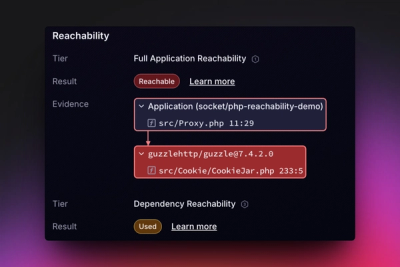
Reachability analysis for PHP is now available in experimental, helping teams identify which vulnerabilities are actually exploitable.