
Product
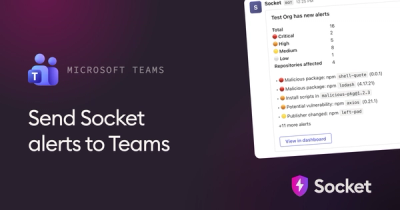
Microsoft Teams Notifications Are Now Available in Socket
Socket can now send alerts and supply chain attack notifications to Microsoft Teams, with filters that route the right updates to each channel.
By Jeppe Hasseriis - Sep 01, 2026
@nomarj/sigil
Advanced tools
Automated security auditing for AI agent code - quarantine-first scanning for pip, npm, git repos, and MCP servers
Automated security auditing for AI agent code
A protective mark for every line of code.
by NOMARK


Sigil scans repositories, packages, MCP servers, skills, and agent tooling for malicious patterns before they reach your working environment. Nothing runs until it's been scanned, scored, and explicitly approved.
The AI tooling ecosystem moves fast. Developers clone repos from tutorials, install MCP servers with 12 GitHub stars, and pull agent skills from Discord — all of which get direct access to API keys, databases, and cloud credentials. Traditional dependency scanners catch known CVEs but miss the real threat: intentionally malicious code designed to exfiltrate credentials, establish backdoors, or execute arbitrary commands via install hooks.
Sigil fills this gap with a quarantine-first approach.
Install via Script:
# Clone the repository
git clone https://github.com/NOMARJ/sigil.git
cd sigil
# Run the installer — downloads the prebuilt release binary for your
# platform and wires up the Claude Code integration by default
# (opt out with --no-integrations)
./install.sh
# Optional: add gclone/safepip/safenpm shell aliases
./install.sh --with-aliases
Package managers:
# Homebrew (macOS/Linux)
brew install nomarj/tap/sigil

# npm (macOS/Linux)
npm install -g @nomarj/sigil

# Cargo (Rust)
cargo install sigil-cli

# curl installer
curl -fsSLO https://www.sigilsec.ai/install.sh && sh install.sh
Coming Soon:
docker pull nomark/sigilNote: The
sigilpackage name on crates.io is occupied by an unrelated project. Install the Rust CLI withcargo install sigil-cli.
→ See all installation methods
┌──────────────┐     ┌──────────────┐     ┌──────────────┐
│  You run a   │────▶│  Sigil       │────▶│  Clean?      │
│  command     │     │  quarantines │     │  Approve.    │
│              │     │  & scans     │     │  Dirty?      │
│  gclone      │     │              │     │  Reject.     │
│  safepip     │     │  8 phases.   │     │              │
│  safenpm     │     │  <3 seconds. │     │  You decide. │
└──────────────┘     └──────────────┘     └──────────────┘
Sigil runs eight analysis phases on every scan (all free; LLM analysis requires Pro):
| Phase | What It Catches | Tier |
|---|---|---|
| Install Hooks | setup.py cmdclass, npm postinstall, Makefile targets that execute on install | Free |
| Code Patterns | eval(), exec(), pickle.loads, child_process, dynamic imports | Free |
| Network / Exfil | Outbound HTTP, webhooks, socket connections, DNS tunnelling | Free |
| Credentials | ENV var access, .aws, .kube, SSH keys, API key patterns | Free |
| Obfuscation | Base64 decode, charCode, hex encoding, minified payloads | Free |
| Provenance | Git history depth, author count, binary files, hidden files | Free |
| Prompt Injection | AI agent instruction injection in code, docs, and tool descriptions | Free |
| Skill Security | MCP permission escalation, over-broad agent tool grants | Free |
| 🔒 LLM Analysis | AI-powered zero-day detection, contextual threat correlation, advanced remediation | Pro |
Each finding is weighted and scored. You get a clear verdict:
| Score / Evidence | Verdict | What Happens |
|---|---|---|
| 0–9 | LOW RISK | No known malicious patterns detected |
| 10–24 | MEDIUM RISK | Suspicious patterns — review before approving |
| 25+ | HIGH RISK | Dangerous patterns — review carefully before use |
| Any single Critical-severity finding | CRITICAL RISK | Strong malicious indicators — regardless of score |
CRITICAL is evidence-gated, not score-based: a pile of medium/low heuristics can only ever reach HIGH RISK, but one Critical-severity finding forces a CRITICAL verdict.
# Clone a repo into quarantine, scan it, get a verdict
sigil clone https://github.com/someone/cool-mcp-server

# Download and scan a pip package before installing
sigil pip some-agent-toolkit

# Download and scan an npm package before installing
sigil npm langchain-community-plugin

# Scan a directory or file already on disk
sigil scan ./downloaded-skill/

# 🔒 Pro: Enhanced LLM-powered scanning (requires authentication)
sigil login                               # browser-based device authorization
sigil scan ./code --enhanced              # AI-powered threat detection
sigil scan ./code --enhanced --verbose    # With detailed output

# Download and scan any URL
sigil fetch https://example.com/agent-tool.tar.gz

# Manage quarantine
sigil list              # See all quarantined items
sigil approve abc123    # Mark trusted: pins the item's digest in the trust ledger
                        # (files stay at ~/.sigil/quarantine/<id>/ — copy them out yourself)
sigil reject abc123     # Permanently delete quarantined code

# Wire Sigil into your tooling
sigil setup claude      # Register the Claude Code plugin (marketplace + install)
sigil setup shell       # Add gclone/safepip/safenpm aliases to your shell rc
sigil setup git         # Install a pre-commit hook (sigil scan --fail-on high)
sigil setup all         # All of the above
Aliases are opt-in: run ./install.sh --with-aliases to append them to your shell rc. Use the commands you already know — Sigil protects you automatically:
| Alias | What It Does |
|---|---|
gclone <url> | git clone with quarantine + scan |
safepip <pkg> | pip install with scan first |
safenpm <pkg> | npm install with scan first |
safefetch <url> | Download + quarantine + scan |
audithere | Scan current directory |
qls | Quarantine status |
qapprove / qreject | Approve or reject most recent item |
Sigil works where you work. Install the plugin for your editor, or connect AI agents via MCP:
| Integration | Coverage | Install |
|---|---|---|
| VS Code / Cursor / Windsurf | Scan workspace, files, selections, packages. Findings in Problems panel. | plugins/vscode |
| JetBrains IDEs | IntelliJ, WebStorm, PyCharm, GoLand, CLion, etc. Tool window + inline annotations. | plugins/jetbrains |
| Claude Code Plugin | 6 skills + 2 security agents. Blocks unscanned installs/clones by default. | plugins/claude-code |
| Claude Code (MCP) | 9 tools: scan, scan_package, clone, quarantine, approve, reject, check_package, search_database, report_threat. | plugins/mcp-server |
| GitHub Actions | Run Sigil as a CI check on every PR. | action.yml |
Install as a native Claude Code plugin — enforcement, skills, agents, and the MCP server in one step:
# Add Sigil marketplace
claude plugin marketplace add NOMARJ/sigil

# Install the plugin
claude plugin install sigil-security@sigil-marketplace
This provides:
git clone, npm install <pkg>, and pip install <pkg> in Claude Code sessions, redirecting them through Sigil's quarantine (bypass per-command with SIGIL_BYPASS=1, tune with SIGIL_GUARD_MODE=enforce|advise|off)/sigil-security:scan-repo - Scan repositories/sigil-security:scan-package - Audit npm/pip packages/sigil-security:scan-file - Analyze specific files/sigil-security:review-quarantine - Manage findings/sigil-security:fix-finding - Propose fixes for scan findings/sigil-security:generate-policy - Generate sandbox policies from scan results@security-auditor - Expert threat analysis agent@quarantine-manager - Quarantine workflow agent→ See Claude Code plugin documentation
Any MCP-compatible client (Cursor, Windsurf, custom agents) can use Sigil's tools directly:
{
  "mcpServers": {
    "sigil": {
      "command": "npx",
      "args": ["-y", "@nomark/sigil-mcp-server"]
    }
  }
}
Note:
@nomark/sigil-mcp-serverv1.3.0 is not yet published to npm — thenpxconfig above will work once it is. Until then, build from source (cd plugins/mcp-server && npm install && npm run build) and point your MCP client atnode /path/to/sigil/plugins/mcp-server/dist/index.js.
When authenticated (sigil login), Sigil connects to a community-powered threat intelligence database. Every scan from every user contributes anonymised pattern data. When someone flags a malicious package, the threat signature propagates to all users within minutes.
What gets transmitted depends on how you use Sigil — see docs/data-handling.md for the exact per-tier breakdown:
sigil login): scan submissions include finding metadata (rule IDs, severities, file paths) and the flagged source lines (the code excerpts shown in your scan output). Full files are not uploaded.Offline mode: All eight scan phases run locally without authentication. Threat intelligence lookups are skipped, but you still get full local analysis.
# Authenticate to enable threat intel
sigil login
Learn more about authentication →
| Capability | Sigil | Aardvark/Codex | Claude Code | Snyk | Semgrep |
|---|---|---|---|---|---|
| Pre-install quarantine | ✅ | ❌ | ❌ | ❌ | ❌ |
| Supply-chain attacks | ✅ Primary | ⚠️ Limited | ⚠️ Limited | ⚠️ CVEs | ❌ |
| Install hook scanning | ✅ | ❌ | ❌ | ❌ | ❌ |
| Malware analysis | ⚠️ Patterns | ✅ Dedicated | ⚠️ Context | ❌ | ❌ |
| AI-powered analysis | ❌ | ✅ GPT-5 | ✅ Claude | ⚠️ Limited | ❌ |
| Deep vuln scanning | ⚠️ Patterns | ✅ 92% recall | ✅ Primary | ✅ | ✅ |
| Auto-patching | ❌ | ✅ Codex | ✅ AI patches | ⚠️ Limited | ❌ |
| AI agent / MCP focus | ✅ | ✅ | ✅ | ❌ | ❌ |
| Multi-ecosystem | ✅ All | ✅ | ✅ | ✅ | ✅ |
| Free tier | ✅ Full | Private beta | Waitlist | Limited | OSS |
The Complete Stack:
Positioning:
→ See complete integration guide
Snyk and Dependabot flag known CVEs — they don't scan for intentional malice. Socket.dev is npm-only. Semgrep is a pattern engine, not a workflow. The AI security stack (Sigil + Aardvark/Claude Code Security) provides defense-in-depth.
Sigil publishes its measured detection numbers, including the ones that
aren't flattering. Full method and results:
evaluation_results/honest_detection_eval.md.
Data Source: Datadog malicious-software-packages-dataset (real, human-triaged
             malicious npm/PyPI packages) + a 20-package clean control set of
             popular npm/PyPI packages fetched from the live registries.
Sample Size: 351 malicious samples; 20 clean control packages.
Limitations: Dataset has GuardDog selection bias (Datadog's own disclaimer).
             Offline static phases only. Small clean control set.
| Metric | Measured |
|---|---|
| Recall (malicious detected, any severity) | 96.87% |
| Recall at ≥ High | 90.31% |
| False-positive rate at ≥ High, clean packages, first scan | 70% |
FP rate after trust-ledger approval (sigil approve) | 0% |
| FP rate at ≥ High with Pro AI adjudication | 30% |
What this means in practice: the static phases deliberately over-trigger —
network calls, base64, and env access are dangerous in malware and routine in
legitimate code, and a first scan of a normal package will often come back
MEDIUM or HIGH. That is the designed workflow, not a bug: review the findings,
then sigil approve what you trust (drops its findings to zero on re-scan) or
use Pro's false-positive verification to have AI adjudicate them. Recall is
unaffected by ledger approvals (measured recall_delta = 0).
The CLI is free and open source with all eight scan phases. Sigil Pro turns your scanner into an AI security consultant.
| Open Source | Pro — $29/mo | Team — $99/mo | |
|---|---|---|---|
| Full CLI scanning | ✅ | ✅ | ✅ |
| 🤖 AI Finding Investigation | — | ✅ | ✅ |
| 🔍 False Positive Verification | — | ✅ | ✅ |
| 💬 Interactive Security Chat | — | ✅ | ✅ |
| ⚡ Smart Model Routing | — | ✅ | ✅ |
| Monthly AI credits | — | 5,000 | 50,000 |
| Monthly cloud scans | — | 500 | 5,000 |
| Cloud threat intelligence | — | ✅ | ✅ |
| Scan history | — | 90 days | 1 year |
| Web dashboard | — | ✅ | ✅ |
| Team management & policies | — | — | Up to 25 seats |
| CI/CD integration | — | — | ✅ |
| Slack / webhook alerts | — | — | ✅ |
Why upgrade? Transform cryptic security alerts into actionable intelligence. Instead of wondering "Is this real?", get AI-powered explanations, threat assessments, and verification in seconds.
Comprehensive documentation is available in the docs/ directory:
Getting Started:
Technical Deep Dives:
Integration Guides:
Security Research:
See ROADMAP.md for the full roadmap.
Today: Quarantine-first scanning for pip, npm, and git repos. Eight-phase behavioral detection. Cloud threat intelligence with community reporting and signature sync. Dashboard with scan history, team management, and policy controls. Rust CLI binary, VS Code / Cursor / Windsurf extension (.vsix), JetBrains plugin, MCP server for AI agents, and GitHub Actions integration.
Now: Hosted cloud — sign up and scan without running infrastructure.
Next: Docker image and Go/Cargo scanning. VS Code Marketplace and JetBrains Marketplace listings. Custom scan rules via YAML. Enterprise SSO, RBAC, and audit logs. GitLab, Jenkins, and CircleCI integrations.
We welcome contributions. See CONTRIBUTING.md for guidelines.
Found a vulnerability? Please report it responsibly. See SECURITY.md.
Apache 2.0 — see LICENSE for details.
SIGIL by NOMARK
A protective mark for every line of code.
FAQs
Automated security auditing for AI agent code - quarantine-first scanning for pip, npm, git repos, and MCP servers
The npm package @nomarj/sigil receives a total of 400 weekly downloads. As such, @nomarj/sigil popularity was classified as not popular.
We found that @nomarj/sigil demonstrated a healthy version release cadence and project activity because the last version was released less than a year ago. It has 1 open source maintainer collaborating on the project.
Product
Socket can now send alerts and supply chain attack notifications to Microsoft Teams, with filters that route the right updates to each channel.

Security News
pnpm 12 rewrites the package manager in Rust, cutting install times by up to 90% while preserving pnpm 11 workflows and lockfiles.

Security News
Socket CTO Ahmad Nassri joins AppSec leaders at Black Hat to discuss active malware, package manager risks, and software supply chain defense.