
Security News
The Code You Didn't Write Is Still Yours to Defend
AI agents are pulling packages into environments no scanner is watching, creating exposure before security teams can see it.
By Brad Arkin - Jun 23, 2026
@agent-pattern-labs/iso-ledger
Advanced tools
Deterministic append-only event ledger for AI-agent workflows: idempotent writes, local queries, verification, and materialized state views.
Append-only operational state for agent workflows.
state-trace is working memory. iso-trace is transcript observation.
iso-guard checks whether a run followed policy. iso-ledger is the
small deterministic layer for workflow truth: append validated events,
dedupe by idempotency key, query before side effects, verify the file,
and materialize a compact state view.
It is local-only, model-free, and MCP-free. The default storage format is
newline-delimited JSON at .iso-ledger/events.jsonl.
npm install -D @agent-pattern-labs/iso-ledger
iso-ledger init

iso-ledger append application.submitted \
  --key "url:https://example.test/jobs/123" \
  --subject "job:example:ai-engineer" \
  --idempotency-key "apply:https://example.test/jobs/123" \
  --data '{"status":"applied"}'

iso-ledger has --key "url:https://example.test/jobs/123"
iso-ledger query --type application.submitted --where status=applied
iso-ledger verify
iso-ledger materialize --out state.json
Every command accepts --ledger <events.jsonl>. append, query,
has, verify, and materialize also support --json.
{
  "id": "evt_apply_001",
  "type": "application.submitted",
  "at": "2026-04-26T00:10:00.000Z",
  "key": "url:https://example.test/jobs/123",
  "subject": "job:example:ai-engineer",
  "idempotencyKey": "apply:https://example.test/jobs/123",
  "data": {
    "status": "applied"
  },
  "meta": {
    "runId": "demo"
  }
}
Fields:
id uniquely identifies one event. If omitted, iso-ledger derives it.type names the event, usually domain.verb.at is an ISO timestamp. If omitted on append, current time is used.key is a lookup key such as a URL, company+role, or external id.subject is the entity being materialized.idempotencyKey prevents duplicate appends for the same side effect.data is domain state.meta is provenance such as run id, source, or tool.import { appendEvent, hasEvent, queryEvents, readLedger } from "@agent-pattern-labs/iso-ledger";
await appendEvent({ dir: process.cwd() }, {
type: "application.submitted",
key: "url:https://example.test/jobs/123",
subject: "job:example:ai-engineer",
idempotencyKey: "apply:https://example.test/jobs/123",
data: { status: "applied" },
});
const events = readLedger({ dir: process.cwd() });
if (hasEvent(events, { key: "url:https://example.test/jobs/123" })) {
// skip duplicate side effect
}
The API is synchronous on purpose. Ledger files are small operational state files, and synchronous local reads make shell/CLI adapters simple.
iso-orchestrator controls durable workflow execution.iso-ledger records canonical domain events and idempotency keys.iso-trace observes harness transcripts.iso-guard audits policy over trace or ledger-derived events.For JobForge, the future adapter can record scan/application/tracker events here, then materialize markdown/TSV views as compatibility output.
FAQs
Deterministic append-only event ledger for AI-agent workflows: idempotent writes, local queries, verification, and materialized state views.
We found that @agent-pattern-labs/iso-ledger demonstrated a healthy version release cadence and project activity because the last version was released less than a year ago. It has 1 open source maintainer collaborating on the project.
Did you know?

Socket for GitHub automatically highlights issues in each pull request and monitors the health of all your open source dependencies. Discover the contents of your packages and block harmful activity before you install or update your dependencies.
Security News
AI agents are pulling packages into environments no scanner is watching, creating exposure before security teams can see it.

Security News
GitHub Actions checkout now blocks risky pull_request_target checkouts by default to help prevent pwn request supply chain attacks.
Product
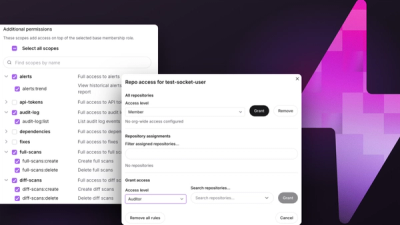
Socket now supports Custom Roles and Repository Access Permissions so organizations can control who can access specific repositories and actions.