


Company News
AWS Security Hub Adds Socket for Supply Chain Security
Socket is now in the AWS Security Hub Extended plan. Adopt it through AWS, apply committed spend, and block malicious open source packages.
By Feross Aboukhadijeh - Aug 04, 2026
@argosvix/mcp-server
Advanced tools
Observability MCP server for AI agents: 89 tools (2 usable with no API key) to query and operate LLM cost, errors, latency, alerts, budgets, evals, prompts, approvals, and safety checks from Claude Desktop, Cursor, or any MCP client. stdio + HTTP transpor
Argosvix MCP server lets AI agents (Claude Desktop, Cursor, Codex CLI, custom MCP clients) query, manage, and operate their LLM observability data directly from the conversation. Supports both stdio (subprocess) and HTTP (remote / self-host) transports.
Surface: 89 tools (86 generally available + 3 internal operations tools that return 403 for customer accounts) / 3 resources / 8 resource templates / 3 prompts. Health and anomaly endpoints (get_account_health / detect_anomaly / propose_alert_rules / classify_calls_batch / propose_eval_criteria) plus a runtime control plane (budget gates / policy gates / human-approval gates) let an agent both observe and act. Release history is available on npm.


You're already sending LLM calls through @argosvix/sdk or the Python SDK. Now ask Claude / Cursor questions like:
No dashboard tab-switching. The agent fetches the data via this MCP server using your Argosvix API key.
One-click (starts keyless; set ARGOSVIX_API_KEY afterwards to use the tools for your own account):

Claude Code users can install the argosvix plugin instead — it bundles this server plus setup skills:
/plugin marketplace add argosvix/claude-plugin
/plugin install argosvix@argosvix
/reload-plugins
Manual:
npm install -g @argosvix/mcp-server
Edit your Claude Desktop config:
~/Library/Application Support/Claude/claude_desktop_config.json%APPDATA%\Claude\claude_desktop_config.json{
"mcpServers": {
"argosvix": {
"command": "argosvix-mcp",
"env": {
"ARGOSVIX_API_KEY": "argk_..."
}
}
}
}
Restart Claude Desktop. All 89 tools appear under the argosvix__ prefix (e.g. argosvix__query_calls, argosvix__get_account_health, argosvix__create_budget_gate).
No API key yet? The server also starts without
ARGOSVIX_API_KEYin introspection-only mode: all 89 tools are listed so you can evaluate the surface, and two public data tools (get_synth_daily/get_daily_readthrough— Argosvix's own daily AI digest and OSS readthrough) work with no key at all. Every other tool call returns instructions for getting a key at https://dashboard.argosvix.com/api-keys.Notes on the public data tools: they are part of the default
fullprofile only (not inARGOSVIX_MCP_PROFILE=core), and like every other tool they honorARGOSVIX_API_BASE— if you point the server at a different base, they fetch/v1/synth-daily//v1/readthroughfrom that base without authentication.
Edit ~/.cursor/mcp.json:
{
  "mcpServers": {
    "argosvix": {
      "command": "argosvix-mcp",
      "env": {
        "ARGOSVIX_API_KEY": "argk_..."
      }
    }
  }
}
ARGOSVIX_MCP_PROFILE)The default profile is full (all 89 tools). If your MCP client's context budget is tight, set ARGOSVIX_MCP_PROFILE=core to expose only the 11 essentials for day-to-day operations:
query_calls · aggregate_calls · get_cost_summary · get_percentiles · get_account_health · detect_anomaly · list_alerts · create_alert · silence_alert · unsilence_alert · get_deployed_prompt
{
  "mcpServers": {
    "argosvix": {
      "command": "argosvix-mcp",
      "env": {
        "ARGOSVIX_API_KEY": "argk_...",
        "ARGOSVIX_MCP_PROFILE": "core"
      }
    }
  }
}
Works in both stdio and HTTP transports. Unknown values fall back to full with a warning on stderr.
ARGOSVIX_MCP_LANG)Tool, resource, and prompt descriptions returned by tools/list / resources/list /
prompts/list are in English by default. Set ARGOSVIX_MCP_LANG=ja to get the original
Japanese descriptions instead. Unset or unknown values fall back to en (with a warning
on stderr for unknown values). Tool names, input schemas, and behavior are identical in
both languages — only the human/agent-facing description text changes.
{
  "mcpServers": {
    "argosvix": {
      "command": "argosvix-mcp",
      "env": {
        "ARGOSVIX_API_KEY": "argk_...",
        "ARGOSVIX_MCP_LANG": "ja"
      }
    }
  }
}
Works in both stdio and HTTP transports.
89 tools in total — the full list is returned by tools/list. A sample of the core read / write surface:
| Tool | Purpose | Type |
|---|---|---|
query_calls | Recent LLM call records, filterable by provider / model / time range | read |
get_cost_summary | Aggregate cost / calls / tokens by provider or model | read |
list_alerts | Configured alerts + recent trigger status | read |
get_alert | Detail of a specific alert + recent trigger history | read |
list_alert_events | Alert trigger events across the account (notification history) | read |
silence_alert | Mute a specific alert (= temporary notification stop, default 24h) | write |
unsilence_alert | Resume notifications for a previously muted alert | write |
create_alert | Create a new alert rule (cost / error rate / latency / anomaly) | write |
acknowledge_alert | Mark a specific alert event as acknowledged (idempotent, orthogonal to silence) | write |
Resources expose read-only snapshots that AI agents can pull into context without an explicit tool call.
| URI | Purpose |
|---|---|
argosvix://account | Plan / quota / current-month record usage / retention snapshot (non-sensitive, Bearer-only) |
argosvix://alerts/active | Snapshot of currently enabled alerts |
argosvix://cost/today | Last-24h cost breakdown by provider (with response.total) |
Resource templates let agents construct dynamic URIs from a known id. The server enforces account scope via PK lookup on the backend, so cross-account ids return 404.
| URI template | Purpose |
|---|---|
argosvix://calls/{id} | Single LLM call record (provider / model / tokens / cost / latency / tags / error / trace_id). Plug in any id from query_calls results. |
argosvix://alerts/{id} | Single alert rule (name / type / threshold / window / channelKinds / sleep / enabled / silencedUntil) + recent 20 trigger events. Plug in any id from list_alerts results. channelTargets (notification destinations) is structurally dropped. |
argosvix://traces/{id} | Single trace = all spans grouped by trace_id (LLM call time-series). Top 50 spans only (LLM context budget cap); errorDetails / requestMeta are structurally dropped. Plug in any traceId from query_calls results. |
Prompts are reusable templates the user can launch as slash commands.
| Name | Purpose |
|---|---|
cost_review | Compare 24h / 7d / 30d cost trends and flag anomalies |
alert_audit | Audit current alert rules and propose improvements |
incident_triage | Investigate recent error / latency anomalies (default last 24h) |
resources.subscribe capability is declared in stdio mode. Clients can subscribe to one or more of the static resources below; the server polls each subscribed resource every 60 seconds and emits notifications/resources/updated when the content hash changes.
Subscribable URIs (resource templates such as argosvix://calls/{id} are not subscribable):
argosvix://accountargosvix://alerts/activeargosvix://cost/todayHTTP transport (= argosvix-mcp --http) does not declare subscribe and rejects subscribe requests, since per-request stateless mode cannot keep a subscription set or deliver server-initiated notifications. Use stdio for live updates.
listChanged is intentionally not declared: the resource list is fixed for the server lifetime.
Implementation notes (v0.10):
readResource calls).isShuttingDown flag, so notifications are not emitted for URIs removed mid-cycle.ARGOSVIX_MCP_DEBUG=1 the server logs { uri, errorClass } to stderr — error messages are intentionally not logged to avoid leaking upstream payload text.McpError(InvalidParams) + axis 4 Tier 1 dispatcher coverage).The MCP server sends queries to https://ingest.argosvix.com using your API key. No prompts or completions are exposed — only metadata (tokens, cost, latency, model name, your tags).
npm install
npm run build
npm test
MIT © Yuto Makihara (Argosvix). See LICENSE.
The server can also run as a remote MCP endpoint over HTTP, suitable for self-hosting or multi-tenant scenarios where API key is supplied per request.
# Start HTTP transport (default: 127.0.0.1:3000)
argosvix-mcp --http

# Bind to all interfaces with custom port + allowed Host headers
MCP_HTTP_HOST=0.0.0.0 \
MCP_HTTP_PORT=4000 \
MCP_HTTP_ALLOWED_HOSTS="mcp.example.com,localhost:4000" \
  argosvix-mcp --http
GET /health → 200 OK with server name/version (no auth)POST /mcp → MCP JSON-RPC endpoint (auth required)curl -X POST http://localhost:3000/mcp \
-H "Authorization: Bearer argk_..." \
-H "Content-Type: application/json" \
-H "Accept: application/json, text/event-stream" \
-d '{
"jsonrpc": "2.0",
"id": 1,
"method": "tools/list",
"params": {}
}'
Each request must include Authorization: Bearer <api-key> with a valid
Argosvix API key (issue at https://dashboard.argosvix.com/api-keys). The
server uses stateless mode (no session ID), so each request is independent
and may carry a different key.
127.0.0.1 (localhost only). Use MCP_HTTP_HOST=0.0.0.0
to expose externally, but pair with a reverse proxy + TLS in production.Host header against a known-localhost allow list. Use
MCP_HTTP_ALLOWED_HOSTS (comma-separated) when binding non-locally.Backend error response bodies are not logged by default to keep production log aggregators free of backend-internal payloads. To enable raw body logging for a debugging session:
ARGOSVIX_MCP_DEBUG=1 argosvix-mcp           # stdio mode
ARGOSVIX_MCP_DEBUG=1 argosvix-mcp --http    # HTTP mode
Without the env var, error logs only include path, status, and x-request-id.
FAQs
Observability MCP server for AI agents: 89 tools (2 usable with no API key) to query and operate LLM cost, errors, latency, alerts, budgets, evals, prompts, approvals, and safety checks from Claude Desktop, Cursor, or any MCP client. stdio + HTTP transpor
The npm package @argosvix/mcp-server receives a total of 484 weekly downloads. As such, @argosvix/mcp-server popularity was classified as not popular.
We found that @argosvix/mcp-server demonstrated a healthy version release cadence and project activity because the last version was released less than a year ago. It has 1 open source maintainer collaborating on the project.
Did you know?

Socket for GitHub automatically highlights issues in each pull request and monitors the health of all your open source dependencies. Discover the contents of your packages and block harmful activity before you install or update your dependencies.
Company News
Socket is now in the AWS Security Hub Extended plan. Adopt it through AWS, apply committed spend, and block malicious open source packages.
Research
/Security News
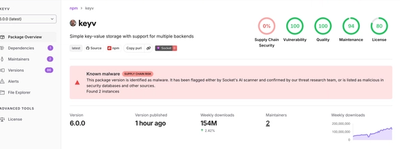
Popular npm packages keyv and cacheable compromised.

Security News
A misconfiguration gave three Anthropic models internet access, and one, believing it was in a simulation, shipped a credential-stealing package to PyPI.