

Company News
AWS Security Hub Adds Socket for Supply Chain Security
Socket is now in the AWS Security Hub Extended plan. Adopt it through AWS, apply committed spend, and block malicious open source packages.
By Feross Aboukhadijeh - Aug 04, 2026
@attest-dev/mcp-server
Advanced tools
A stdio MCP server for Attest that exposes credential, approval, audit, and evidence tools
Attest MCP Server for the Model Context Protocol.
This is a real stdio MCP server built with @modelcontextprotocol/sdk.
Agent hosts like Claude Desktop, Cursor, or Windsurf can connect to it and call Attest tools over MCP.
It currently exposes MCP tools for:
It currently defines:
Run it from npm:
npx -y @attest-dev/mcp-server
Required environment variables:
ATTEST_API_KEY: Attest org API keyATTEST_BASE_URL: optional, defaults to https://api.attestdev.comExample MCP config:
{
  "mcpServers": {
    "attest": {
      "command": "npx",
      "args": ["-y", "@attest-dev/mcp-server"],
      "env": {
        "ATTEST_API_KEY": "attest_live_xxx",
        "ATTEST_BASE_URL": "https://api.attestdev.com"
      }
    }
  }
}
If you are reviewing this repository for MCP support, the server lives here:
The tool implementations live in:
The server is built with the MCP SDK and registers real MCP tools before connecting to a stdio transport:
import { McpServer } from "@modelcontextprotocol/sdk/server/mcp.js";
import { StdioServerTransport } from "@modelcontextprotocol/sdk/server/stdio.js";
import { AttestClient } from "@attest-dev/sdk";

const client = new AttestClient({ baseUrl, apiKey });
const server = new McpServer({ name: "attest", version: "0.1.0" });

registerCredentialTools(server, client, baseUrl);
registerTaskTools(server, client);
registerReportingTools(server, client);
registerApprovalTools(server, client);

await server.connect(new StdioServerTransport());
That implementation is in src/index.ts.
Use this server when your agents do more than answer questions.
Once an agent can send email, touch CRM, update tickets, call internal APIs, or hand work to other agents, you usually need more than an API key and a log line. You need to know:
Attest gives you that control and evidence layer. This MCP server makes those operations available inside MCP-native workflows.
Imagine a support operations assistant handling a refund request.
The top-level orchestrator receives a request like:
Refund the customer, update the billing system, and send a confirmation email.
Without Attest, the orchestrator often runs with broad access and child agents inherit too much of it. If the orchestrator is compromised, every downstream agent can keep acting with no clean chain of authority.
With Attest, the workflow looks like this:
issue_credential for the root task with scopes like
billing:write and email:send.delegate_credential with only billing:write.email:send.request_approval and wait for
a human to grant_approval before the refund goes through.report_action or report_status.list_tasks, get_audit_trail, and
get_evidence to reconstruct exactly what happened.revoke_credential cascades the
revoke through the whole task tree.That is the practical shape of Attest:
Credentials:
issue_credentialdelegate_credentialrevoke_credentialverify_credentialcheck_revocationTasks and evidence:
list_tasksget_audit_trailget_evidenceAudit reporting:
report_actionreport_statusApprovals:
request_approvalget_approvalgrant_approvaldeny_approvalIssue a root credential:
{
  "agent_id": "support-orchestrator",
  "user_id": "usr_123",
  "scope": ["billing:write", "email:send"],
  "instruction": "Refund the customer, update billing, and send confirmation."
}
Delegate to a billing sub-agent:
{
  "parent_token": "<root jwt>",
  "child_agent": "billing-agent",
  "child_scope": ["billing:write"]
}
List recent active tasks for a user:
{
  "user_id": "usr_123",
  "status": "active",
  "limit": 10
}
Fetch evidence for a finished task:
{
  "task_id": "tid_abc123"
}
From this package directory:
npm install
npm run typecheck
npm run build
Run locally:
ATTEST_API_KEY=attest_live_xxx npm exec -- attest-mcp-server
FAQs
A stdio MCP server for Attest that exposes credential, approval, audit, and evidence tools
We found that @attest-dev/mcp-server demonstrated a healthy version release cadence and project activity because the last version was released less than a year ago. It has 1 open source maintainer collaborating on the project.
Did you know?

Socket for GitHub automatically highlights issues in each pull request and monitors the health of all your open source dependencies. Discover the contents of your packages and block harmful activity before you install or update your dependencies.
Company News
Socket is now in the AWS Security Hub Extended plan. Adopt it through AWS, apply committed spend, and block malicious open source packages.
Research
/Security News
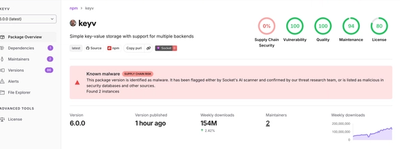
Popular npm packages keyv and cacheable compromised.

Security News
A misconfiguration gave three Anthropic models internet access, and one, believing it was in a simulation, shipped a credential-stealing package to PyPI.