

Company News
AWS Security Hub Adds Socket for Supply Chain Security
Socket is now in the AWS Security Hub Extended plan. Adopt it through AWS, apply committed spend, and block malicious open source packages.
By Feross Aboukhadijeh - Aug 04, 2026
@attrove/mcp
Advanced tools
Catch conversations going quiet — watch outcomes and search Gmail, Slack, and meetings. One MCP.
Catch the conversations going quiet. Attrove watches work across Gmail, Slack, Outlook, Google Calendar, and meetings — watched outcomes (Goals) flag silence and risk with cited evidence, and one MCP gives your AI client search and answers over the same stream. Works in Codex, Claude Code, Cursor, Claude Desktop, and ChatGPT.
npm install @attrove/mcp
# or
yarn add @attrove/mcp
# or
pnpm add @attrove/mcp
Use the CLI as the install layer for hosted OAuth MCP:
npx @attrove/cli install claude-code
That writes a remote MCP config pointed at https://api.attrove.com/mcp, lets Codex, Claude Code, Cursor, and Claude Desktop discover OAuth, and avoids embedding sk_ secrets directly into client config files.
Other hosted install commands:
npx @attrove/cli install cursor
npx @attrove/cli install claude-desktop
npx @attrove/cli install codex
Claude Code defaults to project scope (.mcp.json). Cursor, Claude Desktop, and Codex default to user scope.
Use the CLI to add the hosted MCP endpoint to ~/.codex/config.toml:
npx @attrove/cli install codex
Then complete OAuth:
codex mcp login attrove
Codex uses a local loopback callback during OAuth, then stores credentials in the configured Codex credential store.
After restarting Codex or reloading tool discovery, verify that the raw hosted server exposes tools such as attrove_notes, attrove_create_goal, and attrove_list_goals. If you only see mcp__codex_apps__attrove tools, you are seeing the OpenAI Apps connector named Attrove, not the raw hosted MCP server.
After OAuth completes in your AI client, ask:
"Use Attrove to list my connected integrations."
You should see at least one connected source such as Gmail, Slack, Outlook, Google Calendar, Google Meet, or Teams. Then ask:
"What needs my attention this week? Include the source messages or meetings you used."
That second prompt is the activation check: it should return an answer grounded in your connected context, not just confirm that the MCP server is installed.
Use the local stdio server only if you explicitly want local credential-backed MCP:
npx @attrove/cli login
npx @attrove/cli local install claude-code
npx @attrove/cli connect gmail
Claude Desktop supports two transport options:
HTTP transport (recommended) — uses OAuth discovery, no API key copy/paste needed:
{
  "mcpServers": {
    "attrove": {
      "type": "streamable-http",
      "url": "https://api.attrove.com/mcp"
    }
  }
}
Prefer npx @attrove/cli install claude-desktop to write this for you.
Legacy stdio transport — use only if you explicitly want local env-based auth:
{
  "mcpServers": {
    "attrove": {
      "command": "npx",
      "args": ["-y", "@attrove/mcp@latest"],
      "env": {
        "ATTROVE_SECRET_KEY": "sk_...",
        "ATTROVE_USER_ID": "user-uuid"
      }
    }
  }
}
Preferred hosted install:
npx @attrove/cli install cursor
Or use Cursor's install URL from a partner-issued connect session. Manual remote config also works:
{
  "mcpServers": {
    "attrove": {
      "type": "http",
      "url": "https://api.attrove.com/mcp"
    }
  }
}
On first use, Cursor discovers OAuth via .well-known/oauth-protected-resource and sends the user through the Attrove connect flow automatically.
Preferred hosted install:
npx @attrove/cli install claude-code
If you are onboarding a provisioned end user from a terminal or agent, use the durable connect-session handoff:
npx @attrove/cli connect --session <session-id>
Advanced local fallback is still supported:
npx @attrove/cli login
npx @attrove/cli local install claude-code
ChatGPT and other AI assistants that support MCP connectors can connect via the hosted HTTP endpoint.
ChatGPT's MCP install UX is still evolving. Treat it as a fallback path behind Codex, Claude Code, Cursor, and Claude Desktop.
Basic requirement: add https://api.attrove.com/mcp as a remote MCP server. OAuth-capable clients should discover the authorization flow automatically.
Example setup steps (may vary):
Attrovehttps://api.attrove.com/mcpOnce connected, you can ask ChatGPT questions like:
npx @attrove/cli install claude-code
npx @attrove/cli install codex

# advanced local fallback:
npx @attrove/cli login
npx @attrove/cli local install claude-code
npx @attrove/cli connect gmail

# or manual env injection:
ATTROVE_SECRET_KEY=sk_... ATTROVE_USER_ID=user-uuid npx @attrove/mcp
Once connected, you can ask your AI assistant natural language questions. Here are some examples:
Outcome watching:
"Watch the Acme renewal until it closes — flag it if the thread goes quiet for 5 days"
Needs attention:
"Which of my watched outcomes are at risk right now, and what's the evidence?"
Meeting prep:
"What context do I need for my 2pm meeting with the marketing team?"
Email follow-ups:
"Are there any emails from last week that I haven't responded to?"
Project status:
"What's the latest on the Q4 roadmap discussions?"
People search:
"What has John from Acme Corp been asking about recently?"
Historical context:
"Find the thread where we discussed the pricing changes last month"
Goals are how Attrove catches work going quiet: define the outcome once, and the evaluator keeps checking the communication stream, updating health with cited evidence. Seven tools cover the loop:
attrove_create_goal — create a goal with a watch scope (entity_ids, seed_query, or keywords), optional success criteria, deadline, and a silence_condition that flags the goal when its conversations go quiet too longattrove_list_goals — list goals, optionally filtered by lifecycle or health (health=at_risk surfaces what needs attention)attrove_get_goal_status — get a goal with its latest status snapshot (health, risk signals, cited evidence, suggested next actions) and evaluator runattrove_evaluate_goal — queue a fresh evaluator run for an active goalattrove_add_goal_note — attach a manual note to a goal as evidenceattrove_confirm_goal_status — manually confirm or override lifecycle/health with a reason (lifecycle never changes autonomously)attrove_goal_events — tail goal lifecycle transitions with cursor pagination and a composite watermarkExample prompts:
attrove_queryAsk questions about the user's communications and get AI-generated answers.
Parameters:
query (required): The question to askintegration_ids (optional): Filter to specific integration IDs (array of UUID strings)include_sources (optional): Include source snippets in the responseinstructions (optional): Custom instructions for the AI — controls output format, filtering, and behavior. Takes priority over default style. Max 20,000 charscontext (optional): Authoritative reference data for answer generation. Treated as ground truth by the AI. Influences query rewriting but not used for vector search. Max 20,000 charsExample prompts:
attrove_searchSearch for specific messages or conversations.
Parameters:
query (required): The search queryafter_date (optional): Only messages after this date (YYYY-MM-DD)before_date (optional): Only messages before this date (YYYY-MM-DD)sender_domains (optional): Filter by sender domainsinclude_body_text (optional): Include message content in results (default: true, bodies truncated to 1000 characters)Example prompts:
attrove_integrationsList the user's connected integrations.
Parameters: None
Example prompts:
attrove_eventsList calendar events from the user's connected calendar accounts.
Parameters:
start_date (optional): Start of date range (YYYY-MM-DD)end_date (optional): End of date range (YYYY-MM-DD)limit (optional): Max events to return (default 25, max 100)Example prompts:
attrove_meetingsList meetings with AI-generated summaries and action items.
Parameters:
start_date (optional): Start of date range (YYYY-MM-DD)end_date (optional): End of date range (YYYY-MM-DD)provider (optional): Filter by meeting provider (google_meet, zoom, teams, manual_meetings)limit (optional): Max meetings to return (default 10, max 50)Example prompts:
attrove_notesList notes — analyst observations, partner-pushed context, and session summaries that have been RAG-indexed into the user's context.
Parameters:
ref_type (optional): Filter by reference type (message, meeting, event, entity, goal)ref_id (optional): Filter by referenced item ID (e.g. msg_xxx, mtg_xxx, gol_xxx). Must be provided together with ref_type.limit (optional): Max notes to return (default 20, max 100)Example prompts:
attrove_push_noteSave a note to the user's Attrove context. Notes are RAG-indexed and become queryable via attrove_query and attrove_search, enabling AI assistants to capture decisions and session context that persists across conversations.
Parameters:
body (required): Note content (server-enforced max 10,000 characters)title (optional): Short title for the noteref_type (optional): Link to an existing item type (message, meeting, event, entity, goal). Must be provided together with ref_id.ref_id (optional): ID of the item to link (e.g. msg_xxx, mtg_xxx, evt_xxx, ent_xxx, gol_xxx)external_id (optional): Dedup key. Re-pushing with the same external_id updates the existing note instead of creating a new one.Example prompts:
attrove_push_meetingSave a meeting transcript or summary to the user's Attrove context. Use this when another meeting MCP (Otter, Read.ai, Fireflies, Fathom) or a user-shared transcript (Granola export, voice memo, manual notes) has meeting content that should become queryable alongside Gmail, Slack, calendar, and native meeting data.
Parameters:
title (required): Meeting titlestart_time (required): ISO 8601 datetime with UTC Z or a numeric offset (for example, 2026-05-26T12:00:00-07:00)end_time (required): ISO 8601 datetime with UTC Z or a numeric offset (for example, 2026-05-26T12:25:00-07:00)transcript (optional): Full meeting transcriptsummary (optional): Detailed summaryshort_summary (optional): 1-3 sentence summaryattendees (optional): Attendee objects with name and optional emailaction_items (optional): Action item objects with text and optional assigneeexternal_id (optional): Dedup key. Re-pushing with the same external_id updates the existing meeting.Example prompts:
attrove_delete_meetingReversibly archive a pushed meeting from the user's Attrove context. The meeting is hidden from attrove_meetings, attrove_search, and attrove_query, and can be restored by re-pushing the same external_id.
Parameters:
id (optional): Opaque meeting ID (mtg_xxx)external_id (optional): External ID used when the meeting was pushedProvide exactly one of id or external_id.
Example prompts:
attrove_delete_noteReversibly archive a note from the user's Attrove context. The note is hidden from attrove_notes, attrove_search, and attrove_query, and can be restored by re-pushing the same external_id.
Parameters:
id (optional): Opaque note ID (note_xxx)external_id (optional): External ID used when the note was pushedProvide exactly one of id or external_id.
Example prompts:
These are only required for stdio / manual installs. Remote HTTP MCP installs do not need them.
| Variable | Required | Description |
|---|---|---|
ATTROVE_SECRET_KEY | Yes | Your Attrove secret key (sk_...) |
ATTROVE_USER_ID | Yes | User ID to scope API calls |
ATTROVE_BASE_URL | No | Custom API base URL |
ATTROVE_DEBUG | No | Set to true for verbose error logging |
You can also use the server programmatically:
import { createServer, startServer } from '@attrove/mcp';

// Create a server instance
const server = createServer({
  apiKey: 'sk_...',
  userId: 'user-uuid'
});

// Or start directly with stdio transport
await startServer({
  apiKey: 'sk_...',
  userId: 'user-uuid'
});
For AI assistants that connect via HTTP, prefer adding the hosted endpoint directly and letting the client discover OAuth:
https://api.attrove.com/mcphttps://api.attrove.com/.well-known/oauth-protected-resourceManual curl testing can still use bearer auth:
# Test the endpoint
curl -X POST https://api.attrove.com/mcp \
  -H "Authorization: Bearer sk_..." \
  -H "X-Attrove-User-Id: user-uuid" \
  -H "Content-Type: application/json" \
  -d '{"jsonrpc":"2.0","method":"tools/list","id":1}'
Or integrate in your own server using the HTTP handler:
import { createHttpHandler } from '@attrove/mcp';

const handler = createHttpHandler(
  {
    apiKey: 'sk_...',
    userId: 'user-uuid',
    baseUrl: 'https://api.attrove.com', // optional: custom API endpoint
  },
  {
    enableJsonResponse: true, // optional: use JSON instead of SSE (default: true)
    timeoutMs: 30000, // optional: request timeout in ms (default: 30000)
  }
);

// With Fastify (recommended)
fastify.post('/mcp', async (request, reply) => {
  const result = await handler.handleRequest(request.raw, reply.raw, request.body);

  if (!result.handled) {
    // Handle timeout with 504, other errors with 500
    const statusCode = result.isTimeout ? 504 : 500;
    const userMessage = result.isTimeout
      ? 'Request timed out. Try a simpler query or reduce the scope.'
      : 'An unexpected error occurred. Please try again.';

    // Only send response if headers haven't been sent (e.g., during streaming)
    if (!reply.raw.headersSent) {
      reply.code(statusCode).send({
        success: false,
        error: { code: result.isTimeout ? 'REQUEST_TIMEOUT' : 'INTERNAL_ERROR', message: userMessage }
      });
    } else if (!reply.raw.writableEnded) {
      reply.raw.end(); // Ensure stream is closed
    }
    return;
  }

  // Optional: monitor cleanup failures for resource leak detection
  if (result.cleanupFailed) {
    console.warn('MCP cleanup failed - potential resource leak');
  }
});

// With raw Node.js HTTP server
import { createServer } from 'node:http';
const server = createServer(async (req, res) => {
  // Note: You'll need to parse the body yourself for raw HTTP
  const result = await handler.handleRequest(req, res);
  if (!result.handled) {
    res.writeHead(500, { 'Content-Type': 'application/json' });
    res.end(JSON.stringify({ error: result.error }));
  }
});
sk_...)import { Attrove } from '@attrove/sdk';
const admin = Attrove.admin({
clientId: 'your-client-id',
clientSecret: 'your-client-secret'
});
// Create a user
const { id, apiKey } = await admin.users.create({
email: 'user@example.com'
});
// Use `apiKey` as ATTROVE_SECRET_KEY and `id` as ATTROVE_USER_ID
Make sure you've set the environment variables correctly in your MCP configuration.
Set ATTROVE_DEBUG=true to enable verbose error logging with stack traces:
{
  "mcpServers": {
    "attrove": {
      "command": "npx",
      "args": ["-y", "@attrove/mcp@latest"],
      "env": {
        "ATTROVE_SECRET_KEY": "sk_...",
        "ATTROVE_USER_ID": "user-uuid",
        "ATTROVE_DEBUG": "true"
      }
    }
  }
}
The Attrove API has rate limits. If you're making many requests, you may need to wait before trying again.
For AI assistants and code generation tools, Attrove provides machine-readable documentation:
https://attrove.com/llms.txt - Condensed API reference for LLMshttps://github.com/attrove/examples - Example code with CLAUDE.md contextMIT
FAQs
Catch conversations going quiet — watch outcomes and search Gmail, Slack, and meetings. One MCP.
The npm package @attrove/mcp receives a total of 146 weekly downloads. As such, @attrove/mcp popularity was classified as not popular.
We found that @attrove/mcp demonstrated a healthy version release cadence and project activity because the last version was released less than a year ago. It has 1 open source maintainer collaborating on the project.
Did you know?

Socket for GitHub automatically highlights issues in each pull request and monitors the health of all your open source dependencies. Discover the contents of your packages and block harmful activity before you install or update your dependencies.
Company News
Socket is now in the AWS Security Hub Extended plan. Adopt it through AWS, apply committed spend, and block malicious open source packages.
Research
/Security News
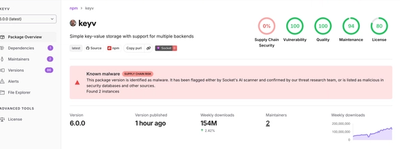
Popular npm packages keyv and cacheable compromised.

Security News
A misconfiguration gave three Anthropic models internet access, and one, believing it was in a simulation, shipped a credential-stealing package to PyPI.