
Product
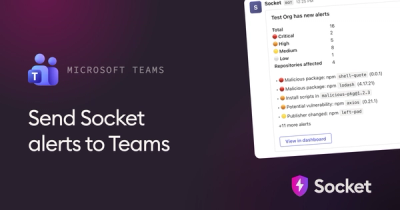
Microsoft Teams Notifications Are Now Available in Socket
Socket can now send alerts and supply chain attack notifications to Microsoft Teams, with filters that route the right updates to each channel.
By Jeppe Hasseriis - Sep 01, 2026
@beyondnet/evolith-cli
Advanced tools
Evolith CLI - Governance, standards validation, and AI agent integration for satellite repositories
Command-line interface for Evolith — governance, standards validation, architecture scaffolding, SDLC lifecycle management, and AI agent integration.
SmartCLI is the primary entry point to the Evolith ecosystem. It connects three layers:
satellite repository
│
▼
evolith-cli ──────── evolith.yaml (configuration)
│
├── Evolith Core (rulesets, ADRs, standards, gate evidence)
│
└── MCP Server ──── AI Agents (Cursor, Claude Desktop, custom)
Evolith Core defines 8 architecture topologies across complementary dimensions. Any command that accepts --topology references them by their canonical id:
| Topology (id) | Name | Dimension |
|---|---|---|
modular-monolith | Modular Monolith | progressive-axis |
distributed-modules | Distributed Modules | progressive-axis |
microservices | Microservices | progressive-axis |
serverless | Serverless | execution |
edge-computing | Edge Computing | execution |
event-driven | Event-Driven | integration |
data-mesh | Data Mesh | data |
agentic-ai | Agentic AI | ai |
The progressive axis (modular-monolith → distributed-modules → microservices) is a linear maturity progression managed by the upgrade command. The other dimensions (execution, integration, data, ai) are complementary and chosen per project needs. Use --topology <id> with the canonical ids above.
npm install -g @beyondnet/evolith-cli
pnpm add -g @beyondnet/evolith-cli
yarn global add @beyondnet/evolith-cli
Or download the binary from GitHub Releases and add it to your PATH.
The package installs two equivalent bins: evolith (the documented name, used
throughout this document) and evolith-cli (kept for compatibility). Both point at
the same entry point and both self-identify as evolith in help and usage text.
evolith --version        # prints the installed @beyondnet/evolith-cli version
evolith --help           # Usage: evolith [options] [command]
evolith-cli --version    # the same binary under its legacy name
EACCES on macOS/Linux:
sudo npm install -g @beyondnet/evolith-cli --unsafe-perm
nvm — binary not found after install:
export PATH=$(npm config get prefix)/bin:$PATH
WORKSPACE_ROOT (optional): the CLI ships a built-in default SDLC workflow, so it runs without any environment setup. Set WORKSPACE_ROOT to a checkout root only when you want to override the workflow/rulesets from disk ($WORKSPACE_ROOT/rulesets/sdlc/default-workflow.yaml).
The CLI runs with zero configuration. The following variables are optional overrides. Those marked (MCP) are read by the standalone @beyondnet/evolith-mcp (the evolith-mcp serve binary).
| Variable | Read by | Purpose |
|---|---|---|
EVOLITH_PROFILE | CLI | Selects the active named profile (per-environment defaults) instead of default. |
EVOLITH_API_KEY | CLI / MCP | API key for the MCP HTTP transport (equivalent to --api-key); required in production HTTP mode. |
PORT | CLI / MCP | Default HTTP port for evolith-mcp serve --transport http when --port is omitted (default 3000). |
OTEL_ENABLED | CLI | When true, enables OpenTelemetry tracing export from the CLI. |
WORKSPACE_ROOT | Core | Checkout root for overriding the bundled workflow/rulesets from disk (see above). |
MCP_HTTP_HOST (MCP) | MCP | Bind host for the HTTP transport (default 0.0.0.0; set 127.0.0.1 for local-only). |
JWT_SECRET (MCP) | MCP | HS256 secret enabling optional JWT bearer auth on the HTTP transport. |
LOG_LEVEL (MCP) | MCP | Log verbosity for the MCP server (default info). |
NODE_ENV (MCP) | MCP | production forces fail-closed auth/policy behavior in the MCP server. |
The CLI is local-first and offline by default. Validation, gate evaluation, ruleset matching and OPA policy checks all run in-process against files on your disk. Your source code is never uploaded; there is no telemetry, no analytics and no licence check phoning home. Repository-wide disclosure: SECURITY.md.
Everything the CLI can send over the network, and its default:
| Traffic | Default | Notes |
|---|---|---|
| Ruleset / gate / ADR evaluation | none | fully local; the rulesets ship inside the package |
| OpenTelemetry traces | off | only when OTEL_ENABLED=true, and only to the collector you configure |
Remote Core API (evolith api ...) | off | contacts only the Core API endpoint you configure; that server is yours |
| MCP HTTP transport | off | a server you host (evolith-mcp serve --transport http), not an outbound call |
| LLM inference (Google Gemini) | off | not reachable from any registered CLI command today; see below |
About the LLM path. @beyondnet/evolith-agent-runtime exports a GeminiProvider
that, when explicitly armed, performs one HTTPS POST to
https://generativelanguage.googleapis.com/v1beta/models/<model>:generateContent
(sub-processor: Google LLC, Gemini API). It is disabled unless
EVOLITH_LLM_EGRESS=true (or { enabled: true } is passed), the credential
(EVOLITH_LLM_API_KEY, falling back to GEMINI_API_KEY) travels in the
x-goog-api-key header and never in a URL, prompts are secret-redacted and capped at
60,000 bytes / ~15,000 estimated tokens (failing closed), and every attempt — including
refusals — is audited on an [evolith:llm-egress] line that carries no content.
No command registered in this CLI reaches that provider, so a default install of the
CLI performs no LLM egress at all. Full disclosure, including its known limitations:
agent-runtime README and
SECURITY.md.
# 1. Seed a demo project to explore the CLI
evolith fixtures --type demo

# 2. Initialize THIS directory as a satellite (--name names the project in
#    evolith.yaml; --yes runs without prompts). Pass a positional directory
#    instead to scaffold into a new one: `evolith init my-sat --yes`.
evolith init --name my-sat --yes

# 3. Scaffold base documentation
evolith docs

# 4. Validate compliance — same directory, no `cd` after step 2
evolith validate

# 5. Connect an AI agent (standalone MCP server, separate package)
evolith-mcp serve
Two things this quickstart does NOT claim, because measuring it said otherwise (GT-571, GT-626):
validate at step 4 is a baseline, not a pass. A freshly initialized satellite
reports blocking findings from rules that assume a fuller repository layout — 91 of
230 issues, measured against 1.2.1 on 2026-07-28. It exits 2 (a blocking verdict,
per the exit taxonomy above), which is the honest answer and not a failure of the
install. Getting that number to zero is open work tracked as GT-571.
scaffold now follows init (GT-626). evolith scaffold runs nx generators
inside ./src, and init scaffolds the satellite around src/ rather than
creating a workspace inside it — so step 5 used to refuse the tree step 2 had just
produced. scaffold creates that workspace itself now (it is the only command that
runs nx, so the workspace root is its own precondition to satisfy), writing
src/nx.json, src/package.json, src/tsconfig.base.json and src/.gitignore
before it installs anything. Supply the choices that have no default so it can run
unattended:
evolith scaffold --phase 1 --frontend react --orm prisma --domains construction
It reports what it did — nxWorkspace: { action: "created" | "already-present" }
in --format json — so a workspace never appears out of nowhere. The one case it
still refuses, in milliseconds rather than crashing inside Nx after a long install,
is a src/ that already holds another project's package.json: Evolith will not
convert someone else's directory into an Nx workspace.
Verified end to end on 2026-07-28 in a clean directory: init then scaffold --phase 1 --frontend react --orm prisma --domains construction exits 0 having
generated tracker-api, tracker-web and six libraries with a real npm install
and real nx generators.
Initializes a satellite repository: writes evolith.yaml and the project structure.
The default target is the current directory, so init followed by validate works
in one place without a cd.
evolith init [directory] [options]

Arguments:
  [directory]            Target directory (default: the current one).
                         `evolith init` initializes here; `evolith init my-sat`
                         creates and initializes ./my-sat

Options:
  -n, --name <string>    Project name written into evolith.yaml. Defaults to the
                         target directory's basename. NEVER creates a directory.
  -D, --dir <path>       Flag form of [directory], for machine callers
  -y, --yes              Non-interactive batch mode: flags/--config plus defaults
  -c, --config <path>    Path to evolith.setup.json for batch mode (no prompts)
  -d, --dry-run          Simulate: writes nothing at all
  -r, --runtime <id>     Runtime: nodejs, dotnet, python
  -m, --monorepo <id>    Monorepo strategy: none, nx, npm-workspaces, rush
  -a, --arch <id>        Architecture pattern: clean, hexagonal, ddd
      --db <id>          Database: postgresql, mongodb, sqlserver
  -f, --format <fmt>     json (ADR-0073 envelope) or human (default)
Examples:
# Initialize the current directory, no prompts (project name = directory basename)
evolith init --yes

# Same, naming the project explicitly, then validate in place
evolith init --name my-sat --yes && evolith validate

# Create and initialize a new subdirectory
evolith init my-sat --yes          # equivalent: evolith init --dir ./my-sat --yes

# Interactive wizard (only when stdin is a TTY and none of --yes/--config/--format json)
evolith init

# Batch mode from a setup file
evolith init --config evolith.setup.json

# Preview without writing anything
evolith init --dry-run --yes

# Machine-readable: exactly one envelope on stdout, no prompts, non-zero exit on failure
evolith init --name my-sat --format json
Behavioural contract worth relying on:
--yes, --config or
--format json is present. A pipe, a CI runner or an agent never gets a prompt.--format json prints exactly one ADR-0073 envelope on stdout (an error envelope on
failure); diagnostics go to stderr.init exits non-zero.--dry-run writes nothing — relevant now that the default target is your own cwd.After init completes, the CLI prints the absolute target directory and numbered next
steps (evolith validate, evolith agents install, evolith sdlc handoff), prefixed
with a cd only when the target is not the current directory.
A fully guided, step-by-step alternative to init that walks through project name, runtime, monorepo strategy, and architecture pattern with interactive prompts. Use it for a first-time, hand-held setup; use init (with flags or --config) for scripted or non-interactive runs.
evolith-cli init-wizard [options]

Options:
      --no-wizard        Fall back to the standard init flow instead of the wizard
      --no-interactive   Run in non-interactive mode (CI/automation)
Scaffolds the base documentation files required by Evolith in the current directory.
Files created by default:
README.md — project overview templateAGENTS.md — AI agent configuration and rulesMASTER_INDEX.md — documentation index.evolith/evolith.yaml — Evolith configurationevolith-cli docs [options]
Options:
-d, --dry-run Preview files without writing
-f, --force Overwrite existing files
-t, --template <type> Template type: default (all 4 files), minimal (README + AGENTS only)
--format <format> Output format: json (ADR-0073 envelope) or human (default)
Examples:
# Scaffold all documentation
evolith-cli docs

# Preview what would be created
evolith-cli docs --dry-run

# Minimal scaffold
evolith-cli docs --template minimal

# Force overwrite and emit JSON envelope
evolith-cli docs --force --format json
Validates repository compliance against Evolith standards. Supports multiple engines, rulesets, topologies, and SDLC phases.
evolith-cli validate [options]

Options:
  -s, --satellite <path>   Satellite repository path (default: cwd)
  -c, --core <path>        Evolith Core path (default: auto-detect)
  -f, --format <format>    Output format: json, table, yaml, markdown (default: markdown)
  -o, --output <file>      Write output to file
  -r, --ruleset <id>       Validate a specific ruleset (see table below)
  -e, --engine <engine>    Validation engine: native (default) or opa
  -t, --topology <id>      Topology to validate by canonical id, e.g. modular-monolith,
                           microservices, serverless, event-driven, agentic-ai (repeatable).
  -m, --manifest <path>    SatelliteManifest JSON for end-to-end evaluation (GT-281 pipeline)
  -p, --phase <phase>      SDLC phase to evaluate: discovery, design, construction, qa, release (activates GT-281 pipeline)
      --adr <id>           Validate against a specific ADR rule set
      --file <path>        Validate a single file (ad-hoc mode)
      --composable         Use the composable GT-312 engine with intelligent mode resolution
Available rulesets (--ruleset):
| ID | Validates |
|---|---|
acl | Access control layer rules |
open-core | Open-core module boundaries |
inheritance | Inheritance and extension contracts |
cli-release | CLI release readiness |
cli-parity | CLI command parity between versions |
evidence | Gate evidence artifact completeness |
mcp | MCP server contract compliance |
observability | Logging, metrics, and tracing coverage |
adr-0002 | ADR-0002 specific rules |
The rulesets enum in reference/config/evolith.config.schema.json additionally recognizes: satellite-contracts, executive-scorecards, compliance-baseline, definition-of-done, engineering-manifesto, repository-taxonomy, phase-gates, quality-thresholds, and dependency-pinning. These are valid configuration values even though the common --ruleset shortcuts above cover the day-to-day set.
Available ADR rules (--adr): adr-0002, adr-0005, adr-0010, adr-0018, adr-0032, adr-0040, adr-0050
Validation engines:
native — built-in TypeScript engine (default, no external dependencies)opa — Open Policy Agent WebAssembly modulesComposable engine (GT-312):
When --composable is set, the CLI auto-resolves which validation modes to activate based on the provided context:
SdlcValidationMode — activated when --phase is presentArchitectureValidationMode — activated when --topology is presentRulesetValidationMode — activated when --ruleset is presentAdrValidationMode — activated when --adr is presentAdhocValidationMode — activated when --file is presentExit codes (GT-580): the CLI publishes a four-value taxonomy, so a consumer can branch on the CAUSE rather than on "non-zero". 0 pass · 1 tool failure (the command could not reach a verdict: I/O, network, an unresolvable ruleset corpus) · 2 blocked (the command ran and the governance verdict blocks) · 3 invalid input (a missing required flag, an unknown action, a prompt required on a non-TTY). validate exits 0 on passed and on warning, and 2 on failed; gate, phase advance and evaluate likewise signal a blocking verdict with 2. The difference between 2 and 1 is the difference between a blocked merge and a retry.
Machine output (GT-580): in --format json, stdout carries the ADR-0073 envelope and NOTHING else — progress, spinners, warnings and the structured log all go to stderr, enforced at the stream so a new command cannot leak into the channel. evolith <command> --format json | jq is safe to pipe. A versioned --format ndjson event stream is not implemented yet.
Examples:
# Basic compliance check
evolith-cli validate

# JSON output for CI
evolith-cli validate --format json --output report.json

# Validate a single topology
evolith-cli validate --topology microservices

# Validate multiple topologies
evolith-cli validate --topology modular-monolith --topology event-driven

# Validate a specific ruleset
evolith-cli validate --ruleset evidence

# Full SDLC phase evaluation (GT-281 pipeline)
evolith-cli validate --phase discovery

# Validate with a SatelliteManifest
evolith-cli validate --manifest ./satellite-manifest.json --phase design

# Ad-hoc file validation
evolith-cli validate --file src/domain/user.entity.ts --composable

# OPA engine
evolith-cli validate --engine opa --ruleset acl
Manages Architecture Decision Records.
evolith-cli adr [options]

Options:
  -c, --create           Create a new ADR (interactive)
  -l, --list             List all ADRs
  -g, --get <id>         Show a specific ADR
  -u, --update <id>      Update ADR status
  -s, --status <status>  New status: Accepted, Deprecated, Superseded, Amended
  -r, --reason <text>    Reason for status change
  -m, --matrix           Show ADR matrix summary
  -d, --dry-run          Preview without writing files
Examples:
# Interactive creation
evolith-cli adr --create

# List all
evolith-cli adr --list

# Show specific ADR
evolith-cli adr --get ADR-0002

# Update status
evolith-cli adr --update ADR-0005 --status Accepted --reason "Approved in design review"

# Show matrix
evolith-cli adr --matrix
Manages Evolith governance standards (architecture, governance, operations).
evolith-cli standards [options]

Options:
      --init             Initialize standards directory structure
  -l, --list             List all standards
  -g, --get <id>         Show a specific standard
  -v, --validate <code>  Validate code against standards
  -e, --export <id>      Export a standard
  -f, --format <format>  Export format: markdown, json
  -c, --category <id>    Filter by category
Examples:
# Initialize
evolith-cli standards --init

# List all standards
evolith-cli standards --list

# Filter by category
evolith-cli standards --list --category governance

# Export as markdown
evolith-cli standards --export STD-001 --format markdown
Manages Evolith BMAD agents — installs, lists, and removes governance agents in the satellite repository.
evolith-cli agents [options]

Options:
  -l, --list             List installed agents
  -i, --install [name]   Install a named agent (interactive if name omitted)
  -r, --remove [name]    Remove an installed agent
  -d, --dry-run          Preview without making changes
Available agent templates:
| Template | Description |
|---|---|
standard | Default agent with basic governance rules (ACL-01 through ACL-06) |
minimal | Lightweight agent with essential rules only |
full-compliance | Full compliance agent with audit trail and approval chains |
Examples:
# List installed agents
evolith-cli agents --list

# Interactive install
evolith-cli agents --install

# Install a specific template
evolith-cli agents --install standard
evolith-cli agents --install full-compliance

# Preview install without writing
evolith-cli agents --install standard --dry-run

# Remove an agent
evolith-cli agents --remove minimal
Scaffolds the Evolith architecture in the current workspace along the progressive axis — phase 1 (modular-monolith), phase 2 (distributed-modules) and phase 3 (microservices). Phases 2–3 are generated as a Module Federation host + remotes (microfrontends), with configurable frontend frameworks, ORMs, and domain names. (F1/F2/F3 remain accepted as legacy aliases for phases 1/2/3.)
evolith-cli scaffold [options]

Options:
      --frontend <framework>   Frontend framework: react, angular
      --orm <orm>              ORM: prisma, typeorm
  -d, --dry-run                Preview without writing files
  -f, --format <format>        Output format: json (ADR-0073 envelope) or human (default)
      --phase <phase>          Architecture phase: 1 (F1), 2 (F2), 3 (F3) — required with --format json
      --api-name <name>        Backend API app name (default: tracker-api)
      --web-app-name <name>    Web app name for phase 1 (default: tracker-web)
      --host-name <name>       Host app name for phase 2/3 (default: tracker-host)
      --remotes <names>        Comma-separated remote names for phase 2/3
      --domains <names>        Comma-separated domain names to generate
Examples:
# Scaffold F1 (Monolithic Modular) interactively
evolith-cli scaffold

# Scaffold F1 with React + Prisma, dry run
evolith-cli scaffold --phase 1 --frontend react --orm prisma --dry-run

# Scaffold F2 (Microfrontend) with custom names
evolith-cli scaffold --phase 2 --host-name shell-app --remotes catalog,checkout

# Scaffold F3 with custom domains and JSON output
evolith-cli scaffold --phase 3 --domains orders,payments,users --format json

# Generate specific domains only
evolith-cli scaffold --domains auth,notifications
Detects architecture drift between the declared topology level and the actual codebase structure. Stores history for trend analysis.
evolith-cli drift [options]

Options:
  -p, --path <path>    Project path to analyze (default: cwd)
  -l, --level <level>  Declared architecture level: F1, F2, F3
      --json           Output as raw JSON
      --history        Show drift scan history (last 10 scans)
      --trend          Show drift trend analysis (improving / stable / degrading)
  -f, --format <fmt>   Output format: json (ADR-0073 envelope) or human (default)
The drift report includes:
Examples:
# Detect drift (auto-detects declared level from evolith.yaml)
evolith-cli drift

# Specify declared level explicitly
evolith-cli drift --level F2

# Analyze a different project path
evolith-cli drift --path ../my-satellite

# Show historical scans
evolith-cli drift --history

# Show trend (requires at least 2 prior scans)
evolith-cli drift --trend

# JSON output for CI
evolith-cli drift --format json
Evaluates SDLC phase gates and emits ADR-0073 GateEvidence artifacts. Supports webhook delivery and multi-actor contexts.
evolith-cli gate <action> [options]

Actions:
  evaluate    Evaluate gates for the specified phase

Options:
  -p, --phase <phase>         SDLC phase: discovery, design, construction, qa, release
      --project <path>        Satellite project path (default: cwd)
  -c, --core <path>           Evolith Core path (default: auto-detect)
  -f, --format <format>       Output format: json (ADR-0073 envelope) or human (default)
      --evaluated-by <actor>  Actor class: human (default), agent, ci
      --initiative <id>       Initiative context — echoed in meta.context
      --tenant <id>           Tenant context — echoed in meta.context
      --webhook-url <url>     POST gate evidence to this URL upon completion
Examples:
# Evaluate design phase gates
evolith-cli gate evaluate --phase design

# CI evaluation with JSON output
evolith-cli gate evaluate --phase construction --evaluated-by ci --format json

# Agent-driven evaluation with webhook delivery
evolith-cli gate evaluate --phase qa --evaluated-by agent --webhook-url https://ci.example.com/hooks/evolith

# Multi-tenant context
evolith-cli gate evaluate --phase release --tenant acme --initiative Q3-launch
Proposes a phase transition between SDLC phases. Emits a transition proposal artifact.
evolith-cli phase advance [options]

Options:
      --from <phase>          Current SDLC phase
      --to <phase>            Target SDLC phase
      --project <path>        Satellite project path (default: cwd)
  -c, --core <path>           Evolith Core path (default: auto-detect)
  -f, --format <format>       Output format: json (ADR-0073 envelope) or human (default)
      --evaluated-by <actor>  Actor class: human, agent (default), ci
      --initiative <id>       Initiative context — echoed in meta.context
      --tenant <id>           Tenant context — echoed in meta.context
      --webhook-url <url>     POST the transition proposal to this URL
Examples:
# Propose advancing from design to construction
evolith-cli phase advance --from design --to construction

# Agent-driven with JSON output
evolith-cli phase advance --from construction --to qa --evaluated-by agent --format json

# With webhook and tenant context
evolith-cli phase advance --from qa --to release --webhook-url https://ci.example.com/hooks/evolith --tenant acme
Parent command that orchestrates SDLC artifacts and lifecycle transitions. Run without a subcommand to see available subcommands.
evolith-cli sdlc <subcommand>

Subcommands:
  handoff       Transition artifacts between phases with interactive guided flow
  generate      Generate Hexagonal Architecture scaffold from a DDD model file
  gate-status   Display phase gate validation status and DORA metrics
Guides an interactive phase transition, validates gates, and generates evidence artifacts.
evolith-cli sdlc handoff [options]

Options:
  -f, --from <phase>   Source phase (phase-0, phase-1, etc.)
  -t, --to <phase>     Target phase (phase-0, phase-1, etc.)
  -a, --artifacts      Generate evidence artifacts
      --validate       Validate phase gates before handoff
      --force          Force handoff even if gates fail
Examples:
# Interactive handoff wizard
evolith-cli sdlc handoff

# Handoff from phase-0 to phase-1 with gate validation
evolith-cli sdlc handoff --from phase-0 --to phase-1 --validate

# Generate artifacts and force even if gates fail
evolith-cli sdlc handoff --from phase-1 --to phase-2 --artifacts --force
Generates a complete Hexagonal Architecture scaffold by reading a Mermaid classDiagram from a Markdown DDD model file.
evolith-cli sdlc generate [options]

Options:
  -f, --from <path>   Path to the Markdown file containing the Mermaid classDiagram
  -o, --output <dir>  Target directory for generated files (default: cwd)
      --dry-run       Print what would be generated without writing files
Examples:
# Generate from a DDD model file
evolith-cli sdlc generate --from docs/domain-model.md

# Preview without writing
evolith-cli sdlc generate --from docs/domain-model.md --dry-run

# Output to a specific directory
evolith-cli sdlc generate --from docs/domain-model.md --output src/domain
The input file must contain a fenced Mermaid block with a classDiagram. The generator creates entities, value objects, repositories, use cases, and ports following hexagonal architecture conventions.
Displays the current SDLC phase gate validation status along with DORA metrics calculated from git history.
evolith-cli sdlc gate-status [options]

Options:
  --since <days>   Days of git history to analyze for DORA metrics (default: 90)
DORA metrics reported:
Examples:
# Current gate status with 90-day DORA window
evolith-cli sdlc gate-status

# Analyze last 30 days only
evolith-cli sdlc gate-status --since 30
Manages named CLI profiles. Each profile stores a set of defaults (satellite path, core path, tenant, initiative) that are applied automatically to subsequent commands.
evolith-cli profile <action> [options]

Actions:
  current   Show the active profile
  list      List all profiles
  create    Create a new profile
  switch    Switch to a named profile
  delete    Delete a profile

Options:
  -n, --name <name>   Profile name (used with create and switch)
Examples:
# Show current profile
evolith-cli profile current

# List all profiles
evolith-cli profile list

# Create a profile interactively
evolith-cli profile create

# Create with a name
evolith-cli profile create --name staging

# Switch profile
evolith-cli profile switch --name staging

# Delete a profile
evolith-cli profile delete --name staging
Seeds reproducible fixture files for demos, tests, and onboarding. The first step recommended in any new environment.
evolith-cli fixtures [type] [options]

Arguments:
  type   Fixture type (default: demo)

Options:
  -d, --dir <directory>   Target directory (default: cwd)
  -n, --dry-run           Preview files without writing
  -t, --type <type>       Fixture type: demo, adr, ruleset, evolith, full
Fixture types:
| Type | Contents |
|---|---|
demo | Sample project with evolith.yaml and demo structure |
adr | Pre-populated ADR entries |
ruleset | Example rulesets (domain, naming, file conventions) |
evolith | Full Evolith configuration files |
full | All of the above combined |
Examples:
# Seed a demo project (fastest way to explore the CLI)
evolith-cli fixtures --type demo

# Preview what would be created
evolith-cli fixtures --type full --dry-run

# Seed ADR fixtures into a specific directory
evolith-cli fixtures --type adr --dir ./reference/core/architecture/adrs
Browses and inspects the Evolith API surface: MCP tools, resources, schemas, and CLI commands.
evolith-cli api [options]

Options:
  -l, --list                  List all available API operations
  -i, --inspect <name>        Inspect a specific operation, resource, or command
  -c, --category <category>   Filter by category: tools, resources, schemas, commands
Examples:
# List everything
evolith-cli api --list

# Filter MCP tools only
evolith-cli api --list --category tools

# Inspect a specific tool
evolith-cli api --inspect evolith-validate

# Inspect a CLI command schema
evolith-cli api --inspect validate --category commands
Checks for and applies CLI updates.
evolith-cli update [options]

Options:
  -c, --current   Show the current installed CLI version
      --check     Check for available updates without installing
  -i, --install   Install the latest available version
Examples:
# Show current version
evolith-cli update --current

# Check for updates
evolith-cli update --check

# Install latest
evolith-cli update --install
Upgrades a satellite repository to the next progressive-axis topology or governance version.
evolith-cli upgrade [options]

Options:
      --dry-run          Simulate the upgrade without making changes
      --target <target>  Target governance version or topology (e.g., F2, 1.1.0)
      --force            Skip eligibility checks
Examples:
# Preview upgrade to the next topology
evolith-cli upgrade --dry-run

# Upgrade to F2
evolith-cli upgrade --target F2

# Force upgrade ignoring eligibility checks
evolith-cli upgrade --target F3 --force
Manages shorthand aliases for CLI commands.
evolith-cli alias [options]

Options:
  --add <alias=command>   Add a new alias (format: name=command)
  --remove <alias>        Remove an alias
  --list                  List all aliases
Examples:
# Add an alias
evolith-cli alias --add "v=validate --format table"

# List aliases
evolith-cli alias --list

# Remove an alias
evolith-cli alias --remove v
Views and manages CLI command execution history.
evolith-cli history [options]

Options:
  -l, --list             List recent commands
  -g, --get <id>         Show command details by ID
  -s, --search <query>   Search history
      --stats            Show history statistics
      --clear            Clear all history
  -n, --limit <number>   Number of entries to show (default: 20)
      --replay <id>      Show the command string for a given history entry
Examples:
# Show last 20 commands
evolith-cli history

# Show last 50
evolith-cli history --limit 50

# Search for validate runs
evolith-cli history --search validate

# Show statistics
evolith-cli history --stats

# Clear history
evolith-cli history --clear
Generates and installs shell completion scripts. Also provides shell hook functions for context and status display.
evolith-cli completion [options]

Options:
  --install <shell>   Install completion for specified shell: bash, zsh, fish
  --shell <shell>     Generate completion script for specified shell (prints to stdout)
  --hooks             Generate shell hook functions for context/status display
Examples:
# Install zsh completion
evolith-cli completion --install zsh

# Install bash completion
evolith-cli completion --install bash

# Install fish completion
evolith-cli completion --install fish

# Print completion script to stdout (for manual setup)
evolith-cli completion --shell zsh

# Generate hook functions
evolith-cli completion --hooks
Pre-built scripts are also included in the package under shell/:
shell/completion.bashshell/completion.zshshell/completion.fishshell/hooks.bashshell/hooks.zshEvolith ships a standalone MCP server, @beyondnet/evolith-mcp, for AI agent integration. Run it with the evolith-mcp binary (or npx @beyondnet/evolith-mcp serve).
# stdio transport (default — for Cursor, Claude Desktop)
evolith-mcp serve

# HTTP transport (for remote or containerized deployments)
evolith-mcp serve --transport http --port 3000

# HTTP with API key authentication
evolith-mcp serve --transport http --port 3000 --api-key <secret>
evolith-mcp [action] [options]

Actions:
  serve       Start the MCP server (default)
  version     Print the MCP server version banner

Options:
  -t, --transport <stdio|http>   Transport: stdio (default) or http
  -p, --port <number>            HTTP server port (default: 3000, or $PORT)
      --api-key <key>            API key for HTTP transport authentication (or $EVOLITH_API_KEY)
      --no-confirm               Skip confirmation prompts
npm run mcp:smoke
Verifies initialize, tools/list, resources/list, prompts/list, and a real tools/call end-to-end through the built CLI.
The bundled server registers 47 tools. The live, authoritative set is always browsable with evolith-cli api --list --category tools; the table below mirrors the current @beyondnet/evolith-mcp registry.
Validation & architecture
| Tool | Description |
|---|---|
evolith-validate | Validate a satellite repository against Evolith rules (end-to-end pipeline via manifest) |
evolith-composable-validate | Validate with the composable engine (GT-312): SDLC, Architecture, Ruleset, ADR, Ad-hoc modes (combinable) |
evolith-architecture-validate | Validate architecture against the declared topology with optional deep analysis |
evolith-drift-detect | Detect architecture drift in a repository |
evolith-auto-fix | Apply automatic fixes to architectural violations reported by Core rule evaluators |
evolith-topology-list | List all available architecture topologies in Evolith Core |
evolith-topology-get | Get a specific architecture topology by id |
SDLC, gates & metrics
| Tool | Description |
|---|---|
evolith-gate-evaluate | Evaluate a specific SDLC phase gate |
evolith-phase-advance | Propose an SDLC phase transition by evaluating exit criteria |
evolith-sdlc-handoff | Perform a phase gate handoff (e.g. phase-0 → phase-1) |
evolith-sdlc-status | Get the current SDLC phase status |
evolith-dora-metrics | Calculate DORA metric approximations from git log history |
evolith-metrics | Get MCP server metrics (per-tool call counts, latency, failures) |
Agents
| Tool | Description |
|---|---|
evolith-agent-install | Install a new BMAD agent |
evolith-agent-list | List installed agents |
evolith-agent-validate | Validate an agent ruleset |
evolith-agent-upgrade | Upgrade an existing agent |
evolith-agent-remove | Remove an agent |
Configuration
| Tool | Description |
|---|---|
evolith-config-get | Get an Evolith configuration value |
evolith-config-set | Set an Evolith configuration value |
MoSCoW prioritization
| Tool | Description |
|---|---|
evolith-moscow-create | Create a new MoSCoW prioritization analysis |
evolith-moscow-load | Load an existing MoSCoW analysis |
evolith-moscow-update | Update an item in a MoSCoW analysis |
evolith-moscow-remove | Remove an item from a MoSCoW analysis |
evolith-moscow-list | List all MoSCoW analyses for a repository |
evolith-moscow-validate | Validate a MoSCoW analysis for correctness |
evolith-moscow-report | Generate a markdown report from a MoSCoW analysis |
Add to ~/.cursor/mcp.json:
{
  "mcpServers": {
    "evolith": {
      "command": "evolith-mcp",
      "args": ["serve"]
    }
  }
}
Add to ~/Library/Application Support/Claude/claude_desktop_config.json:
{
  "mcpServers": {
    "evolith": {
      "command": "evolith-mcp",
      "args": ["serve"]
    }
  }
}
{
  "mcpServers": {
    "evolith": {
      "url": "http://localhost:3000",
      "headers": { "x-api-key": "<secret>" }
    }
  }
}
# Validate a specific SDLC phase with full gate evaluation
evolith-cli validate --phase design --format json --output gate-evidence.json

# With explicit SatelliteManifest
evolith-cli validate --manifest ./satellite-manifest.json --phase construction --format json
# Evaluate construction gates from CI
evolith-cli gate evaluate \
  --phase construction \
  --evaluated-by ci \
  --format json \
  --webhook-url $WEBHOOK_URL
- name: Evolith Gate Evaluation
  run: |
    evolith-cli gate evaluate \
      --phase ${{ env.SDLC_PHASE }} \
      --evaluated-by ci \
      --format json \
      --output gate-evidence.json
  env:
    SDLC_PHASE: construction
Evolith uses evolith.yaml in .evolith/ or the repository root:
coreRef:
  version: "1.0.0"
  path: "../../evolith"

governance:
  version: "1.0"
  adrRegistry:
    - id: "ADR-0001"
      status: "accepted"

product:
  name: "my-project"
  type: "library"
  runtime: "typescript"
# Create a profile per environment
evolith-cli profile create --name local
evolith-cli profile create --name staging
evolith-cli profile create --name ci

# Switch before running commands
evolith-cli profile switch --name staging
evolith-cli validate
Most commands accept --format:
# Human-readable (default for most commands)
evolith-cli validate

# Markdown
evolith-cli validate --format markdown

# Table
evolith-cli validate --format table

# YAML
evolith-cli validate --format yaml

# JSON (ADR-0073 envelope — for automation and CI)
evolith-cli validate --format json
Command not found after install:
export PATH="$(npm config get prefix)/bin:$PATH"
Validation fails with no evolith.yaml:
evolith-cli docs         # scaffold evolith.yaml and base docs
evolith-cli validate
MCP server not responding:
evolith-mcp serve --no-confirm
Unknown topology in scaffold or drift:
Ensure your evolith.yaml has a valid product.topology field using a canonical topology id — modular-monolith, distributed-modules, microservices, serverless, edge-computing, event-driven, data-mesh or agentic-ai (per reference/config/evolith.config.schema.json).
cd sdk/cli
npm install
npm run build
npm link
npm test               # unit + e2e
npm run test:unit      # unit only
npm run test:e2e       # e2e only
npm run test:cov       # coverage report
npm run mcp:smoke      # MCP protocol smoke test
sdk/cli/
├── src/
│   ├── commands/       # CLI commands (one directory per command)
│   ├── config/         # Runtimes catalog, CLI commands matrix, aliases
│   ├── contributions/  # Contribution validation
│   ├── infrastructure/ # Config, filesystem, formatters, prompts, plugins
│   └── plugins/        # Plugin registry and module
├── shell/              # Bash, Zsh, Fish completion and hooks
├── templates/          # Configuration templates
├── test/               # E2E test suite
└── docs/               # Extended documentation
See the repository-root CONTRIBUTING.md for the full workflow, branch/commit conventions, and authoring standards.
MIT
FAQs
Evolith CLI - Governance, standards validation, and AI agent integration for satellite repositories
The npm package @beyondnet/evolith-cli receives a total of 33 weekly downloads. As such, @beyondnet/evolith-cli popularity was classified as not popular.
We found that @beyondnet/evolith-cli demonstrated a healthy version release cadence and project activity because the last version was released less than a year ago. It has 1 open source maintainer collaborating on the project.
Product
Socket can now send alerts and supply chain attack notifications to Microsoft Teams, with filters that route the right updates to each channel.

Security News
pnpm 12 rewrites the package manager in Rust, cutting install times by up to 90% while preserving pnpm 11 workflows and lockfiles.
Security News
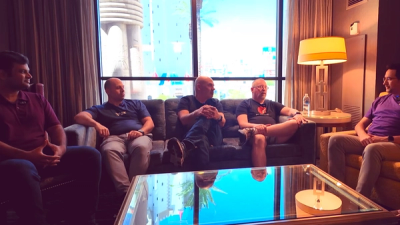
Socket CTO Ahmad Nassri joins AppSec leaders at Black Hat to discuss active malware, package manager risks, and software supply chain defense.