
Research
/Security News
Popular npm Packages in the keyv and Cacheable Namespaces Compromised in Active Supply Chain Attack
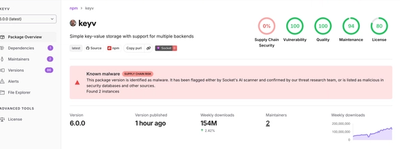
Popular npm packages keyv and cacheable compromised.
By Socket Research Team - Aug 04, 2026
@bilig/workpaper
Advanced tools
Run workbook-shaped business rules in Node services: edit inputs, recalculate formulas, read outputs, and save WorkPaper JSON.
Bilig WorkPaper is an API, CLI evaluator, and optional MCP server for workbook-shaped business logic in Node.js.
Use this when business logic is easiest to review as workbook cells and formulas, but the calculation needs to run in a backend service, queue worker, serverless route, test, or tool.
@bilig/workpaper is the canonical scoped npm entrypoint. The unscoped
bilig-workpaper package remains published as a compatibility and search alias.
npm install @bilig/workpaper
Pick the door that matches the state you own:
| Door | Run first | What it proves |
|---|---|---|
| Node service or test | npm exec --yes --package @bilig/workpaper@latest -- bilig-evaluate --door workpaper-service --json | edit input, recalculate output, persist JSON, restore, and return verified: true. |
| New project | npm create @bilig/workpaper@latest pricing-workpaper | a starter wired to the same WorkPaper proof loop. |
| Tool host or MCP client | npm exec --yes --package @bilig/workpaper@latest -- bilig-evaluate --door agent-mcp --json | tool discovery, cell mutation, formula readback, JSON export, restart proof, and verified: true. |
| Unsure which proof fits | npm exec --yes --package @bilig/workpaper@latest -- bilig-agent-start --json | compact routing card with proof commands, evidence fields, and public links. |
bilig-agent-start --json is intentionally small. It prints first proof
commands, required evidence fields, expected MCP tools, and public discovery
links without asking a tool host to read the whole site.
Run the service proof without cloning the repo:
npm exec --yes --package @bilig/workpaper@latest -- bilig-evaluate --door workpaper-service --json
The useful output is not a write-call status. It is readback proof:
{
  "schemaVersion": "bilig-evaluator.v1",
  "door": "workpaper-service",
  "verified": true,
  "packageVersions": {
    "@bilig/workpaper": "0.164.11"
  },
  "evidence": {
    "editedCell": "Inputs!B2",
    "dependentCell": "Summary!B2",
    "before": 24000,
    "after": 38400,
    "afterRestore": 38400,
    "persistedDocumentBytes": 999
  }
}
For recompute and output boundaries, see https://proompteng.github.io/bilig/eval-workpaper-service.html#recompute-and-output-boundaries.
For a richer tool check, add --scenario revenue-plan to the agent-mcp
evaluator. It proves SUM, SUMIF, XLOOKUP, FILTER, a named expression,
JSON persistence, and restart readback.
npm exec --yes --package @bilig/workpaper@latest -- bilig-evaluate --door agent-mcp --scenario revenue-plan --json
If the workbook has provider-backed formulas such as IMPORTRANGE, run
npm exec --yes --package @bilig/workpaper@latest -- bilig-evaluate --door agent-mcp --scenario provider-backed --json.
That proves the formula fails closed with an adapter diagnostic, then verifies a
local synthetic adapter readback. It does not call Google Sheets.
Framework examples live in the repo instead of this first screen. Use them after one evaluator passes:
These are integration guide names that users search for on npm. They are links, not the first-run path:
import { buildA1WorkPaper } from '@bilig/workpaper'

const book = buildA1WorkPaper({
  Inputs: [
    ['Metric', 'Value'],
    ['Units', 40],
    ['Price', 1200],
  ],
  Summary: [
    ['Metric', 'Value'],
    ['Revenue', '=Inputs!B2*Inputs!B3'],
  ],
})

const proof = book.editAndReadback('Inputs!B2', 48, {
  readbackRange: 'Summary!B2',
})

console.log({
  editedCell: proof.editedCell,
  before: proof.beforeReadback.displayValues,
  after: proof.afterReadback.displayValues,
  afterRestore: proof.restoredReadback.displayValues,
  persistedDocumentBytes: proof.persistedDocumentBytes,
  verified: proof.verified,
})

book.dispose()
Use book.set('Inputs!B2', 48), book.setMany({ 'Inputs!B3': 1500 }),
book.readMany(['Inputs!B2', 'Summary!B2']), book.display('Summary!B2'),
and book.saveJson() when you do not need the full proof object. Use
book.editManyAndReadback() when several inputs should commit as one atomic
proof with typed readback comparison, formula diagnostics, persistence, and
restore checks.
Install the AI SDK and Zod in the application that owns the agent loop:
npm install @bilig/workpaper ai zod
Then expose a WorkPaper as normal AI SDK tools:
import { generateText, stepCountIs } from 'ai'
import { WorkPaper } from '@bilig/workpaper'
import { createAiSdkWorkPaperTools } from '@bilig/workpaper/ai-sdk'

const workpaper = WorkPaper.buildFromSheets({
  Inputs: [
    ['Metric', 'Value'],
    ['Qualified opportunities', 20],
    ['Win rate', 0.25],
    ['Average ARR', 12000],
  ],
  Summary: [
    ['Metric', 'Value'],
    ['Expected customers', '=Inputs!B2*Inputs!B3'],
    ['Expected ARR', '=B2*Inputs!B4'],
  ],
})

const tools = createAiSdkWorkPaperTools({
  workpaper,
  defaultReadRange: 'Summary!A1:B3',
  proofRange: 'Summary!A1:B3',
  writableSheets: ['Inputs'],
})

const result = await generateText({
  model,
  tools,
  stopWhen: stepCountIs(2),
  prompt: 'Read the summary, set Inputs!B3 to 0.4, then report the computed ARR change.',
})

console.log(result.text)
The mutating tool returns editedCell, before, after, restored, and
checks. Keep writableSheets narrow so the model can edit inputs without
rewriting formula sheets.
The public package ships three no-clone checks. Start with the smallest one that matches the state owner:
npm exec --yes --package @bilig/workpaper@latest -- bilig-evaluate --door workpaper-service --json
npm exec --yes --package @bilig/workpaper@latest -- bilig-evaluate --door agent-mcp --json
npm exec --yes --package @bilig/workpaper@latest -- bilig-agent-start --json
bilig-evaluate prints a bilig-evaluator.v1 object with door, evidence,
verified, limitations, and the source command output.
Use the raw challenge commands only when you need a lower-level transcript for debugging:
npm exec --yes --package @bilig/workpaper@latest -- bilig-agent-challenge --json
npm exec --package @bilig/workpaper@latest -- bilig-mcp-challenge --json
Those commands edit one input, recalculate dependent formulas, export WorkPaper
JSON, restore it, and print a verified: true proof object.
When a tool host is about to solve a spreadsheet task by opening Excel, LibreOffice, Google Sheets, or a screenshot grid, hand it the WorkPaper checklist instead:
npx --yes skills@latest add https://bilig.proompteng.ai --list
npx --yes skills@latest add proompteng/bilig --skill bilig-workpaper --list
npm exec --yes --package @bilig/workpaper@latest -- bilig-evaluate --door agent-mcp --json
The kit gives the host one path: install the instructions, run the no-key MCP
evaluator, paste a workbook edit task, and require computed readback plus
persisted state before reporting success. Use bilig-mcp-challenge --json only
when debugging the lower-level MCP transcript.
Docs: https://proompteng.github.io/bilig/agent-adoption-kit.html
Use the local formula-readback server when a workflow platform should orchestrate the task but Bilig should own workbook state:
npm exec --package @bilig/workpaper@latest -- bilig-n8n-formula-server --port 4321
Start from the repo examples:
examples/directus-workpaper-flow-operationexamples/windmill-workpaper-scriptexamples/triggerdev-workpaper-taskexamples/airbyte-workpaper-validationexamples/meltano-workpaper-utilityexamples/temporal-workpaper-activityexamples/airflow-workpaper-dagexamples/dagster-workpaper-assetexamples/kestra-workpaper-flowexamples/prefect-workpaper-flowexamples/n8n-workpaper-formula-readback/bilig-workpaper-formula-readback.n8n.jsonexamples/dify-workpaper-formula-readback mirrors the Dify plugin source;
the package was merged upstream in
https://github.com/langgenius/dify-plugins/pull/2451examples/flowise-workpaper-formula-readback/bilig-workpaper-formula-readback.flowise-tool.jsonintegrations/pipedream-bilig-workpaper mirrors the Pipedream action shape;
the public review is https://github.com/PipedreamHQ/pipedream/pull/20972examples/fastmcp-workpaper-clientexamples/langchain-mcp-workpaper-toolnodeexamples/smolagents-workpaper-toolDocs:
import { WorkPaper } from '@bilig/workpaper'
import { exportXlsx, importXlsx } from '@bilig/workpaper/xlsx'
Use saved-file commands only when a workbook file is the integration contract:
npm exec --package @bilig/workpaper@latest -- bilig-workpaper-mcp --from-xlsx ./pricing.xlsx
npm exec --package @bilig/workpaper@latest -- bilig-workpaper-mcp --from-xlsx ./pricing.xlsx --workpaper ./.bilig/pricing.workpaper.json --writable
The --from-xlsx path imports the file once into an in-memory MCP server by
default, or into persisted WorkPaper JSON when --workpaper --writable is also
supplied. It also exposes analyze_workbook_risk, a read-only tool fixed to the
source workbook passed at startup. That report surfaces workbook risk indicators
before a workflow trusts the imported WorkPaper; it does not certify Excel compatibility.
Use @bilig/xlsx-formula-recalc when the job is only to edit and recalculate
XLSX files. Use @bilig/exceljs-formula-recalc when an existing ExcelJS
workflow needs recalculated formula results after changing inputs.
The npm tarball exposes the same CLI entrypoints through the canonical scoped package, so tool hosts can install one focused package and still get the MCP stdio server:
import { createWorkPaperMcpServer } from '@bilig/workpaper/mcp'
For a runnable starter project with AGENTS.md, MCP client config, and an
agent:verify script:
npm create @bilig/workpaper@latest pricing-agent -- --agent
Bilig is not a desktop Excel clone. It is a formula workbook runtime for service-owned calculations, JSON persistence, XLSX import/export, and verified readback. Unsupported Excel functions, external workbook links, macros, and volatile functions may need review.
If the starter or challenge output matches your service or tool workflow, keep the repository nearby for release notes and public limits: https://github.com/proompteng/bilig.
Watch releases if this is close to a production path: https://github.com/proompteng/bilig/subscription.
If the model is close but blocked by a formula, import/export, persistence, framework, MCP, or package-boundary gap, open the smallest implementation gap: https://github.com/proompteng/bilig/discussions/new?category=general.
Full docs: https://proompteng.github.io/bilig/
FAQs
Run workbook-shaped business rules in Node services: edit inputs, recalculate formulas, read outputs, and save WorkPaper JSON.
The npm package @bilig/workpaper receives a total of 225 weekly downloads. As such, @bilig/workpaper popularity was classified as not popular.
We found that @bilig/workpaper demonstrated a healthy version release cadence and project activity because the last version was released less than a year ago. It has 1 open source maintainer collaborating on the project.
Did you know?

Socket for GitHub automatically highlights issues in each pull request and monitors the health of all your open source dependencies. Discover the contents of your packages and block harmful activity before you install or update your dependencies.
Research
/Security News
Popular npm packages keyv and cacheable compromised.

Security News
A misconfiguration gave three Anthropic models internet access, and one, believing it was in a simulation, shipped a credential-stealing package to PyPI.

Security News
/Company News
Socket has joined the new Composer and Packagist sponsorship program as a launch sponsor, supporting the team that keeps PHP's package ecosystem secure.