
Company News
AWS Security Hub Adds Socket for Supply Chain Security
Socket is now in the AWS Security Hub Extended plan. Adopt it through AWS, apply committed spend, and block malicious open source packages.
By Feross Aboukhadijeh - Aug 04, 2026
@borough/mcp
Advanced tools
MCP server for Borough NYC Real Estate API — search rentals, sales, property details, and building data across all five NYC boroughs
Remote MCP bridge package for Borough, a read-only NYC real estate connector for Claude, ChatGPT, Cursor, VS Code, and other MCP-compatible clients.
Borough MCP gives AI tools authenticated access to:
For hosted MCP clients, use Borough's remote MCP endpoint:
https://borough.qwady.app/mcp
OAuth-capable clients should prefer the built-in Borough OAuth flow. That is the primary connector path for Claude and other hosted remote MCP clients.
Docs:
https://borough.qwady.app/mcp
Discovery metadata:
https://borough.qwady.app/.well-known/mcp/server.json
search_rentalssearch_saleslist_areasget_market_snapshotget_market_trendscompare_neighborhoodsget_propertyget_property_by_urlget_buildingget_building_listingsAll Borough MCP tools are read-only.
The search and market tools accept either area IDs or neighborhood names. Search tools also support compact amenity-aware filtering, including DISHWASHER and WASHER_DRYER.
If your MCP client supports remote connectors and OAuth, use the hosted endpoint directly and complete the Borough sign-in flow when prompted.
For Claude-specific steps:
For MCP clients that do not support Borough's OAuth flow, use a Borough API key in the Authorization header:
Authorization: Bearer BOROUGH-<your_key>
Examples:
{
  "mcpServers": {
    "borough": {
      "url": "https://borough.qwady.app/mcp",
      "headers": {
        "Authorization": "Bearer BOROUGH-<your_key>"
      }
    }
  }
}
{
  "servers": {
    "borough": {
      "type": "http",
      "url": "https://borough.qwady.app/mcp",
      "headers": {
        "Authorization": "Bearer BOROUGH-<your_key>"
      }
    }
  }
}
npx Bridge UsageThis package is mainly useful when you want to bridge the hosted Borough MCP endpoint into a stdio-only client.
BOROUGH_API_KEY=BOROUGH-<your_key> npx @borough/mcp
BOROUGH_API_KEY is required for the direct stdio bridge path.
Ask your AI client:
For support, contact api@qwady.com.
FAQs
MCP server for Borough NYC Real Estate API — search rentals, sales, property details, and building data across all five NYC boroughs
We found that @borough/mcp demonstrated a healthy version release cadence and project activity because the last version was released less than a year ago. It has 1 open source maintainer collaborating on the project.
Did you know?

Socket for GitHub automatically highlights issues in each pull request and monitors the health of all your open source dependencies. Discover the contents of your packages and block harmful activity before you install or update your dependencies.
Company News
Socket is now in the AWS Security Hub Extended plan. Adopt it through AWS, apply committed spend, and block malicious open source packages.
Research
/Security News
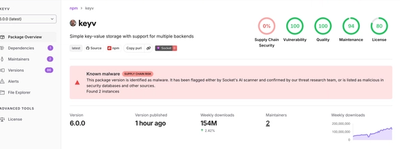
Popular npm packages keyv and cacheable compromised.

Security News
A misconfiguration gave three Anthropic models internet access, and one, believing it was in a simulation, shipped a credential-stealing package to PyPI.