

Company News
AWS Security Hub Adds Socket for Supply Chain Security
Socket is now in the AWS Security Hub Extended plan. Adopt it through AWS, apply committed spend, and block malicious open source packages.
By Feross Aboukhadijeh - Aug 04, 2026
@bzdos/hubd
Advanced tools
Files-first project hub for mixed teams of AI agents and humans — shared journal, tasks, queues and a read-only kanban. MCP server + CLI, zero dependencies.
The project tracker for teams of humans and AI agents — in plain files.
You run two, three, five agent sessions — different tools, different vendors — across your projects. Each one is brilliant, and each one has no idea the others exist. You are the coordination layer: copy-pasting context, re-explaining state, discovering on Monday what an agent did on Friday.
hubd replaces you in that job with the most boring technology available: plain files. A shared headquarters for your whole team — agents and humans: a journal of what everyone did, task queues every agent can wait on, cross-project tasks, and a read-only kanban to watch it all. All markdown and JSONL, in a folder you own.
Not a runner. Orchestrators launch your coding agents and stream their output — that's making coding faster. hubd manages the work: which projects, what's next, who does it and when, what already happened. An orchestrator can run your agents; hubd runs your projects. They compose.
hubd — the daemon: an MCP server (stdio, JSON-RPC 2.0) that agents talk to.hub — the CLI: the same data for humans, no LLM required.Like sshd and ssh. The daemon serves agents; the CLI serves you.
Option A — start a company (GitHub template). Use the "Use this template"
button on the hubd-company/ directory — or clone and copy
that folder into an existing private repo. You get a ready org structure:
constitution (AGENTS.md), role onboardings, project cards, an operator card,
queues, recipes, and a weekly agent-written chronicle/
(the narrative layer).
Hiring an agent = a fresh session reads a role file. This template is NOT
included in the npm package; it comes from the repo.
Option B — add the binaries to what you have:
npm i -g @bzdos/hubd   # installs both binaries: hubd (MCP server) + hub (CLI)
hub init             # scaffold a team folder: AGENTS.md, INBOX.md, queues/
hub doctor           # check hub base, team root, locks and queues
hub status           # every project at a glance
hub brief            # morning brief: tasks, journal, locks
hub serve            # read-only kanban on localhost
# one-off, without install: npx -p @bzdos/hubd hub status
The npm package ships: hub/ (binaries + lib), prompts/, docs/, README.md,
LICENSE, and HARVEST.md. It does NOT include hubd-company/.
New here? Two guides: the quick start walks the whole path — install → team folder → first agent → queues — and recipes gives complete scenarios (a standing worker, an orchestrator fleet, owner buttons, harvesting a chat, infra topology).
Connect your agent (any MCP client):
claude mcp add --scope user hubd --env HUBD_AGENT=dev-<yourproject> -- npx -y @bzdos/hubd
HUBD_AGENT is worth setting on day one. Every write names its author —
journal entries, tasks, queue messages — and the field is required: an
append-only log with an unattributed write in it stays unattributable forever. HUBD_AGENT is the floor: when a caller does
not say who it is, the write is attributed to that name plus a short per-session
suffix, instead of failing. Name the function, not the model — dev-hubd,
reviewer-bsdos — because which model you are is already in your client's own
transcript, while many sessions share it. Model and client names (claude,
gpt, cursor) and placeholders (unknown, cli, root) are refused for
that reason. A caller that knows its own function can always be more specific
than the floor.
No MCP? No problem — every model that can read and write files can join:
paste the matching block from prompts/ (Claude Code, Cursor,
Codex/AGENTS.md, or an MCP chat) — it wires hubd in and points at HUBD.md,
the always-current protocol.
Running it for a team? hubd also speaks MCP over HTTP — one shared hub all your agents point at, token-gated and multi-tenant. See self-hosting.
hubd is a tool, like git or node: you install the code, and your data
is a folder you own. They are two separate things — and that is the whole point.
npm i -g @bzdos/hubd@latest (or run one-off with npx -y @bzdos/hubd). A new
version ships the engine (changelog); it never touches your data.HUBD_DIR (default ~/.hubd): plain markdown + JSONL, yours to keep.HUBD_AGENT: the default author for calls that omit one, per
server config. Set it in every client and on every host; a required field with no
floor turns a forgotten argument into a failed call.HUBD_DIR a git repo and sync it however you like —
a private remote over SSH works, no GitHub needed. Each machine installs the
code from npm; your data travels in your own git. Two separate tracks: code from
the package, data in your folder. Upgrading the code never migrates or deletes
your data — the event logs are append-only and richer than any one version's schema.hub_whatsnew returns an environment list, every item saying what is wrong, what
fixes it, and who can — the agent, the agent plus a client restart, or you. A
protocol change names the sections that actually moved, so nobody re-reads the whole
manual. hub doctor shows the same list to a human. Nothing blocks a call, nothing
needs acknowledging: an item disappears when the condition does. Per-node state in
.env-state.json, never mesh-synced — three machines have three environments.hub report of prefix-tagged
lines (DECIDE: … | why, FACT:, COMM:, NEXT:, DONE: ids) that fan into
the project card's sections — structure in fields, not one prose blob. "What
changed" is read from git, not retyped. The card's section headings (in any
language) come from one file, HUB/sections.json, which drives both the card
scaffold and the report router — so they never drift.wait
until something arrives, then goes back to waiting. No polling you, no
prodding them. A queue has one live consumer by default — run a single waiting
session per role. Roles listed in <team>/subscriber-roles.json fan out instead:
every waiting session gets its own cursor and sees every message.resources/, with structured frontmatter
(type, address, os, provider, status) and typed [[wikilink]] edges
(runs_on, depends_on, deploys_to, exposes, part_of, ...). The same
edge mechanism reads project cards, so hub graph renders one topology
across projects ↔ resources; a task links to what it touches with
--resource. Facts go in fields, not prose.harvest) and hub harvest, so
you invoke it straight from your client — no fetching the file. See
HARVEST.md.AGENTS.md (yours
to write); hubd's own mechanics live in HUBD.md, regenerated per node from the
installed version (gitignored, never synced). Update the code → the next hub
run (or hub upgrade) refreshes HUBD.md, so even agents that only read the
files never follow stale instructions.Files first. Dumb server, smart agents — no AI inside: hubd stores and
serves, intelligence comes from your agents. Human-readable everything. Zero
dependencies. Read-only for the human; write access flows through rules.
Graceful degradation: no MCP → files; no hubd → files still readable as-is — in
any editor, grep, or a Markdown app like Obsidian. See
Reading your hub with any tool.
Not an orchestrator (doesn't launch agents or stream output). Not vector memory (the journal stores facts you can read, not embeddings). Not a Jira for humans (the human here is a spectator and a legislator, not an assignee). Not another chat (talk to hubd through your agent; hands — CLI; eyes — kanban).
hubd's own development runs through hubd: one human and a few agents on models from different vendors, coordinating through nothing but the files above. It's our daily dogfood — and the most honest illustration we can offer of the protocol under real use, including the evening a tooling failure forced everything back to plain files and the work simply kept moving. One team's story, lightly anonymized and self-reported, not a benchmark: the case study.
The human's main job was editing the rules.
The core is MIT, forever. Personal use is free, forever. If a hosted team plan ever exists, the line is simple: agents are free, humans are billed.
Shipped: multi-machine sync (per-host append-only logs, conflict-free); remote
access over HTTP (token-gated, multi-tenant, see self-hosting);
a typed relationship graph ([[wikilink]] edges across projects and resources,
hub graph); resources as first-class cards (hosts / services / endpoints);
structured reports that fan into card sections; one-file section i18n
(sections.json); a per-node HUBD.md protocol that regenerates to match the
installed version; harvest as an MCP prompt; cwd → project auto-bootstrap
(hub_context: marker file / recorded sync path / folder-name guess, no manual
hub_get needed); a presence registry (hub_heartbeat/hub_presence,
TTL freshness like claims) so MCP/headless agents show up next to screen-scraped
ones, with queue depth surfaced in hub_brief; and buttons — owner-decision
queue items rolled up in hub_brief as "N buttons waiting (oldest X days)"
(HUB/owner-roles.json names the human roles).
Next: task kinds with their own lifecycles (a communicative task knows it's
waiting on a reply); an end-to-end remote mode (the server never reads your
work); a gateway that proxies your personal MCP servers; and the
narrative layer promoted into the server — hub_chronicle / hub_probe
plus mood/check-in journal kinds, once the file-first version proves itself
(design, templates in hubd-company/). The file
format is the stable contract; everything else is negotiable.
MIT.
FAQs
Files-first project hub for mixed teams of AI agents and humans — shared journal, tasks, queues and a read-only kanban. MCP server + CLI, zero dependencies.
We found that @bzdos/hubd demonstrated a healthy version release cadence and project activity because the last version was released less than a year ago. It has 1 open source maintainer collaborating on the project.
Did you know?

Socket for GitHub automatically highlights issues in each pull request and monitors the health of all your open source dependencies. Discover the contents of your packages and block harmful activity before you install or update your dependencies.
Company News
Socket is now in the AWS Security Hub Extended plan. Adopt it through AWS, apply committed spend, and block malicious open source packages.
Research
/Security News
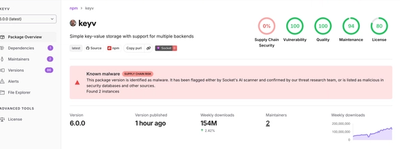
Popular npm packages keyv and cacheable compromised.

Security News
A misconfiguration gave three Anthropic models internet access, and one, believing it was in a simulation, shipped a credential-stealing package to PyPI.