

Research
/Security News
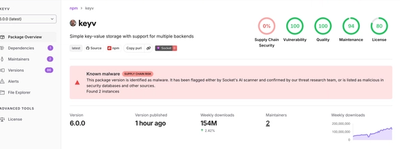
Popular npm Packages in the keyv and Cacheable Namespaces Compromised in Active Supply Chain Attack
Popular npm packages keyv and cacheable compromised.
By Socket Research Team - Aug 04, 2026
@callmcp/server
Advanced tools
CallMCP server core — MCP server implementing the 14-tool CallMCP telephony contract (SPEC.md) against any registered driver.
The CallMCP server core — an MCP server implementing the 14-tool CallMCP
telephony contract (SPEC.md at the repo root) against
whichever Driver you configure. This package has no telephony logic of its
own; it's the neutral layer that turns a Driver implementation
(@callmcp/driver-kaicalls,
@callmcp/driver-dograh,
@callmcp/driver-byok,
or a third-party one) into a spec-conformant MCP server.
| File | What it's for |
|---|---|
src/config.ts | Resolves a callmcp.config.json file or env vars into a set of configured drivers, exactly one marked default. |
src/driverRegistry.ts | Dynamically loads driver packages (or embeds already-constructed Drivers), falls back to @callmcp/driver-interface's MockDriver if nothing loads, notifies listeners on reconfiguration. |
src/approval.ts | ApprovalStore — the SPEC §3 approval state machine (pending/approved/denied/expired), elicitation-first with the out-of-band-URL fallback for clients that don't support MCP elicitation. |
src/tools.ts | ServerCore — registers all 14 tools with their SPEC-defined schemas and annotations; make_call/send_sms route through ensureDestinationApproved before ever touching a driver. |
src/dynamicTools.ts | Computes the live tools/list from the active driver's capability manifest (SPEC §2.2) and fires notifications/tools/list_changed when the driver set changes. |
src/transports.ts | stdio and Streamable HTTP transports, both backed by the same ServerCore. Also serves /approve/:id, the human-facing approval page for the non-elicitation fallback. |
src/index.ts | CLI entrypoint (callmcp-server bin). |
test/server.test.ts | Unit tests against @callmcp/driver-interface's MockDriver, plus a real dynamic-import() test against the three bundled driver packages. |
npx @callmcp/server                    # stdio transport, reads ./callmcp.config.json if present
npx @callmcp/server --http --port 8787 # Streamable HTTP transport
npx @callmcp/server doctor             # read-only journey preflight
npx @callmcp/server --sandbox          # explicit local sandbox; never contacts a provider
{
  "drivers": [
    { "id": "kaicalls", "type": "kaicalls", "default": true,
      "credentials": { "apiKey": "kc_live_..." } },
    { "id": "dograh", "type": "dograh",
      "credentials": { "baseUrl": "http://localhost:8000", "apiKey": "..." } }
  ],
  "http": { "port": 8787, "publicUrl": "https://your-host.example.com" }
}
type is one of kaicalls, dograh, byok, or mock (an in-memory
no-credentials driver for local testing, from @callmcp/driver-interface)."default": true. Omit it entirely and the
first configured driver becomes default. A tool call with no driver
field routes to whichever one is default.credentials/options are shallow-merged and passed straight through to
the driver package's constructor — see each driver's own README for its
expected shape (e.g. KaiCallsDriverConfig, DograhDriverOptions,
BYOKDriverConfig).http.publicUrl matters even in stdio mode: it's what the out-of-band
approval link (SPEC §3.4) points at when the connected client doesn't
support MCP elicitation. If you're running stdio-only with no HTTP
surface reachable at that URL, a human can't open the link — see the
note in src/index.ts.CALLMCP_DRIVER_TYPE=kaicalls
CALLMCP_DRIVER_CREDENTIALS='{"apiKey":"kc_live_..."}'
npx @callmcp/server
Or CALLMCP_DRIVERS_JSON (a JSON array, same shape as the config file's
drivers field) for more than one driver without a mounted file.
The server fails closed. It does not silently load the in-memory mock, because
that can make an unconfigured deployment look production-ready. Use
--sandbox or an explicit { "id": "mock", "type": "mock" } entry for
local testing, then configure a real provider before activation.
For the shortest hosted path, configure type: "kaicalls" with a
kc_live_... API key. KaiCalls' API-first onboarding is POST https://www.kaicalls.com/api/v1/signup; existing accounts use the managed
MCP endpoint at https://www.kaicalls.com/api/mcp. KaiCalls currently does not
issue a kc_test_ sandbox key, so CallMCP's --sandbox is intentionally local
and never substitutes for provider-side activation.
A driver package doesn't need to be in this monorepo. Export a
createDriver(entry: { id, credentials, options }) => Driver factory (named
or default export) and reference it as type in your config — see
driverRegistry.ts's factory-convention lookup. The three bundled drivers
predate this convention and are loaded via a known-class fallback instead;
new drivers should use the factory.
FAQs
CallMCP server core — MCP server implementing the 14-tool CallMCP telephony contract (SPEC.md) against any registered driver.
The npm package @callmcp/server receives a total of 162 weekly downloads. As such, @callmcp/server popularity was classified as not popular.
We found that @callmcp/server demonstrated a healthy version release cadence and project activity because the last version was released less than a year ago. It has 1 open source maintainer collaborating on the project.
Did you know?

Socket for GitHub automatically highlights issues in each pull request and monitors the health of all your open source dependencies. Discover the contents of your packages and block harmful activity before you install or update your dependencies.
Research
/Security News
Popular npm packages keyv and cacheable compromised.

Security News
A misconfiguration gave three Anthropic models internet access, and one, believing it was in a simulation, shipped a credential-stealing package to PyPI.

Security News
/Company News
Socket has joined the new Composer and Packagist sponsorship program as a launch sponsor, supporting the team that keeps PHP's package ecosystem secure.