
Research
/Security News
Miasma Mini Shai-Hulud Hits ImmobiliareLabs npm Packages
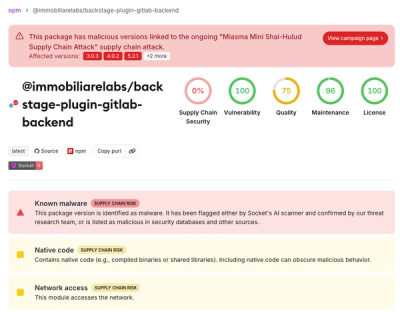
Miasma Mini Shai-Hulud hits @immobiliarelabs Backstage plugins, targeting GitLab and LDAP auth packages on npm.
By Socket Research Team - Jun 26, 2026
@captigo/turnstile
Advanced tools
Cloudflare Turnstile adapter for Captigo — client widget and server-side verification
Cloudflare Turnstile adapter for Captigo — client widget lifecycle and server-side token verification.
Provides a browser-side widget lifecycle and a server-side token verification
helper — both behind the same CaptchaAdapter interface that the rest of the
captigo ecosystem uses.
npm install @captigo/turnstile
@captigo/core is installed automatically as a transitive dependency. Add @captigo/react or @captigo/vue on the client if you use those integrations.
import { turnstile } from "@captigo/turnstile";

const adapter = turnstile({
  siteKey: "0x4AAAAAAA...", // your Turnstile site key
});
Pass the same adapter instance to both your client-side rendering code and
your server-side verification handler. The adapter holds no mutable state.
const container = document.getElementById("captcha")!;

const widget = adapter.render(container, {
  callbacks: {
    onSuccess: (token) => {
      // token.value is the string to submit to your server
      document.querySelector<HTMLInputElement>("[name=cf-turnstile-response]")!.value =
        token.value;
    },
    onExpire: () => {
      // token expired — clear your stored value
      console.log("Token expired, user will need to solve again.");
    },
    onError: (err) => {
      console.error("Turnstile error:", err.message);
    },
  },
});

// On cleanup (e.g. component unmount):
widget.destroy();
The Turnstile script is lazy-loaded the first time render() is called. You
can call preloadScript() earlier in your app to start that request sooner:
import { preloadScript } from "@captigo/turnstile";

preloadScript(); // fire and forget — safe to call multiple times
This step is required. Turnstile tokens are unverified on their own; you must validate them against Cloudflare's API from your server before trusting them.
Never expose your secret key to the browser.
// In an API route, server action, or edge function:
import { adapter } from "./captcha.js"; // your shared adapter instance

export async function POST(request: Request) {
  const body = await request.formData();
  const token = body.get("cf-turnstile-response") as string;

  const result = await adapter.verify(token, process.env.TURNSTILE_SECRET!);

  if (!result.success) {
    return Response.json({ error: "CAPTCHA verification failed" }, { status: 400 });
  }

  // Proceed with the actual request
  return Response.json({ ok: true });
}
You can also call the standalone verifyToken() function without creating an
adapter — useful in edge runtimes or serverless functions where you don't want
to import the browser-side widget code:
import { verifyToken } from "@captigo/turnstile";

const result = await verifyToken(token, process.env.TURNSTILE_SECRET!);
The optional third argument accepts { remoteip } to forward the visitor's IP
to Cloudflare for additional signal:
const result = await verifyToken(token, secret, {
  remoteip: request.headers.get("x-forwarded-for") ?? undefined,
});
Turnstile includes a bot-likelihood score in the verification response (0.0 =
likely bot, 1.0 = likely human). It is available on result.score:
const result = await verifyToken(token, secret);
if (!result.success) return Response.json({ error: "CAPTCHA failed" }, { status: 400 });

// Optional: tighten the threshold beyond Cloudflare's own threshold.
if ((result.score ?? 1) < 0.5) {
  return Response.json({ error: "Low confidence score" }, { status: 400 });
}
Note: The score is only present for Managed and Invisible widgets. It may be absent for some configurations — always treat it as optional.
Turnstile supports an invisible mode where no widget is rendered — the
challenge fires when you call widget.execute(). Set execution: "execute" to
enable it:
const adapter = turnstile({
  siteKey: "0x4AAAAAAA...",
  execution: "execute",
});

// adapter.meta.mode === "interactive"

const widget = adapter.render(container, { callbacks: { onSuccess: storeToken } });

// On form submit:
async function handleSubmit() {
  const token = await widget.execute("login"); // action label for analytics
  await submitFormWithToken(token.value);
}
The execute() call returns a Promise<CaptchaToken> that resolves when the
challenge completes (which may show a brief overlay to the user).
All options except siteKey are optional.
| Option | Type | Default | Description |
|---|---|---|---|
siteKey | string | — | Required. Your Turnstile site key. |
execution | "render" | "execute" | "render" | "render" = visible managed widget. "execute" = invisible, requires widget.execute(). |
theme | "light" | "dark" | "auto" | "auto" | Widget color scheme. |
size | "normal" | "compact" | "flexible" | "normal" | Widget dimensions. |
language | string | browser default | Language override (e.g. "en", "de"). |
appearance | "always" | "execute" | "interaction-only" | "always" | When to show the widget UI. |
action | string | — | Label shown in the Turnstile analytics dashboard. Max 32 chars. |
cData | string | — | Arbitrary customer data attached to the challenge. Max 255 bytes. |
retry | "auto" | "never" | "auto" | Whether to auto-retry failed challenges. |
retryInterval | number | 8000 | Milliseconds between retries. |
refreshExpired | "auto" | "manual" | "never" | "auto" | Token refresh policy on expiry. |
refreshTimeout | "auto" | "manual" | "never" | "auto" | Behavior when the challenge times out. |
tabindex | number | — | Tab index for the widget iframe. |
const widget = adapter.render(container, { callbacks });

await widget.execute(action?)  // trigger the challenge (interactive/managed)
widget.reset()                 // reset to unsolved state
widget.destroy()               // remove from DOM, release resources
widget.getToken()              // returns CaptchaToken | null
execute() behaviour depends on the adapter's mode:
execution: "render") — returns the current token if already
solved, otherwise waits for the next solve. The user drives the interaction.execution: "execute") — triggers the invisible challenge.
Resolves when the user completes it.Call destroy() on component unmount. After destroy(), do not call any other
methods on the widget instance.
import { CaptchaError } from "@captigo/turnstile";

const widget = adapter.render(container, {
  callbacks: {
    onSuccess: (token) => {
      submitForm(token.value);
    },
    onError: (err) => {
      // err.code is one of: "script-load-failed" | "provider-error" | "execute-failed" | ...
      console.error(`[${err.code}] ${err.message}`);
      showErrorMessage("The CAPTCHA failed. Please try again.");
    },
    onExpire: () => {
      // Fired when a token expires OR when the challenge presentation times out.
      // The widget auto-refreshes by default (refreshExpired / refreshTimeout: "auto").
      clearStoredToken();
    },
  },
});
onExpire is called in two situations:
In both cases, any stored token is invalid and the widget will reset automatically
(when using the default refreshExpired: "auto" / refreshTimeout: "auto" settings).
See the CaptchaError source for the full list of error codes.
| Field | Type | Description |
|---|---|---|
success | boolean | Whether the token passed verification. |
provider | string | Always "turnstile". |
challengeTs | string? | ISO 8601 timestamp of challenge completion. |
hostname | string? | The hostname that rendered the widget. |
score | number? | Bot-likelihood score (0.0 = bot, 1.0 = human). |
errorCodes | string[]? | Cloudflare error codes if success is false. |
adapter.verify() or
verifyToken().destroy() first will cause unexpected behaviour.TURNSTILE_SECRET must never be included in
client-side bundles. Keep it in environment variables only accessible to your
server.FAQs
Cloudflare Turnstile adapter for Captigo — client widget and server-side verification
We found that @captigo/turnstile demonstrated a healthy version release cadence and project activity because the last version was released less than a year ago. It has 1 open source maintainer collaborating on the project.
Did you know?

Socket for GitHub automatically highlights issues in each pull request and monitors the health of all your open source dependencies. Discover the contents of your packages and block harmful activity before you install or update your dependencies.
Research
/Security News
Miasma Mini Shai-Hulud hits @immobiliarelabs Backstage plugins, targeting GitLab and LDAP auth packages on npm.

Security News
Rolldown paused Rust React Compiler integration after a 5MB binary size increase raised concerns about shipping React-specific code to all Vite users.

Security News
/Research
Mini Shai-Hulud expands into the Go ecosystem after hitting LeoPlatform npm packages and targeting GitHub Actions workflows.