

Security News
The Code You Didn't Write Is Still Yours to Defend
AI agents are pulling packages into environments no scanner is watching, creating exposure before security teams can see it.
By Brad Arkin - Jun 23, 2026
@captigo/vue
Advanced tools
Vue 3 components and composables for Captigo — works with any CAPTCHA adapter
Vue 3 composables and components for Captigo.
Swap providers without changing your component tree — use @captigo/turnstile, @captigo/hcaptcha, or @captigo/recaptcha.
npm install @captigo/vue @captigo/turnstile
@captigo/core is installed transitively via the adapter. Peer dependency: vue ≥ 3.3.
The most common case. The widget renders automatically; you read the token reactively.
<script setup lang="ts">
import { turnstile } from "@captigo/turnstile";
import { Captcha } from "@captigo/vue";

// Create the adapter once — outside the component or via computed() to
// avoid unnecessary widget remounts on every reactive update.
const adapter = turnstile({ siteKey: "0x4AAAAAAAxxx" });

function onToken(token) {
  // Forward token.value to your server for verification.
  console.log(token.value);
}
</script>

<template>
  <form @submit.prevent="submitForm">
    <Captcha :adapter="adapter" @success="onToken" />
    <button type="submit">Submit</button>
  </form>
</template>
For invisible Turnstile or invisible hCaptcha, call execute() on form submit to trigger the challenge imperatively.
<script setup lang="ts">
import { ref } from "vue";
import { turnstile } from "@captigo/turnstile";
import { Captcha } from "@captigo/vue";
import type { CaptchaInstance } from "@captigo/vue";

const adapter = turnstile({
  siteKey: "0x4AAAAAAAxxx",
  execution: "execute", // invisible mode
});

const captchaRef = ref<CaptchaInstance>();

async function handleSubmit() {
  const token = await captchaRef.value!.execute("login");
  await fetch("/api/login", {
    method: "POST",
    body: JSON.stringify({ token: token.value }),
  });
}
</script>

<template>
  <form @submit.prevent="handleSubmit">
    <Captcha ref="captchaRef" :adapter="adapter" />
    <button type="submit">Log in</button>
  </form>
</template>
useCaptcha composableFor when you need lower-level control or want to integrate with your own markup.
<script setup lang="ts">
import { turnstile } from "@captigo/turnstile";
import { useCaptcha } from "@captigo/vue";

const adapter = turnstile({ siteKey: "0x4AAAAAAAxxx" });

const { containerRef, token, execute, reset } = useCaptcha(adapter, {
  onSuccess: (t) => console.log("solved:", t.value),
  onExpire: () => console.log("token expired"),
  onError: (err) => console.error("widget error:", err),
});
</script>

<template>
  <div>
    <!-- Attach containerRef to the element that should host the widget. -->
    <div :ref="containerRef" class="my-captcha" />

    <!-- token is reactive — use it directly in templates or computed(). -->
    <p v-if="token">Token ready: {{ token.value }}</p>

    <button @click="execute('checkout')">Verify</button>
    <button @click="reset">Reset</button>
  </div>
</template>
useCaptcha accepts a plain value, a Ref, or a getter function for the adapter. Changing the adapter destroys the old widget and mounts a new one automatically.
const selectedProvider = ref<"turnstile" | "hcaptcha">("turnstile");

const adapter = computed(() =>
  selectedProvider.value === "turnstile"
    ? turnstile({ siteKey: "..." })
    : hcaptcha({ siteKey: "..." }),
);

const { containerRef, token, execute } = useCaptcha(adapter);
Never trust tokens on the client. Validate them on your server before acting on them.
// server.ts (Node.js / edge)
import { verifyToken } from "@captigo/turnstile";

const result = await verifyToken(token, process.env.TURNSTILE_SECRET_KEY!);

if (!result.success) {
  throw new Error("CAPTCHA verification failed");
}
See each provider package (@captigo/turnstile, @captigo/hcaptcha, @captigo/recaptcha) for provider-specific verification functions and options.
<Captcha> component| Prop | Type | Required | Description |
|---|---|---|---|
adapter | CaptchaAdapter | Yes | Provider adapter (e.g. from @captigo/turnstile) |
onSuccess | (token: CaptchaToken) => void | No | Called when a token is produced |
onError | (error: CaptchaError) => void | No | Called on an unrecoverable widget error |
onExpire | () => void | No | Called when the current token expires |
Extra attributes (id, class, style, etc.) fall through to the underlying container <div> automatically.
CaptchaInstance (accessed via template ref):
| Method | Description |
|---|---|
execute(action?) | Trigger the challenge. Returns Promise<CaptchaToken>. |
reset() | Reset the widget to its initial unsolved state. |
getToken() | Returns the current CaptchaToken or null. |
useCaptcha(adapter, options?)| Parameter | Type | Description |
|---|---|---|
adapter | MaybeRefOrGetter<CaptchaAdapter> | Provider adapter — can be a plain value, Ref, or getter |
options.onSuccess | (token) => void | Success callback |
options.onError | (error) => void | Error callback |
options.onExpire | () => void | Expiry callback |
Returns { containerRef, token, execute, reset }.
| Return | Type | Description |
|---|---|---|
containerRef | Ref<HTMLDivElement | null> | Bind to the widget container element |
token | Ref<CaptchaToken | null> | The current token, reactive |
execute | (action?) => Promise<CaptchaToken> | Trigger the challenge |
reset | () => void | Reset and clear token |
The widget is remounted when the resolved adapter value changes. If you construct the adapter inside a computed() that re-runs frequently, the widget will remount each time. Keep adapters stable:
// Good — created once
const adapter = turnstile({ siteKey: "..." });

// Fine — computed with stable inputs
const adapter = computed(() => turnstile({ siteKey: props.siteKey }));

// Avoid — new object on every reactive update
const adapter = turnstile({ siteKey: reactiveValue.value }); // inside setup()
Score-based providers don't render a visible widget. The <Captcha> component still mounts an empty container; the adapter uses it to initialize. You can hide it with CSS or use useCaptcha and skip rendering containerRef entirely (call execute() to get the token on demand).
@captigo/vue is compatible with Vue's production build. No special handling is needed for development strict mode since Vue 3 does not remount components the way React Strict Mode does.
FAQs
Vue 3 components and composables for Captigo — works with any CAPTCHA adapter
The npm package @captigo/vue receives a total of 2 weekly downloads. As such, @captigo/vue popularity was classified as not popular.
We found that @captigo/vue demonstrated a healthy version release cadence and project activity because the last version was released less than a year ago. It has 1 open source maintainer collaborating on the project.
Did you know?

Socket for GitHub automatically highlights issues in each pull request and monitors the health of all your open source dependencies. Discover the contents of your packages and block harmful activity before you install or update your dependencies.
Security News
AI agents are pulling packages into environments no scanner is watching, creating exposure before security teams can see it.

Security News
GitHub Actions checkout now blocks risky pull_request_target checkouts by default to help prevent pwn request supply chain attacks.
Product
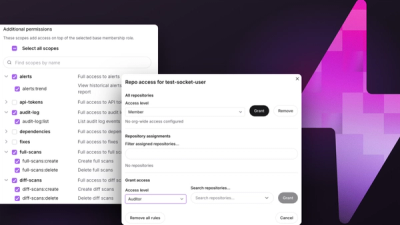
Socket now supports Custom Roles and Repository Access Permissions so organizations can control who can access specific repositories and actions.