

Company News
AWS Security Hub Adds Socket for Supply Chain Security
Socket is now in the AWS Security Hub Extended plan. Adopt it through AWS, apply committed spend, and block malicious open source packages.
By Feross Aboukhadijeh - Aug 04, 2026
@cinch-codes/mcp
Advanced tools
MCP server for Cinch — let AI assistants run untrusted code in secure, isolated sandboxes.
MCP server for Cinch. Gives your AI assistant a real sandbox to run code in.
Without it, an assistant writes code and you run it yourself. With it, the assistant runs the code and reads the actual output — inside a gVisor-isolated container on Cinch's infrastructure, with no access to your machine, filesystem, or local network.
Pay per execution. No subscription floor.
Get an API key at cinch.codes, then add the server to your MCP client.
Claude Desktop — claude_desktop_config.json:
{
  "mcpServers": {
    "cinch": {
      "command": "npx",
      "args": ["-y", "@cinch-codes/mcp"],
      "env": {
        "CINCH_API_KEY": "cinch_live_..."
      }
    }
  }
}
Claude Desktop on Windows — same file, but Windows can't spawn npx directly, so wrap it with cmd /c:
{
  "mcpServers": {
    "cinch": {
      "command": "cmd",
      "args": ["/c", "npx", "-y", "@cinch-codes/mcp"],
      "env": {
        "CINCH_API_KEY": "cinch_live_..."
      }
    }
  }
}
Claude Code (macOS/Linux):
claude mcp add --scope user cinch -e CINCH_API_KEY=cinch_live_... -- npx -y @cinch-codes/mcp
Claude Code (Windows):
claude mcp add --scope user cinch -e CINCH_API_KEY=cinch_live_... -- cmd /c npx -y @cinch-codes/mcp
Cursor — .cursor/mcp.json, same shape as the Claude Desktop config above.
Restart the client. That's it — no install step, npx fetches it on first run.
execute_codeRuns a self-contained Python or JavaScript program and returns stdout, stderr, exit code, and duration.
| Parameter | Type | Default | Description |
|---|---|---|---|
code | string | — | The complete program to run. Must print to stdout to return anything. |
language | python | javascript | python | Runtime to execute in. |
Each call gets a clean sandbox. State does not persist between calls, so every snippet needs to stand on its own.
Deliberately minimal. Worth knowing before you wonder why an import failed:
| Runtimes | Python 3.12, Node 20 |
| Packages | Standard library only. No pip or npm packages are installed, and none can be installed at runtime. |
| Network | None. HTTP, DNS, and package installs all fail. |
| Filesystem | Root is read-only. /tmp is writable (64 MB) and destroyed when the run ends. |
| Memory | 256 MB |
| CPU | 0.5 cores |
| Time limit | 10 seconds |
| Isolation | gVisor (runsc), all capabilities dropped, no-new-privileges, non-root user, 64-process cap |
The tool description tells the model all of this up front, so it writes stdlib-only code instead of reaching for numpy and failing on the first call.
| Variable | Required | Default | Description |
|---|---|---|---|
CINCH_API_KEY | yes | — | Your Cinch API key. |
CINCH_TIMEOUT_MS | no | 20000 | Client-side timeout in ms. The API caps execution at 10s regardless. |
CINCH_BASE_URL | no | https://api.cinch.codes | Override the API endpoint. |
Windows: "Failed to connect" in claude mcp list — you're missing the cmd /c wrapper. Windows resolves npx to a batch script that can't be spawned directly; re-add the server using the Windows command above.
Windows: npm error ENOENT ... AppData\Roaming\npm — some Node installs never create npm's global folder, and npx refuses to run without it. Create it once and retry:
mkdir %APPDATA%\npm
Server exits immediately with "CINCH_API_KEY is not set" — the env var didn't reach the server. In Claude Code, put -e CINCH_API_KEY=... before the server name in claude mcp add. In config files, check the env block is inside the cinch entry.
Debugging any connection failure — run the server directly to see the real error instead of a generic status:
CINCH_API_KEY=cinch_live_... npx -y @cinch-codes/mcp # macOS/Linux
set CINCH_API_KEY=cinch_live_... && cmd /c npx -y @cinch-codes/mcp # Windows
Correct behavior is cinch-mcp ... ready followed by silence — an MCP server waits for a client. Anything else printed is the actual failure.
Code written by a model is untrusted code — nothing reviewed it before it ran. Executing it directly on your machine means handing it your filesystem, your network, and your credentials. Cinch runs it somewhere else entirely, in a disposable container with kernel-level isolation, and sends back only the output.
@cinch-codes/pangolinpangolin-sdkMIT
FAQs
MCP server for Cinch — let AI assistants run untrusted code in secure, isolated sandboxes.
We found that @cinch-codes/mcp demonstrated a healthy version release cadence and project activity because the last version was released less than a year ago. It has 1 open source maintainer collaborating on the project.
Did you know?

Socket for GitHub automatically highlights issues in each pull request and monitors the health of all your open source dependencies. Discover the contents of your packages and block harmful activity before you install or update your dependencies.
Company News
Socket is now in the AWS Security Hub Extended plan. Adopt it through AWS, apply committed spend, and block malicious open source packages.
Research
/Security News
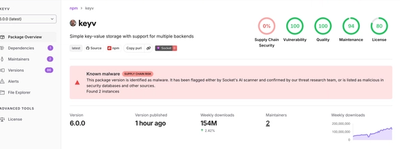
Popular npm packages keyv and cacheable compromised.

Security News
A misconfiguration gave three Anthropic models internet access, and one, believing it was in a simulation, shipped a credential-stealing package to PyPI.