

Company News
AWS Security Hub Adds Socket for Supply Chain Security
Socket is now in the AWS Security Hub Extended plan. Adopt it through AWS, apply committed spend, and block malicious open source packages.
By Feross Aboukhadijeh - Aug 04, 2026
@clipy/mcp
Advanced tools
Model Context Protocol (MCP) server for Clipy — give Claude, Cursor, and other AI agents read access to your screen recordings' transcripts, AI summaries, and key moments with frames.
Give your AI agent access to your Clipy screen recordings.
Developed in the Clipy monorepo. A public mirror for browsing the source and filing issues lives at github.com/manovagyanik1/clipy-mcp (MIT), kept in sync with each npm release.
This is a Model Context Protocol (MCP) server. It lets
Claude, Cursor, Windsurf, and other MCP-capable agents search your recordings and read
their transcripts and AI summaries — so you can do things like "turn this bug-report
recording into a Linear ticket" without leaving your agent — and, with the record
tool, record a web app headlessly and get it back as a Clipy recording ("build the
feature, then record the outcome").
The canonical cross-surface operating contract is
clipy.online/agents.md. For the exact
connected MCP version and schemas, use the standard tools/list request.
The read tools need the recordings:read scope, which every key gets by default. The
write tools — record, the session tools (start_recording, add_marker, add_chapter,
stop_recording, abort_recording), and replace_transcript — additionally need the
key to carry the ingest scope ("Record & upload"), which the server enforces. A
recordings:read-only key can read your recordings but cannot create, modify, or
delete anything.
Log in once with the Clipy CLI:
npx @clipy/cli@latest login
It opens your browser; click Approve once. The key is saved to
~/.config/clipy/config.json, and this server reads that file — so there is no key to
copy anywhere, and no secret ends up in your shell history or your MCP config.
Then add the server to your MCP client.
The --scope user flag installs Clipy globally for every project. Without it,
claude mcp add defaults to local scope (the current folder only):
claude mcp add --scope user clipy -- npx -y @clipy/mcp
This writes the server to your global ~/.codex/config.toml, so it's available in every
Codex session:
codex mcp add clipy -- npx -y @clipy/mcp
Or add it to ~/.codex/config.toml by hand:
[mcp_servers.clipy]
command = "npx"
args = ["-y", "@clipy/mcp"]
Edit the matching user-level config (claude_desktop_config.json, ~/.cursor/mcp.json,
or the Windsurf MCP config) directly:
{
  "mcpServers": {
    "clipy": {
      "command": "npx",
      "args": ["-y", "@clipy/mcp"]
    }
  }
}
Add an "env": { "CLIPY_API_KEY": "clipy_sk_live_xxx" } block only if you are not using
clipy login on this machine.
Use CLIPY_API_KEY when there is no clipy login to read from — CI, a container — or
when you deliberately want a different key than the logged-in one. An explicit env var
always wins over the config file. Mint keys at
https://clipy.online/settings/api-keys (shown only once).
Never inline your key into the server's launch command — e.g.
"command": "sh", "args": ["-c", "CLIPY_API_KEY=… npx -y @clipy/mcp"]. Command-line arguments are visible to every local process via the process table (ps,/proc), so a key placed there is effectively world-readable on the machine. Put it in theenvblock instead. (claude mcp add --env …/codex mcp add --env …write thatenvblock for you — they expose the key only in the argv of that single setup command, never in the long-running server's.)
| Tool | What it does |
|---|---|
search_memory | Search the whole Clipy memory at once — every screen recording the user made and every video they imported — returning the matching moments with timestamps and a URL that opens at that point. Matching is semantic as well as literal, so "login flow" finds a moment where someone said "the authentication screen". Reach for this first when the user refers to something they showed, recorded, or watched; the per-library tools below each see only half the picture. Each hit carries kind (recording or context) to tell you which tool to read next, a resolution saying whether its timestamp is an exact moment or a ~50s span, and a semantic.status to check before treating an empty result as "nothing recorded". |
search_recordings | Search your recordings by keyword (title + description). |
list_recordings | List your most recent recordings. |
get_recording | Metadata for one recording (status, duration, transcript/summary status). |
get_transcript | The full timestamped transcript + plaintext. |
get_summary | The AI summary: TL;DR, key points, action items. |
wait_for_artifacts | Poll until a recording's transcript/summary finish processing. |
download_recording | Download the MP4 locally so you can clip it or extract frames yourself (e.g. with ffmpeg). |
get_key_moments | Key moments: timestamps, captions, and click coordinates. |
get_agent_context | The full agent-context bundle (summary + key moments + transcript) as markdown. |
record | Record a web app headlessly and upload it as a Clipy recording; returns its share + agent-context URLs. Accepts a type (recording kind), viewports (sweep several screen sizes into one video), storageState / userDataDir+profileDirectory / initScript (record behind a login), and timestamped notes that become the (silent) recording's transcript. Needs Playwright in this server's environment and an ingest-scoped key (see below). |
start_recording | Start a recording session that keeps recording while you work (drive the page with your own browser tools, run commands, …). Accepts type, storageState / userDataDir+profileDirectory / initScript, and exposeCdp (get a CDP endpoint + in-page window.__clipyMark/window.__clipyChapter bridge to drive the recorded page). Auto-stops + uploads at maxSeconds (default 600) so it can never run away. |
add_marker | Drop a narration marker into the active session (live clock, or backdate with atSeconds) — markers become the recording's transcript chapters. Can carry evidence in one of two provenances: clipy-verified (assertSelector / assertText / assertUrl) where Clipy checks the page itself, or driver-attested (observed + verdict) where you report what your own tooling saw. Clipy-verified outcomes render with a verdict glyph (✓ pass, ✗ failure that can abort via failMode, ⚠ unverified — never a silent pass); driver-attested ones render with a weaker-looking hedge glyph (≈) so the two are never mistaken at a glance, and they are tallied in separate segments. Navigations + console errors are added automatically as [auto] marks. |
add_chapter | Drop a === CHAPTER: <label> === boundary into the active session — split a recording into named sections (ideal for before/after demos). |
stop_recording | Finish the session: close the browser, upload, return the share + agent-context URLs. |
abort_recording | Discard the active session; nothing is uploaded. |
list_context_documents | List the user's context documents — YouTube videos and local video files they imported with clipy context import, so agents can read them. A separate library from their own screen recordings. |
get_context_document | One context document's metadata: source, duration, tags, the server's classification (video type, whether visual evidence is needed, planned moments), and which transcript/frames exist. Not the transcript itself. |
read_context_document | Read a context document as compiled markdown — header, metadata, then the timestamped transcript with frame captions interleaved. Takes startMs/endMs so you can walk a two-hour video section by section instead of flooding your context. |
replace_transcript | Replace a recording's transcript with text you author (needs the ingest scope). Fix a bad speech-to-text pass, translate, or enrich a silent agent capture; the summary regenerates automatically. Marked as agent-edited, never passed off as speech-to-text. |
Read tools accept a recording's public id (the slug in its share URL) or the full
https://clipy.online/video/<id> URL.
Capturing the real screen is CLI-only. These tools record a headless Chromium page. To record the actual Mac screen or a specific window (ScreenCaptureKit — the real logged-in browser), use the Clipy CLI:
clipy record --source mac-screen --window "<app>".
recordrecord opens a URL in a headless Chromium (works in CI / cloud sandboxes, no display),
records for a few seconds, and streams it into Clipy — then returns the id so you can call
wait_for_artifacts and get_agent_context to read it back. It needs:
npm install -g playwright && npx playwright install chromium
Parameters: url (required, http/https), durationSeconds (default 15, max 300, applied
per viewport pass), name, description, type (recording kind — bug_report,
feature_request, product_demo, walkthrough_tutorial, feedback_review,
discussion_talk, other, plus aliases), viewports (e.g. mobile,desktop or
390x844,1440x900 — recorded sequentially into one video, frame sized to the largest,
each pass slow-scrolled and auto-chaptered), storageState / initScript (paths, never
logged), notes, and width/height (default 1280×720, ignored when viewports is set).
Recording behind a login. storageState seeds exactly what its JSON contains (cookies +
localStorage) but can't reproduce a whole browser identity (IndexedDB, service workers, some
cross-origin auth). For a full identity, pass userDataDir — Chrome's user-data root
(macOS: ~/Library/Application Support/Google/Chrome) — in one of two modes:
Copy a named profile (recommended). Add profileDirectory ("Profile 1", "Default", …
— the exact folder from chrome://version → Profile Path). Clipy copies that profile
into a temporary root and records the copy, so your real profile is never opened or modified
and the copy is deleted after upload. The tool result discloses the copy (profile name, bytes,
and a warning if Chrome was running while it was copied).
⚠️ macOS: cookie logins may not survive the copy. Chrome encrypts cookies with the Chrome Safe Storage Keychain key; the recorder's bundled Chromium looks for Chromium Safe Storage. So on macOS a copied profile can produce a browser that looks like your identity but is silently logged out wherever the session is cookie-based —
localStorage/Preferences-based sessions still work. This is a pre-existing Playwright-vs-Chrome constraint, not something the copy introduces, and the copy disclosure repeats it. If the recording lands logged out, that's why. Record the real browser with the CLI'sclipy record --source mac-screen, or drive your own browser and attach evidence viaadd_marker'sobserved/verdict.
Open the Default profile directly. Omit profileDirectory. Clipy opens the root's
Default profile and writes to it, so it's refused while a live Chrome holds it locked —
quit Chrome first. When the dir looks like a real Chrome root, the result carries a
userDataDirWarning saying so and pointing you at profileDirectory (ephemeral copy) or the
CLI's --source mac-screen instead. Prefer those unless you specifically want in-place use.
Playwright strips Chromium's
--profile-directory(it always loadsDefaultfrom whatever dir it's given), so copying is the only way to record a named profile. PointinguserDataDirat a profile subdir (.../Chrome/Default) is refused — launching from there would silently record a blank, logged-out profile.
storageState and userDataDir are mutually exclusive; profileDirectory requires userDataDir.
record and start_recording both return a source object describing what is actually
being recorded, resolved fresh at start time — the post-redirect url, the page title,
and the recording viewport:
"source": {
  "kind": "headless_browser",
  "title": "Orders — Admin",
  "url": "https://app.example.com/orders",
  "viewport": { "width": 1280, "height": 720 }
}
Compare it against the surface your driver is acting on before doing minutes of work. This exists because driver-attested evidence proves what the driver observed and nothing ties it to what the camera saw — it's entirely possible to produce truthful marks over footage of the wrong thing. Clipy will never focus or foreground a window or tab for you; pointing the driver and the camera at the same surface is the caller's job.
kind is always headless_browser here: these tools record a headless page Clipy owns.
Capturing a real application window or display is CLI-only
(clipy record --source mac-screen --window "<app>"), so no window id or window title is
reported — an empty or invented one would be exactly the kind of false confidence this
field exists to prevent.
add_marker can carry evidence in exactly one of two provenances — they are tallied and rendered
separately, never pooled:
| Provenance | How | What it means |
|---|---|---|
| clipy-verified | assertSelector / assertText / assertUrl | Clipy checked the recorded page itself. Strongest evidence. Renders [assert ✓ verified-by-clipy; …], or [ASSERT ✗ verified-by-clipy; …], or [ASSERT ⚠ clipy could not evaluate — …] when it couldn't check. |
| driver-attested | observed + verdict (both required) | You report what your own tooling saw. Clipy vouches only that you said it — not that it verified it — which is falsifiable against the recorded frames. Renders with a hedge glyph rather than a verdict glyph: [≈ ASSERT driver-attested; observed=…], or [≈ FAILED driver-attested; observed=…]. |
Use driver-attested when your agent drives its own browser/tooling while Clipy records (e.g.
--source mac-screen on the CLI) or when there's no Clipy-owned page to assert against. It's
weaker than clipy-verified but far stronger than plain prose. The transcript's leading
[verification] note segments the two, e.g.
[verification] 3 clipy-verified: 2 passed, 1 failed · 2 driver-attested: 2 passed, 0 failed.
start_recording + exposeCdp: true)Pass exposeCdp: true to start_recording and the recording browser opens a Chrome
DevTools Protocol endpoint; the result returns cdpHttpUrl + cdpUrl. Connect your own
Playwright and drive the page while Clipy records it:
const { chromium } = require("playwright");
const browser = await chromium.connectOverCDP(cdpHttpUrl);
const page = browser.contexts()[0].pages()[0]; // the page being recorded
await page.goto("http://localhost:3000/settings");
await browser.close();                          // detaches; the recording keeps going
It's off by default — while it's open, any local process can attach to that browser.
CLIPY_DISABLE_CDP=1 is a hard kill switch that forces it off. Gotchas: the recorded page
is contexts()[0].pages()[0] (a new context you open won't be captured); page.viewportSize()
reads null over a CDP attach; and to change the viewport use newCDPSession +
Emulation.setDeviceMetricsOverride, not setViewportSize.
In-page bridge (zero extra tool calls). When exposeCdp is on, the recorded page also
exposes window.__clipyMark(text, opts?) and window.__clipyChapter(label), so your CDP
driver can drop asserted marks/chapters from inside the page:
await page.evaluate(() =>
  window.__clipyMark("saved the form", { assertSelector: ".toast", assertText: "Saved" }),
);
await page.evaluate(() => window.__clipyChapter("AFTER — fix applied"));
opts mirrors add_marker (assertSelector / assertText / assertUrl / failMode);
assertText requires assertSelector (the call rejects otherwise), and a failed assert with
failMode: "abort" discards the session — same annotations and tally as the tools.
| Env var | Required | Default | Notes |
|---|---|---|---|
CLIPY_API_KEY | no | apiKey from ~/.config/clipy/config.json | Your personal key from /settings/api-keys. Set it only when clipy login has not run on this machine; when set it overrides the config file. |
CLIPY_API_URL | no | https://clipy.online | Override for self-hosted/staging. |
Your key only ever reads your own recordings. Revoke it any time at
/settings/api-keys. The server runs locally on your machine; your key is never sent
anywhere except to the Clipy API over HTTPS.
FAQs
Model Context Protocol (MCP) server for Clipy — give Claude, Cursor, and other AI agents read access to your screen recordings' transcripts, AI summaries, and key moments with frames.
We found that @clipy/mcp demonstrated a healthy version release cadence and project activity because the last version was released less than a year ago. It has 1 open source maintainer collaborating on the project.
Did you know?

Socket for GitHub automatically highlights issues in each pull request and monitors the health of all your open source dependencies. Discover the contents of your packages and block harmful activity before you install or update your dependencies.
Company News
Socket is now in the AWS Security Hub Extended plan. Adopt it through AWS, apply committed spend, and block malicious open source packages.
Research
/Security News
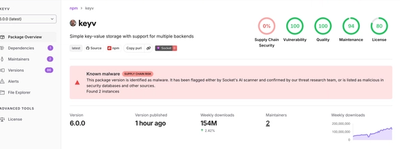
Popular npm packages keyv and cacheable compromised.

Security News
A misconfiguration gave three Anthropic models internet access, and one, believing it was in a simulation, shipped a credential-stealing package to PyPI.