
Research
/Security News
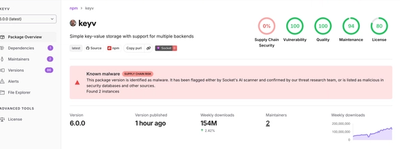
Popular npm Packages in the keyv and Cacheable Namespaces Compromised in Active Supply Chain Attack
Popular npm packages keyv and cacheable compromised.
By Socket Research Team - Aug 04, 2026
@constructive-io/errors
Advanced tools
Canonical Constructive error system: registry, codes, i18n messages, and cross-source (PostgreSQL/GraphQL/client) parsing. Zero runtime dependencies.
Canonical Constructive error system. Zero runtime dependencies — usable by any service or client without pulling in pgpm.
code to its
classification (public vs internal), HTTP hint, and default message.parse(anyError) — normalize an error from any source (a
ConstructiveError, a node-postgres DatabaseError, a GraphQL error or
{ errors: [...] } wrapper, a plain Error, or a string) into a canonical
{ code, context, class, known }.format(code, context, locale) — render a localized, interpolated
message. {{var}} placeholders + registerable per-locale catalogs (i18n).errors.* factory — type-safe throwable builders derived from the
registry, e.g. throw errors.MODULE_NOT_FOUND({ name }).classify(code) — public or internal; unknown codes are internal
(fail safe) so transports never leak unregistered errors.httpStatusFor(code) — the canonical code → HTTP status mapping, so no
transport keeps its own table. Unregistered codes answer 500 and are
reported, never silently.import { parse, format, errors, classify } from '@constructive-io/errors';
// Normalize a DB error surfaced through GraphQL
const parsed = parse(graphqlError);
if (parsed.class === 'public') {
showUser(format(parsed.code!, parsed.context, locale));
}
// Throw a structured error
throw errors.ACCOUNT_EXISTS();
code is deliberately separate from user-facing copy so codes
are stable and messages are localizable.parse() recovers structure from the code's precedence: structured DETAIL
JSON → GraphQL extensions.code → a leading ALL_CAPS token in the message
(legacy DB RAISE, incl. CODE (arg, arg) positional args) → native
SQLSTATE constraint mapping.src/generated/registry.generated.ts) — every code raised via
EXCEPTION/THROW across constructive-db (deploy sources + generated output),
each with a public/internal class, HTTP hint, and default message.src/registry.ts) — refined, typed-context entries for the codes
that matter most (public auth/limit copy, native PostgreSQL constraint codes,
pgpm CLI codes). These override the generated entries.parse() and are classified internal (masked).Every registry entry carries http, so an HTTP surface never needs its own
code → status table: toError(err).http, or httpStatusFor(code) when all you
have is a code.
import { httpStatusFor, setUnmappedStatusReporter, toError } from '@constructive-io/errors';

setUnmappedStatusReporter(code => log.warn({ code }, 'error code has no HTTP status'));

const err = toError(caught);
res.status(err.http).json(err.toExtensions());

httpStatusFor('ACCOUNT_DISABLED'); // { status: 403, mapped: true }
httpStatusFor('BRAND_NEW_CODE');   // { status: 500, mapped: false } + one report
mapped: false is the one case where a 500 does not mean "the server broke" —
it means the code never reached the registry. That is the failure mode this
exists to make loud: a refusal that is plainly a 403 or a 409 answering 500
looks like a crash, and the codes most likely to be missing are the newest ones.
When a constructive-db release adds codes, refresh the registry (below);
__tests__/registry-sync.test.ts fails if the snapshot and the generated
registry disagree.
The generated layer is produced from a committed audit snapshot:
# 1. re-audit constructive-db (refreshes scripts/db-error-inventory.json)
CONSTRUCTIVE_DB_DIR=~/repos/constructive-db python3 scripts/audit-db-errors.py
# 2. regenerate src/generated/registry.generated.ts from the snapshot
python3 scripts/generate-registry.py
audit-db-errors.py scans every EXCEPTION/THROW across constructive-db deploy
sources and generated output and writes scripts/db-error-inventory.json (the
committed audit snapshot). It also captures the authoritative public/internal
class from each canonical errors.raise_error('CODE', context, 'class') call — the
database is the source of truth for classification, so an explicit class is trusted
directly; codes without one (e.g. single-arg calls relying on the helper default, or
legacy RAISE EXCEPTION) fall back to a name-based heuristic.
generate-registry.py reads that snapshot and, when a
constructive-io/dashboard checkout is found (via DASHBOARD_DIR or a sibling
../dashboard), seeds public copy from its error catalogs. Re-run both whenever
constructive-db error codes change. Never hand-edit the generated file.
🚀 Quickstart: Getting Up and Running Get started with modular databases in minutes. Install prerequisites and deploy your first module.
📦 Modular PostgreSQL Development with Database Packages Learn to organize PostgreSQL projects with pgpm workspaces and reusable database modules.
✏️ Authoring Database Changes Master the workflow for adding, organizing, and managing database changes with pgpm.
🧪 End-to-End PostgreSQL Testing with TypeScript Master end-to-end PostgreSQL testing with ephemeral databases, RLS testing, and CI/CD automation.
⚡ Supabase Testing Use TypeScript-first tools to test Supabase projects with realistic RLS, policies, and auth contexts.
💧 Drizzle ORM Testing Run full-stack tests with Drizzle ORM, including database setup, teardown, and RLS enforcement.
🔧 Troubleshooting Common issues and solutions for pgpm, PostgreSQL, and testing.
SET LOCAL) into queries—ideal for setting role, jwt.claims, and other session settings.libpg_query, converting SQL into parse trees.Install skills for AI coding agents:
# All platform skills (security, blueprints, codegen, billing, etc.)
npx skills add constructive-io/constructive-skills

# Individual repo skills (pgpm, testing, CLI, search, etc.)
npx skills add https://github.com/constructive-io/constructive --skill pgpm
npx skills add https://github.com/constructive-io/constructive --skill constructive-testing
🛠 Built by the Constructive team — creators of modular Postgres tooling for secure, composable backends. If you like our work, contribute on GitHub.
AS DESCRIBED IN THE LICENSES, THE SOFTWARE IS PROVIDED "AS IS", AT YOUR OWN RISK, AND WITHOUT WARRANTIES OF ANY KIND.
No developer or entity involved in creating this software will be liable for any claims or damages whatsoever associated with your use, inability to use, or your interaction with other users of the code, including any direct, indirect, incidental, special, exemplary, punitive or consequential damages, or loss of profits, cryptocurrencies, tokens, or anything else of value.
FAQs
Canonical Constructive error system: registry, codes, i18n messages, and cross-source (PostgreSQL/GraphQL/client) parsing. Zero runtime dependencies.
The npm package @constructive-io/errors receives a total of 20,990 weekly downloads. As such, @constructive-io/errors popularity was classified as popular.
We found that @constructive-io/errors demonstrated a healthy version release cadence and project activity because the last version was released less than a year ago. It has 3 open source maintainers collaborating on the project.
Did you know?

Socket for GitHub automatically highlights issues in each pull request and monitors the health of all your open source dependencies. Discover the contents of your packages and block harmful activity before you install or update your dependencies.
Research
/Security News
Popular npm packages keyv and cacheable compromised.

Security News
A misconfiguration gave three Anthropic models internet access, and one, believing it was in a simulation, shipped a credential-stealing package to PyPI.

Security News
/Company News
Socket has joined the new Composer and Packagist sponsorship program as a launch sponsor, supporting the team that keeps PHP's package ecosystem secure.