

Security News
/Company News
Securing the Financial Frontier: How Capital One Uses Socket for Open Source Security
Capital One is partnering with Socket to proactively secure its open source supply chain.
By Sarah Gooding - Oct 01, 2026
@contextq/mcp
Advanced tools
MCP server for ContextQ — exposes the full ContextQ knowledge-management API as Model Context Protocol tools
MCP server for ContextQ -- exposes the ContextQ knowledge-management API (89 tools: save, search, ingest, goal graphs, agent sessions, relays, and more) as Model Context Protocol tools. A curated ~24-tool default set loads at connection to keep the token cost of tools/list low; the rest load on demand or via CONTEXT_MCP_TOOL_PROFILE=full -- see below.
npx -y @contextq/mcp
Two environment variables are required in every client:
| Variable | Description |
|---|---|
CONTEXT_API_URL | Base URL of your ContextQ server (e.g. https://ctx.example.com) |
CONTEXT_API_KEY | API key sent as Authorization: Bearer on every request |
Optional:
| Variable | Description |
|---|---|
CONTEXT_MCP_TOOL_PROFILE | default (default if unset) loads a curated ~24-tool set at connection, well under most hosts' comfortable tool-list budget; full loads all ~89 tools from the start. On default, the rest stay reachable via the ctx_tool_groups (list) / ctx_load_tool_group (load) tools without reconnecting -- see docs/mcp-tools.md "Discoverability under ToolSearch deferral" |
Setup paths: Claude Code and Claude Desktop have automated setup via the contextq init CLI command. Cursor, Windsurf, and Cline require manual config file editing — see docs/mcp-setup.md for the full reference.
Add to claude_desktop_config.json:
{
  "mcpServers": {
    "contextq": {
      "command": "npx",
      "args": ["-y", "@contextq/mcp"],
      "env": {
        "CONTEXT_API_KEY": "sk_live_YOUR_API_KEY",
        "CONTEXT_API_URL": "https://ctx.example.com"
      }
    }
  }
}
claude mcp add contextq \
  -e CONTEXT_API_KEY=sk_live_YOUR_API_KEY \
  -e CONTEXT_API_URL=https://ctx.example.com \
  -- npx -y @contextq/mcp
Add to your Cursor MCP config (.cursor/mcp.json or Settings > MCP):
{
  "mcpServers": {
    "contextq": {
      "command": "npx",
      "args": ["-y", "@contextq/mcp"],
      "env": {
        "CONTEXT_API_KEY": "sk_live_YOUR_API_KEY",
        "CONTEXT_API_URL": "https://ctx.example.com"
      }
    }
  }
}
STATUS (2026-06-02): Windsurf was rebranded as Devin Desktop and Cascade was end-of-lifed (2026-07-01). If you have an existing Windsurf install, the configuration below still applies, but new installations should use Devin Desktop instead. Devin Desktop uses the same MCP config format under .devin/mcp.json.
Add to your Windsurf MCP config (.windsurf/mcp.json):
{
  "mcpServers": {
    "contextq": {
      "command": "npx",
      "args": ["-y", "@contextq/mcp"],
      "env": {
        "CONTEXT_API_KEY": "sk_live_YOUR_API_KEY",
        "CONTEXT_API_URL": "https://ctx.example.com"
      }
    }
  }
}
CONTEXT_API_URL and returns the response. No telemetry, no background sync, no usage tracking beyond what your ContextQ server logs./api/* endpoints enforce tenant isolation -- an API key can only access the tenant it was issued for. Cross-tenant data leaks are impossible at the API layer.CONTEXT_API_KEY is sent as an Authorization: Bearer header on every call. It never appears in tool names, argument schemas, or responses returned to the LLM.A handful of ContextQ tools run LLM calls, kNN scans, or bulk DB operations server-side and can legitimately take longer than a typical MCP client's default request timeout. If your client aborts before the server responds, you will see a timeout error that looks like a broken tool — it usually isn't. Configure a longer per-server timeout for this MCP server rather than assuming the tool is hung.
Slow-class tools (recommend a longer timeout, e.g. 120000-180000 ms depending on workspace size):
| Tool | Why it's slow |
|---|---|
ctx_dream | Clusters a workspace's contexts via vector similarity, then runs one LLM synthesis call per cluster. |
ctx_evolve | Runs LLM judging over up to 20 nearest-neighbor contexts to decide links/archival. |
ctx_ingest | Fetches/parses a source and runs LLM claim extraction + kNN diffing. Large or URL-sourced ingests already return { jobId, statusUrl } and expect polling via ctx_ingest_status — but small inline ingests still run synchronously and can take several seconds. |
ctx_regenerate_mocs | Re-clusters all of a tenant's contexts and runs one LLM synthesis call per cluster (admin scope). |
ctx_memory_review_run | Samples older contexts and asks the LLM to verdict each one (superadmin scope). |
ctx_bulk_update | Applies a lifecycle/archive patch to up to 200 context ids in one call — bounded, but still slower than a single-row update. |
ctx_audit_cleanup_run | Deletes up to 5000 activity_logs rows in one pass (superadmin scope). |
ctx_snapshot_create / ctx_fork_world / ctx_diff_world | Clone or diff a workspace's full memory state (contexts, links, goal graph) — cost scales with workspace size. |
Everything else (ctx_search, ctx_get, ctx_save, ctx_list, agent_*, goal_*, relay_*, etc.) is ordinary CRUD/search and should complete well within a default client timeout.
These numbers are starting points, not guarantees — actual latency depends on your ContextQ server's hardware, workspace size, and configured LLM/embedding provider. Measure against your own deployment before tuning tighter.
.mcp.json per-server request_timeout_msMost MCP clients that support .mcp.json (including Claude Code) accept a per-server request_timeout_ms to override the client's default request timeout for every tool call on that server:
{
  "mcpServers": {
    "contextq": {
      "command": "npx",
      "args": ["-y", "@contextq/mcp"],
      "env": {
        "CONTEXT_API_KEY": "sk_live_YOUR_API_KEY",
        "CONTEXT_API_URL": "https://ctx.example.com"
      },
      "request_timeout_ms": 120000
    }
  }
}
request_timeout_ms applies per server, not per tool — if you regularly call slow-class tools, size it for the slowest one you expect to hit, not the average. Claude Code 2.1.206 fixed a bug where this field was silently ignored (a 60s default was applied regardless); confirm your Claude Code version is at least 2.1.206 if the setting doesn't seem to take effect.
Independently of request_timeout_ms, Claude Code (2.1.187+) also enforces CLAUDE_CODE_MCP_TOOL_IDLE_TIMEOUT — an idle-abort timeout (default around 5 minutes) that fires if an MCP tool call produces no activity for that long. Set it in your shell environment (not .mcp.json) when calling slow-class tools against a large workspace:
export CLAUDE_CODE_MCP_TOOL_IDLE_TIMEOUT=300000 # milliseconds; raise if ctx_dream/ctx_ingest still time out
Treat both settings as recommendations, not guarantees, of how long any given call will take.
The 99-tool surface exposed by this MCP server is a direct projection of the ContextQ API (24 loaded by default, the rest via CONTEXT_MCP_TOOL_PROFILE=full or on-demand -- see "Client configuration" above). The tool count and signatures drift with the server. Pin compatible versions:
| MCP package | ContextQ server API |
|---|---|
@contextq/mcp@2.x | ContextQ v2.x (99 tools) |
When upgrading your ContextQ server, check the changelog and bump the MCP package to the matching major version. A version mismatch may surface unknown tools or break call signatures.
MIT
FAQs
MCP server for ContextQ — exposes the full ContextQ knowledge-management API as Model Context Protocol tools
The npm package @contextq/mcp receives a total of 12 weekly downloads. As such, @contextq/mcp popularity was classified as not popular.
We found that @contextq/mcp demonstrated a healthy version release cadence and project activity because the last version was released less than a year ago. It has 1 open source maintainer collaborating on the project.
Security News
/Company News
Capital One is partnering with Socket to proactively secure its open source supply chain.
Security News
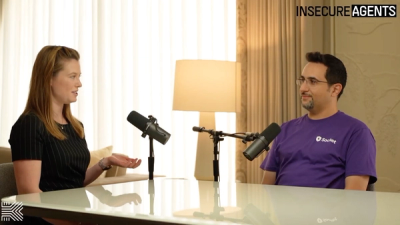
Socket CTO Ahmad Nassri discusses how to keep AI agents from bypassing package blocks, limit credential access, and monitor their actions.

Security News
GPT-6 Astra tried to plant malicious code in simulated open source projects using fake GitHub accounts and deceptive PRs during an assigned CTF challenge.