

Company News
AWS Security Hub Adds Socket for Supply Chain Security
Socket is now in the AWS Security Hub Extended plan. Adopt it through AWS, apply committed spend, and block malicious open source packages.
By Feross Aboukhadijeh - Aug 04, 2026
@ctalasila/pdf-report-generator
Advanced tools
MCP server that generates professional corporate PDF reports from structured content or raw LLM output
An MCP server that generates professional corporate PDF reports from structured JSON specs or raw LLM text output. Drop it into Claude Desktop (or any MCP client) and ask Claude to turn analysis, research, or meeting notes into a polished multi-page report complete with cover page, table of contents, executive summary, section headings, tables, and charts.
A sample output is at examples/sample_report.pdf.
Install Python dependencies:
pip install reportlab matplotlib
Add to your claude_desktop_config.json:
{
  "mcpServers": {
    "pdf-report": {
      "command": "npx",
      "args": ["-y", "pdf-report-generator"]
    }
  }
}
generate_reportGenerates a PDF from a full structured spec.
Minimal example input:
{
  "spec": {
    "metadata": {
      "title": "Q3 Performance Review",
      "author": "Engineering Team",
      "company": "Acme Corp",
      "classification": "INTERNAL"
    },
    "executive_summary": "Overall performance improved this quarter...",
    "sections": [
      {
        "heading": "Infrastructure",
        "body": "Uptime reached 99.94%...",
        "subsections": []
      }
    ],
    "tables": [],
    "charts": []
  }
}
generate_report_from_textConverts raw text into a structured PDF report. Sections are auto-detected from headings.
{
  "text": "# Overview\nThis quarter...\n\n# Key Findings\n...",
  "title": "Q3 Summary",
  "author": "Data Team",
  "company": "Acme Corp",
  "classification": "INTERNAL",
  "theme_name": "navy"
}
list_themesReturns available color themes: default, navy, charcoal, forest, burgundy.
metadata
  title*          string
  subtitle        string
  author          string
  date            string (YYYY-MM-DD; defaults to today)
  company         string
  department      string
  document_id     string  (e.g. RPT-2026-001)
  classification  string  (PUBLIC | INTERNAL | CONFIDENTIAL)
  logo_path       string  (absolute path to PNG/JPG)
  page_size       "letter" | "a4"

executive_summary  string

sections[]
  heading*        string
  body*           string  (\n\n = paragraph break)
  subsections[]
    heading*      string
    body*         string

tables[]
  title           string
  headers*        string[]
  rows*           string[][]
  after_section   int  (0-based section index; -1 = after exec summary)

charts[]
  title           string
  type            "bar" | "line" | "pie" | "horizontal_bar"
  labels*         string[]
  datasets*       [{label, values[]}]
  after_section   int

images[]
  path*           string  (absolute path)
  caption         string
  width_inches    number
  after_section   int

theme
  primary_color    [R, G, B]
  accent_color     [R, G, B]
  highlight_color  [R, G, B]
Python not found — ensure python or python3 is on your PATH and is version 3.8+.
reportlab not installed — run pip install reportlab matplotlib.
Charts missing — matplotlib is required for charts. Install it with pip install matplotlib.
Large PDFs — complex specs with many charts can take 5–15 seconds. This is normal.
MIT
FAQs
MCP server that generates professional corporate PDF reports from structured content or raw LLM output
We found that @ctalasila/pdf-report-generator demonstrated a healthy version release cadence and project activity because the last version was released less than a year ago. It has 1 open source maintainer collaborating on the project.
Did you know?

Socket for GitHub automatically highlights issues in each pull request and monitors the health of all your open source dependencies. Discover the contents of your packages and block harmful activity before you install or update your dependencies.
Company News
Socket is now in the AWS Security Hub Extended plan. Adopt it through AWS, apply committed spend, and block malicious open source packages.
Research
/Security News
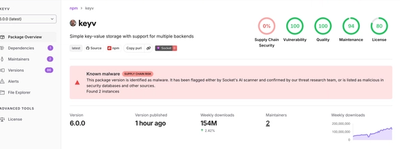
Popular npm packages keyv and cacheable compromised.

Security News
A misconfiguration gave three Anthropic models internet access, and one, believing it was in a simulation, shipped a credential-stealing package to PyPI.