
Research
/Security News
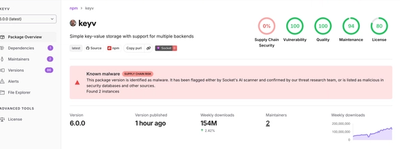
Popular npm Packages in the keyv and Cacheable Namespaces Compromised in Active Supply Chain Attack
Popular npm packages keyv and cacheable compromised.
By Socket Research Team - Aug 04, 2026
@cueapi/cuechain
Advanced tools
TypeScript primitive for verifying contracts between LLM pipeline steps. Typed inputs/outputs via Zod, quality gates with retry, and failure context that makes silent agent failure impossible.
Cuechain is not an LLM chaining framework. It is a contract verification primitive for TypeScript pipelines.


Imagine you ask a robot to bake a cake in six steps. At step 1, the robot grabs a tennis ball instead of an egg. It doesn't notice. It "cracks" the tennis ball, adds flour, mixes, pours, bakes, and announces "cake is done." From the outside, everything looks fine. A scheduler would record the execution as successful. But what's on the table is not a cake.
Every non-trivial AI agent workflow is a chain of steps where one step's output feeds the next step's input. LLMs are non-deterministic. They return JSON that almost matches the schema, fields that are the right shape but wrong content, arrays with the wrong length. Without verification at every handoff, bad data propagates silently through the pipeline and surfaces far from its root cause.
Cuechain catches the tennis ball at step 1. It validates contracts between every step in a pipeline, runs quality gates on outputs, and feeds failure context back into retries so LLM-driven steps can self-correct.
npm install @cueapi/cuechain zod
Zod is a peer dependency. You probably already have it.
import { z } from 'zod'
import { defineStep, pipeline } from '@cueapi/cuechain'

// Step 1: Load data
const loadData = defineStep({
  name: 'load-data',
  input: z.object({ source: z.string() }),
  output: z.object({ text: z.string(), wordCount: z.number() }),
  run: async (input) => {
    const text = `Content from ${input.source}`
    return { text, wordCount: text.split(/\s+/).length }
  },
})

// Step 2: Summarize (with a gate and retry)
const summarize = defineStep({
  name: 'summarize',
  input: z.object({ text: z.string(), wordCount: z.number() }),
  output: z.object({ summary: z.string() }),
  gates: [
    (out) =>
      out.summary.length <= 200
        ? { ok: true }
        : { ok: false, reason: `Summary too long: ${out.summary.length} chars` },
  ],
  retry: { maxAttempts: 3, on: ['gate'] },
  run: async (input, failureContext) => {
    if (failureContext) {
      // Use failure context to self-correct
      return { summary: input.text.slice(0, 100) }
    }
    return { summary: input.text }
  },
})

// Step 3: Format
const format = defineStep({
  name: 'format',
  input: z.object({ summary: z.string() }),
  output: z.object({ formatted: z.string() }),
  run: async (input) => ({ formatted: `RESULT: ${input.summary}` }),
})

// Compose and run
const myPipeline = pipeline('my-pipeline')
  .step(loadData)
  .step(summarize)
  .step(format)

const result = await myPipeline.run({ source: 'doc.md' })

if (result.ok) {
  console.log(result.value.formatted)
} else {
  console.error(`Failed at ${result.failure.step}: ${result.failure.reason}`)
}
A step has an input schema, an output schema (both Zod), and an async run function. The runtime validates input before running and output after.
const extractTitle = defineStep({
  name: 'extract-title',
  input: z.object({ draft: z.string() }),
  output: z.object({ title: z.string().max(80) }),
  run: async (input) => {
    const title = await callLLM(`Extract a title from: ${input.draft}`)
    return { title }
  },
})
A pipeline chains steps where each step's output feeds the next step's input. TypeScript enforces type compatibility at compile time. Runtime validates at every handoff.
const draft = pipeline('draft-monthly')
  .step(loadProfile)   // { month: string } -> { profile: Profile }
  .step(generateDraft) // { profile: Profile } -> { draft: string }
  .step(extractTitle)  // { draft: string } -> { title: string }
Mismatched types fail the build, not the runtime.
A gate is a pure synchronous function that checks a step's output beyond what a schema can express.
const step = defineStep({
  name: 'validate-draft',
  input: z.object({ draft: z.string() }),
  output: z.object({ draft: z.string(), charCount: z.number() }),
  gates: [
    (out) =>
      out.charCount <= 280
        ? { ok: true }
        : { ok: false, reason: `Draft is ${out.charCount} chars, max 280` },
    (out) =>
      !out.draft.includes('<script>')
        ? { ok: true }
        : { ok: false, reason: 'Draft contains unsafe HTML' },
  ],
  run: async (input) => ({
    draft: input.draft,
    charCount: input.draft.length,
  }),
})
Gates are pure code, not LLM calls. Deterministic verification only.
When a step fails, Cuechain retries it with the failure reason passed as a second argument. For LLM-driven steps, this means the next prompt can include why the previous attempt failed.
const step = defineStep({
  name: 'generate',
  input: z.object({ topic: z.string() }),
  output: z.object({ text: z.string() }),
  gates: [(out) => out.text.length < 500 ? { ok: true } : { ok: false, reason: 'too long' }],
  retry: { maxAttempts: 3, on: ['schema', 'gate'] },
  run: async (input, failureContext) => {
    const prompt = failureContext
      ? `Generate text about ${input.topic}. Previous attempt failed: ${failureContext.reason}`
      : `Generate text about ${input.topic}`
    return { text: await callLLM(prompt) }
  },
})
failureContext includes { reason, attempt, type } where type is 'schema', 'gate', or 'exception'.
Pipelines return Result<T> — either success with a value, or a structured failure identifying exactly what went wrong.
const result = await myPipeline.run(input)

if (!result.ok) {
  result.failure.step      // which step failed
  result.failure.reason    // human-readable reason
  result.failure.type      // 'schema_input' | 'schema_output' | 'gate' | 'exception'
  result.failure.attempts  // how many attempts were made
  result.failure.input     // what the step received
  result.failure.output    // what the step produced (if it got that far)
}
Prefer thrown exceptions? Use .runOrThrow():
try {
  const value = await myPipeline.runOrThrow(input)
} catch (error) {
  if (error instanceof PipelineError) {
    console.error(error.failure) // same structured failure
  }
}
const desc = myPipeline.describe()
// {
//   name: 'my-pipeline',
//   steps: [
//     { name: 'load-data', inputSchema: {...}, outputSchema: {...}, gates: 0, retry: {...} },
//     { name: 'summarize', inputSchema: {...}, outputSchema: {...}, gates: 1, retry: {...} },
//   ]
// }
Schemas are serialized as JSON Schema via zod-to-json-schema.
When a step fails, the Failure object contains the raw input, output, and error.message from the step. This is useful for debugging but may contain sensitive data if your step processes PII, API keys, or other confidential information.
Before exposing failures to end users, logs, or monitoring systems, sanitize the failure object:
const result = await myPipeline.run(input)

if (!result.ok) {
  // Internal logging — full context
  logger.debug('Pipeline failure', result.failure)

  // User-facing — redact raw data
  const safeError = {
    step: result.failure.step,
    reason: result.failure.reason,
    type: result.failure.type,
    attempts: result.failure.attempts,
    // Omit: input, output (may contain sensitive data)
  }
  return { error: safeError }
}
A pipeline-level onFailure redaction hook is planned for v0.2.
Cuechain verifies contracts between steps. CueAPI verifies outcomes against reality. Use one, use both.
Standalone Cuechain: run a contract-verified pipeline from any trigger — a button click, an HTTP handler, a test, a local script. No infrastructure required.
Standalone CueAPI: schedule a cue that fires a webhook. The handler does whatever it wants internally. No Cuechain required.
Composed: CueAPI fires on schedule, the handler invokes a Cuechain pipeline, the pipeline runs contract-verified steps and returns a structured result, the handler reports that result back to CueAPI as the outcome. Outcome verification at the temporal boundary, contract verification at the data boundary.
Cuechain does not import CueAPI. The relationship is compositional, not architectural.
Narrow scope is the product.
defineStep(config)Define a pipeline step.
| Field | Type | Required | Description |
|---|---|---|---|
name | string | Yes | Step identifier |
input | z.ZodType | Yes | Input schema |
output | z.ZodType | Yes | Output schema |
run | (input, failureContext?) => Promise<output> | Yes | Step function |
gates | Gate[] | No | Quality gate functions |
retry | { maxAttempts?, on? } | No | Retry config |
pipeline(name)Create a pipeline builder. Chain .step() to add steps.
Pipeline.run(input)Returns Result<T> — { ok: true, value } or { ok: false, failure }.
Pipeline.runOrThrow(input)Returns the value directly. Throws PipelineError on failure.
Pipeline.describe()Returns PipelineDescription with step metadata and JSON Schemas.
MIT. Vector Apps Inc.
FAQs
TypeScript primitive for verifying contracts between LLM pipeline steps. Typed inputs/outputs via Zod, quality gates with retry, and failure context that makes silent agent failure impossible.
We found that @cueapi/cuechain demonstrated a healthy version release cadence and project activity because the last version was released less than a year ago. It has 1 open source maintainer collaborating on the project.
Did you know?

Socket for GitHub automatically highlights issues in each pull request and monitors the health of all your open source dependencies. Discover the contents of your packages and block harmful activity before you install or update your dependencies.
Research
/Security News
Popular npm packages keyv and cacheable compromised.

Security News
A misconfiguration gave three Anthropic models internet access, and one, believing it was in a simulation, shipped a credential-stealing package to PyPI.

Security News
/Company News
Socket has joined the new Composer and Packagist sponsorship program as a launch sponsor, supporting the team that keeps PHP's package ecosystem secure.