


Research
/Security News
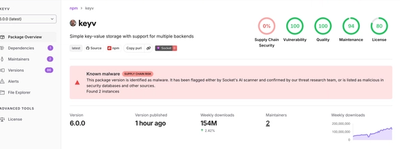
Popular npm Packages in the keyv and Cacheable Namespaces Compromised in Active Supply Chain Attack
Popular npm packages keyv and cacheable compromised.
By Socket Research Team - Aug 04, 2026
@cyanheads/attack-surface-mcp-server
Advanced tools
Passive external attack-surface mapping: CT subdomains, DNS, TLS, HTTP posture, RDAP/WHOIS, Shodan via MCP. STDIO or Streamable HTTP.
Passive external attack-surface mapping: CT subdomains, DNS, TLS, HTTP posture, RDAP/WHOIS, Shodan via MCP. STDIO or Streamable HTTP.









[!IMPORTANT] Authorized, defensive use only. Point this server only at assets you own or are explicitly authorized to assess. It performs passive, non-intrusive reconnaissance — it reads public records (Certificate Transparency logs, DNS, RDAP/WHOIS) and each target's own published surface (one TLS handshake and one HTTP GET per host). It does not port-scan, exploit, brute-force, fuzz, or probe for vulnerabilities; that capability is excluded from the surface by design, not gated behind a flag. Output is descriptive — what exists and what the security posture is — never an exploitation plan. Every outbound connection passes an SSRF guard that refuses private, loopback, link-local, and cloud-metadata targets.
Eight tools organized around the recon workflow — attacksurface_map_domain orchestrates the full flow end to end, the per-aspect tools back it for targeted follow-up, and attacksurface_recon_guidance synthesizes findings into a defensive review plan. Seven are keyless; one (attacksurface_lookup_host) needs a Shodan key and degrades gracefully without it.
| Tool | Description |
|---|---|
attacksurface_map_domain | Flagship workflow. Maps a domain's external surface end to end: CT-log subdomain discovery → DNS liveness → (standard+) DNS records, TLS posture, HTTP headers/tech → optional RDAP/WHOIS → (thorough + key) per-IP Shodan enrichment. Returns a structured surface map and a defensive assessment of observable facts. |
attacksurface_enumerate_subdomains | Passive subdomain discovery from Certificate Transparency logs (crt.sh → Certspotter → TLS-SAN fallback chain), with DNS resolution to mark which names are live. Per-source provenance; no DNS brute-forcing. |
attacksurface_resolve_dns | Resolve and enumerate DNS records (A/AAAA/CNAME/MX/NS/TXT/CAA) for one or more hosts across multiple public resolvers, with optional reverse DNS (PTR). Per-resolver values surface propagation gaps. |
attacksurface_inspect_tls | Inspect TLS/SSL posture via a real read-only handshake: protocol, cipher, full certificate chain, SANs, validity window, days-to-expiry, issuer, validation status. Reports invalid/expired/self-signed certs instead of failing. |
attacksurface_probe_http | Passive HTTP(S) probe: one GET following redirects. Returns status, redirect chain, headers, a security-header audit (HSTS/CSP/X-Frame-Options/cookie flags/CORS reflection), and an evidence-bound technology fingerprint. |
attacksurface_lookup_registration | Registration and ownership lookup via RDAP (JSON; WHOIS fallback). A domain returns registrar, status, lifecycle events, nameservers, DNSSEC; an IP/CIDR returns netblock, allocation CIDRs, origin ASN, country. |
attacksurface_lookup_host | Infrastructure intelligence for a single IP (open ports, banners, software versions, ASN, geo) or a faceted internet-wide search, via Shodan. Requires SHODAN_API_KEY — returns a typed source_unavailable error when unset; the rest of the server is unaffected. |
attacksurface_recon_guidance | Offline synthesis over findings gathered so far. Returns a prioritized defensive review plan plus pre-filled follow-up calls (which certs to renew, which hosts to inspect, which software versions to check for CVEs against an external NVD/OSV server). No external calls. |
attacksurface_map_domainThe spine of most engagements — one call maps a domain end to end.
depth control: quick = subdomains + liveness only; standard = + DNS records, TLS, and HTTP posture; thorough = + Shodan enrichment (when a key is present, otherwise skipped with a note)includeRegistration adds an RDAP/WHOIS lookup for the apex at standard+ depthPromise.allSettled — one failed source or unreachable host degrades to a note, never tanks the callATTACKSURFACE_MAX_SUBDOMAINS, default 200) with the cap disclosed when hitassessment block synthesizes only observable facts — expiring certs, missing HSTS/CSP, weak TLS versions, failed chain validation — never an exploitation pathattacksurface_enumerate_subdomainsPassive subdomain discovery from public Certificate Transparency logs.
includeUnresolved: false returns only live hostsattacksurface_resolve_dnsMulti-resolver DNS enumeration with propagation visibility.
8.8.8.8, 1.1.1.1, 9.9.9.9)attacksurface_inspect_tlsRead-only TLS posture inspection — surfacing problems is the point.
attacksurface_probe_httpA single passive HTTP(S) GET with a security read-out.
attacksurface_lookup_registrationRegistration and ownership from public registries.
attacksurface_lookup_hostShodan infrastructure intelligence — the one optional-key path.
mode: "host" (default) — a free single-IP lookup: open ports, service banners, software versions, hostnames, ASN, geomode: "search" — a faceted internet-wide query that consumes paid Shodan query creditsSHODAN_API_KEY; without it the tool returns a typed source_unavailable error and every other tool keeps workingattacksurface_recon_guidanceState-aware synthesis — no network calls, just reasoning over what you've found.
nist-nvd-mcp-server) or OSV (osv-advisory-mcp-server) server for CVE context| Type | Name | Description |
|---|---|---|
| Resource | attacksurface://surface/{domain} | Read-once snapshot of a domain's mapped surface (subdomains, live hosts, per-host TLS/HTTP posture summary), equivalent to a standard-depth attacksurface_map_domain call. |
All resource data is also reachable via tools — tool-only clients lose nothing, since attacksurface_map_domain covers the same ground. Large maps disclose a truncation count rather than returning unbounded host detail. The server exposes no prompts; attacksurface_recon_guidance supplies the one "structure the next steps" pattern as a state-aware tool instead of a static template.
Built on @cyanheads/mcp-ts-core:
none, jwt, oauthin-memory, filesystem, Supabase, Cloudflare KV/R2/D1Attack-surface-specific:
ATTACKSURFACE_ALLOW_PRIVATE_TARGETS)Agent-friendly output:
source: crt.sh | certspotter | tls-san, source: rdap | whois) and per-source status so agents can assess completeness and trusterror fields and operational notes instead of failing the whole call; only malformed input throwssource_unavailable, blocked_target, all_sources_failed) and union output (kind: domain | ip) let callers branch on data, not string parsingAdd the following to your MCP client configuration file. Every tool except attacksurface_lookup_host works with no configuration — the keyless core boots on an empty environment.
{
  "mcpServers": {
    "attack-surface-mcp-server": {
      "type": "stdio",
      "command": "bunx",
      "args": ["@cyanheads/attack-surface-mcp-server@latest"],
      "env": {
        "MCP_TRANSPORT_TYPE": "stdio",
        "MCP_LOG_LEVEL": "info"
      }
    }
  }
}
Or with npx (no Bun required):
{
  "mcpServers": {
    "attack-surface-mcp-server": {
      "type": "stdio",
      "command": "npx",
      "args": ["-y", "@cyanheads/attack-surface-mcp-server@latest"],
      "env": {
        "MCP_TRANSPORT_TYPE": "stdio",
        "MCP_LOG_LEVEL": "info"
      }
    }
  }
}
Or with Docker:
{
  "mcpServers": {
    "attack-surface-mcp-server": {
      "type": "stdio",
      "command": "docker",
      "args": ["run", "-i", "--rm", "-e", "MCP_TRANSPORT_TYPE=stdio", "ghcr.io/cyanheads/attack-surface-mcp-server:latest"]
    }
  }
}
To enable Shodan host intelligence (attacksurface_lookup_host), add SHODAN_API_KEY to the env block.
For Streamable HTTP, set the transport and start the server:
MCP_TRANSPORT_TYPE=http MCP_HTTP_PORT=3010 bun run start:http
# Server listens at http://localhost:3010/mcp
Refer to "your MCP client configuration file" generically — different clients use different config paths and this server isn't client-specific.
attacksurface_lookup_host, and a Certspotter API key to raise CT-fallback rate limits.git clone https://github.com/cyanheads/attack-surface-mcp-server.git
cd attack-surface-mcp-server
bun install
cp .env.example .env
# edit .env only if you want Shodan, a Certspotter key, or non-default behavior
All variables are optional — the server boots and delivers its keyless core with an empty environment.
| Variable | Description | Default |
|---|---|---|
SHODAN_API_KEY | Enables attacksurface_lookup_host. Absent → that tool returns source_unavailable; every other tool keeps working. | — |
CERTSPOTTER_API_KEY | Raises Certspotter rate limits for the CT-log subdomain fallback. Absent → free unauthenticated tier (rate-limited but functional). | — |
ATTACKSURFACE_DEFAULT_RESOLVERS | Comma-separated default DNS resolver IPs for attacksurface_resolve_dns. | 8.8.8.8,1.1.1.1,9.9.9.9 |
ATTACKSURFACE_HTTP_USER_AGENT | Default User-Agent for attacksurface_probe_http (overridable per call). | identifies the server honestly |
ATTACKSURFACE_MAX_SUBDOMAINS | Cap on subdomains resolved during a map_domain run — bounds fan-out cost. | 200 |
ATTACKSURFACE_RDAP_BOOTSTRAP_URL | RDAP bootstrap base URL; override for a private/mirrored RDAP. | https://rdap.org |
ATTACKSURFACE_ALLOW_PRIVATE_TARGETS | Set true to disable the SSRF guard for internal-network assessment. Leave false on any public deployment — it is the safety boundary that keeps the server from being pointed at internal infrastructure. | false |
MCP_TRANSPORT_TYPE | Transport: stdio or http. | stdio |
MCP_HTTP_PORT | Port for HTTP server. | 3010 |
MCP_AUTH_MODE | Auth mode: none, jwt, or oauth. | none |
MCP_LOG_LEVEL | Log level (RFC 5424). | info |
OTEL_ENABLED | Enable OpenTelemetry instrumentation. | false |
See .env.example for the full list of optional overrides.
Build and run:
# One-time build
bun run rebuild

# Run the built server
bun run start:stdio
# or
bun run start:http
Run checks and tests:
bun run devcheck   # Lint, format, typecheck, security
bun run test       # Vitest test suite
bun run lint:mcp   # Validate MCP definitions against spec
docker build -t attack-surface-mcp-server .
docker run --rm -e MCP_TRANSPORT_TYPE=http -p 3010:3010 attack-surface-mcp-server
The Dockerfile defaults to HTTP transport, stateless session mode, and logs to /var/log/attack-surface-mcp-server. OpenTelemetry peer dependencies are installed by default — build with --build-arg OTEL_ENABLED=false to omit them.
| Directory | Purpose |
|---|---|
src/index.ts | createApp() entry point — registers tools/resources and inits the six services. |
src/config | Server-specific environment variable parsing and validation with Zod. |
src/mcp-server/tools | Tool definitions (*.tool.ts). |
src/mcp-server/resources | Resource definitions (*.resource.ts). |
src/services | Domain service integrations (ct, dns, tls, http, registration, shodan). |
src/utils | SSRF guard and input validation. |
tests/ | Unit and integration tests mirroring src/. |
See CLAUDE.md/AGENTS.md for development guidelines and architectural rules. The short version:
try/catch in tool logicctx.log for request-scoped logging, ctx.state for tenant-scoped storagesrc/mcp-server/*/definitions/index.tsassertSafeDomain / assertSafeUrl / assertSafeResolverIp) before connectingIssues and pull requests are welcome. Run checks and tests before submitting:
bun run devcheck
bun run test
Apache-2.0 — see LICENSE for details.
FAQs
Passive external attack-surface mapping: CT subdomains, DNS, TLS, HTTP posture, RDAP/WHOIS, Shodan via MCP. STDIO or Streamable HTTP.
We found that @cyanheads/attack-surface-mcp-server demonstrated a healthy version release cadence and project activity because the last version was released less than a year ago. It has 1 open source maintainer collaborating on the project.
Did you know?

Socket for GitHub automatically highlights issues in each pull request and monitors the health of all your open source dependencies. Discover the contents of your packages and block harmful activity before you install or update your dependencies.
Research
/Security News
Popular npm packages keyv and cacheable compromised.

Security News
A misconfiguration gave three Anthropic models internet access, and one, believing it was in a simulation, shipped a credential-stealing package to PyPI.

Security News
/Company News
Socket has joined the new Composer and Packagist sponsorship program as a launch sponsor, supporting the team that keeps PHP's package ecosystem secure.