


Product
PHP and Composer Support Is Now in Beta
Socket’s PHP and Composer support is now in Beta for all customers, with PHP reachability analysis generally available.
By Trevor Norris, Benjamin Barslev - Aug 21, 2026
@davesheffer/hunch
Advanced tools
Engineering memory and a deterministic Change Gate for AI-assisted codebases: decisions, rejected approaches, constraints, and bug lineage become portable context and opt-in enforcement for every MCP assistant.


For the precise rules your team explicitly trusts and proves, Hunch gives a concrete guarantee: your agents do not re-make a decided decision or re-introduce a fixed bug without a deterministic violation being surfaced. The mechanism is an engineering-memory and architectural-conformance layer — the decisions, constraints, rejected approaches, and bug history behind your code, delivered as evidence before an assistant changes anything, with the result checked deterministically after.
Memory starts advisory. Nothing blocks until you explicitly trust a precise rule and choose strict enforcement.
Memory is the input. The product boundary is the receipt: relevant evidence before an edit, then a deterministic check of the change against the rules your team has explicitly trusted.
New in v1.18.0: YAML and Helm now enter the same dependency graph as application code. Anchors and aliases become reference edges; chart-scoped
define,include, andtemplaterelationships survive pre-render syntax without weakening fail-closed handling for ordinary invalid YAML.
Read the v1.18 release story for the graph semantics, chart boundaries, honest limits, and Oliver Sampson's contribution.
See the public roadmap for what is next and what is deliberately out of scope.
Requires Node 22.13+ and a git repository.
npm i -g @davesheffer/hunch
cd your-repo
hunch init
hunch backfill --since 90d   # optional: seed memory from recent history
Reload your coding assistant, then ask:
Why is this built this way?
hunch init indexes the repo, installs the local memory hooks, and connects supported assistants
to the same graph. It merges into existing configuration instead of replacing it.
hunch import-adr populates the graph from an existing MADR/Nygard corpus;
hunch export-adr projects it back as standard MADR any ADR reader understands, and the
projection then tracks the graph automatically and reports its own drift.The source of truth is readable JSON in .hunch/. A local SQLite index makes retrieval fast but
is always rebuildable.
Most memory work happens automatically after commits. These commands cover the common manual paths:
| Command | Use it for |
|---|---|
hunch why <file> | Decisions, bugs, constraints, and blast radius behind a file |
hunch query "<question>" | Search project memory |
hunch check --working | Review all current changes against recorded intent |
hunch log | See the memory timeline and its reversible moves |
hunch escalations | See the rare decisions only a human can make |
hunch doctor | Diagnose setup, provider, index, or private-overlay problems |
Corrections can become scoped rules, but captured memory cannot hard-block on its own. Enforcement is deterministic and opt-in:
hunch firmness strict
hunch check --staged --strict
Matrix mode keeps the team's decisions, corrections, constraints, and proofs in one dedicated Git repository, separate from the code repository. Hunch does not host that repository: create a private Git repo that every teammate can access, install the Matrix release on team machines and CI, then have one maintainer run:
npm i -g @davesheffer/hunch@1.18.1
hunch shared --repo git@github.com:acme/project-hunch-memory.git
git add .gitignore .hunch/team.json
git commit -m "chore: connect shared Hunch memory"
git push
Use a credential-free URL in the command; keep tokens in your Git credential helper or use SSH.
If this project already publishes memory in .hunch/ and you want to move it into the dedicated
repo, add --migrate, review the reported untrack/ignore changes, and follow the commit instructions
printed by Hunch. Omit --migrate for a new setup.
After the pointer commit lands, teammates need Hunch installed and Git access to the memory repo:
npm i -g @davesheffer/hunch@1.18.1
git pull
hunch init
hunch doctor
hunch init validates and connects an ignored local clone of the memory repo. Memory-reading and
writing CLI operations attempt a bounded refresh at startup; connected MCP sessions check for new
team memory at each tool-request boundary and rebuild their local index only when the JSON changed.
New captures route to that repo and are committed and synchronized automatically by default. If a
push cannot complete, a later capture or hunch shared --sync retries it.
The committed .hunch/team.json contains only the credential-free memory-repo locator and canonical
branch. The ignored .hunch/local.json contains local paths and preferences, not credentials;
authentication stays in SSH or the normal Git credential helper. Shared memory records,
.hunch/local.json, and .hunch-private/ stay out of code history. Use
hunch check --base origin/main --strict --public-only --format markdown for output that may be
posted publicly; omit --public-only for an internal check that should enforce team memory.
HUNCH_PRIVATE_DIR remains an explicit process-level override for CI and portability. When it
redirects a repo away from .hunch/local.json or bypasses an advertised team store, CLI and MCP
startup warn on stderr and hunch doctor labels the effective source.
For a correction that Hunch can express as a deterministic policy, create and inspect its proof-backed proposal:
hunch policy upgrade-correction con_...
hunch policy card pol_...
The upgrade creates evidence, a plan, and a proof but leaves the policy proposed with
authority: none. A proved policy still requires explicit, audited human acceptance before it can
become advisory or blocking; Hunch never grants that authority automatically.
Need to pause or roll back without deleting memory?
hunch firmness off
hunch shared --repo git@github.com:acme/project-hunch-memory.git --no-auto-commit
# Later, publish any pending local memory explicitly:
hunch shared --sync
The first command turns off agent-hook enforcement; the second keeps shared reads and local captures
but stops automatic memory commits and pushes. As a team-coordinated rollback, revert the setup
commit to stop discovery after teammates pull the revert. Existing machines retain their ignored
local overlay until they are deliberately disconnected; do not delete the memory repo as part of a
rollback. For this rollout, reinstall the previous published package with
npm i -g @davesheffer/hunch@1.16.0; the release receipt resolves and records the verified rollback
target from the npm registry instead of trusting Git tags. Pause enforcement first as shown above,
and keep every team client on the same release before resuming Matrix policy workflows.
Hunch can draft structured memory through:
When several subscription CLIs are installed, Hunch does not guess which plan to use:
hunch provider codex-cli
Local and private-network endpoints work without a billing flag. Every public remote requires the
explicit HUNCH_SYNTH_ALLOW_METERED=1 opt-in, because Hunch cannot infer cost from a hostname.
See Synthesis & billing for setup details.
Hunch has no hosted memory service or telemetry. Your graph travels with git and speaks MCP, so it is not tied to one editor or model provider.
Sensitive reasoning can live in a separate private overlay:
hunch private --repo git@github.com:you/project-memory.git
Local tools see the combined graph; public CI and committed documentation stay public-only.
Hunch releases are built and tested without publication credentials. The resulting npm tarball or VSIX is content-addressed, carried unchanged into a minimal publisher, and checked again against the registry after publication. The npm path also runs native, atomic-write, and Matrix safety checks on Windows and macOS and verifies provenance back to the exact source tag.
The editor companion is published from an exact vscode-v* tag to
Open VSX. The workflow verifies the
downloaded public VSIX has the same digest as the credential-free release candidate.
Apache-2.0
FAQs
Engineering memory and a deterministic Change Gate for AI-assisted codebases: decisions, rejected approaches, constraints, and bug lineage become portable context and opt-in enforcement for every MCP assistant.
The npm package @davesheffer/hunch receives a total of 928 weekly downloads. As such, @davesheffer/hunch popularity was classified as not popular.
We found that @davesheffer/hunch demonstrated a healthy version release cadence and project activity because the last version was released less than a year ago. It has 1 open source maintainer collaborating on the project.
Product
Socket’s PHP and Composer support is now in Beta for all customers, with PHP reachability analysis generally available.
Product
Socket is bringing experimental protection to Firefox, scanning 97,000+ extensions in Mozilla's official directory for malware and risky updates.
Research
/Security News
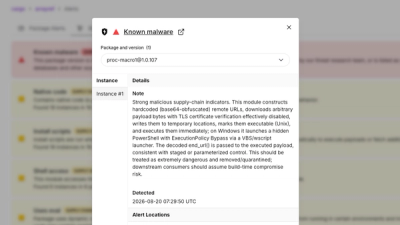
Three compromised Rust crates pulled in a malicious dependency that downloaded and executed cross-platform malware during Cargo builds.