


Security News
Ruby's Bundler 4.0.18 Extends Cooldown to bundle lock and bundle cache
The supply chain control that delays freshly published gems now covers lockfile generation and gem vendoring in Ruby projects.
By Sarah Gooding - Aug 06, 2026
@decantr/mcp-server
Advanced tools
MCP server for Decantr — exposes Contract context, typed graph artifacts, and verification evidence to AI coding assistants



Support status: core-supported
Release channel: stable
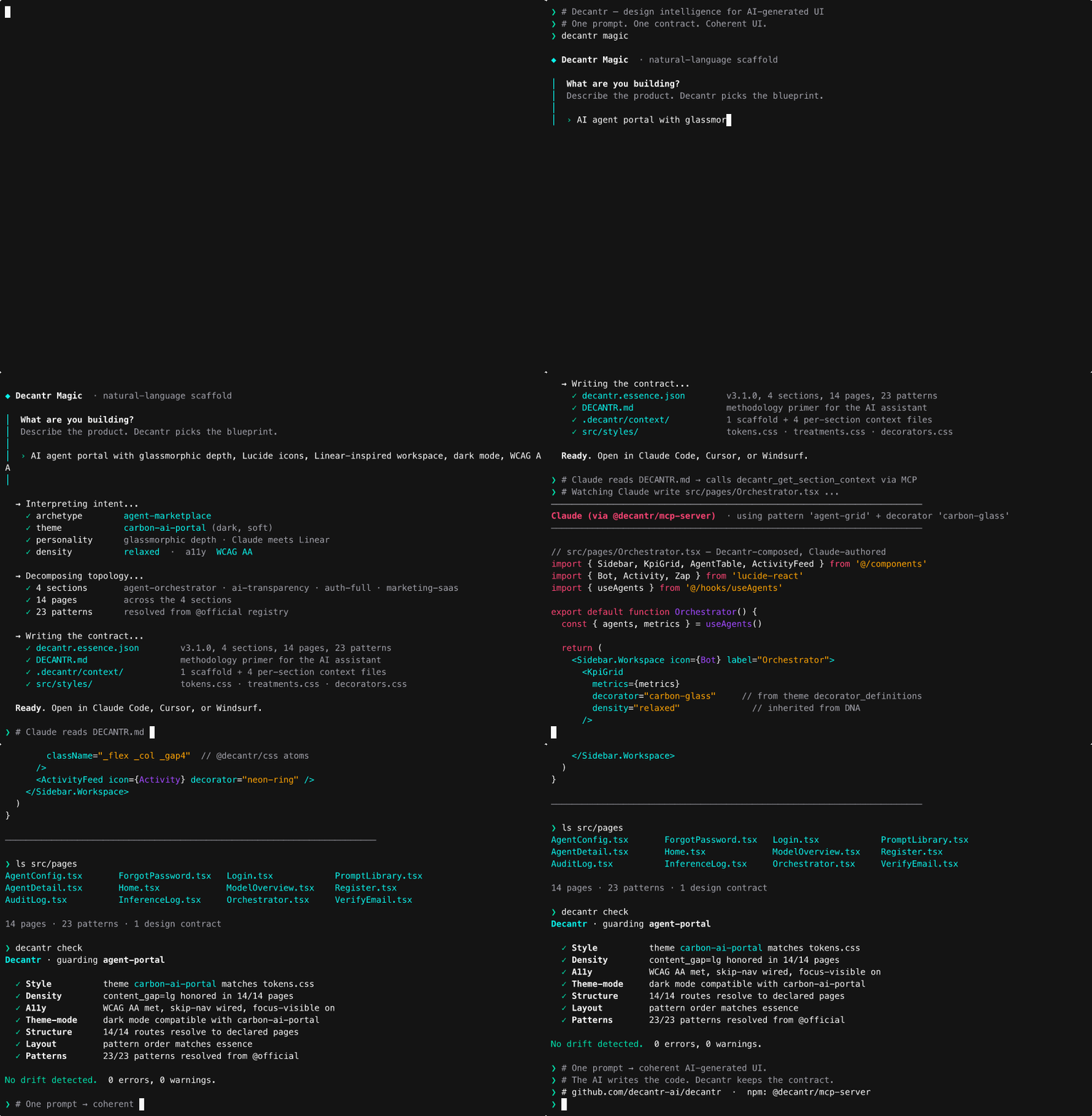
AI Frontend Governance for codebases touched by AI agents. Give Claude, Cursor, Windsurf, VS Code, Zed, and Continue a typed Contract, scoped Context, and repairable Evidence instead of a giant rule dump.
npx, no API keys or accounts requiredAdd to your Claude Desktop config (~/Library/Application Support/Claude/claude_desktop_config.json on macOS):
{
  "mcpServers": {
    "decantr": {
      "command": "npx",
      "args": ["@decantr/mcp-server"]
    }
  }
}
Restart Claude Desktop. The Decantr tools will appear automatically.
Preferred setup:
npx @decantr/cli connect cursor
From a monorepo root:
pnpm exec decantr connect cursor --project apps/web
The connector preserves existing MCP servers and writes the project rule that tells Cursor Agent to call Decantr task context before route edits. For manual setup, create .cursor/mcp.json in your project root:
{
  "mcpServers": {
    "decantr": {
      "command": "npx",
      "args": ["-y", "@decantr/mcp-server"]
    }
  }
}
Restart Cursor. The tools are available in Agent mode. Add a project rule equivalent to decantr connect cursor if you configure MCP manually.
Add to your Windsurf MCP config (~/.windsurf/mcp.json):
{
  "mcpServers": {
    "decantr": {
      "command": "npx",
      "args": ["@decantr/mcp-server"]
    }
  }
}
Create .vscode/mcp.json in your workspace (or add to your user profile mcp.json):
{
  "servers": {
    "decantr": {
      "command": "npx",
      "args": ["-y", "@decantr/mcp-server"]
    }
  }
}
MCP tools are available in VS Code Copilot Chat agent mode.
Add to your Zed settings.json:
{
  "context_servers": {
    "decantr": {
      "command": "npx",
      "args": ["-y", "@decantr/mcp-server"],
      "env": {}
    }
  }
}
Create .continue/mcpServers/decantr.yaml in your workspace:
name: Decantr MCP Server
version: 0.0.1
schema: v1
mcpServers:
  - name: Decantr
    type: stdio
    command: npx
    args:
      - "-y"
      - "@decantr/mcp-server"
MCP tools are only available in Continue.dev agent mode.
The server exposes a hard 8-tool MCP surface. Pass an action to select the routed behavior:
| Tool | Description | Example Input |
|---|---|---|
decantr_project | Read local project state, canonical adoption truth, shared discovery summary, and workspace health | { "action": "state", "project_path": "apps/web" } |
decantr_contract | Read Essence, validate, check drift, generate a skeleton, or read the Contract capsule | { "action": "validate", "path": "./decantr.essence.json" } |
decantr_context | Read scaffold, section, page, task, shared discovery summary, and execution-pack context | { "action": "task", "project_path": "apps/web", "route": "/feed", "task": "improve recipe card loading" } |
decantr_graph | Read graph snapshots, query graph nodes/edges, or traverse graph relations | { "action": "query", "project_path": "apps/web", "file_path": "src/app/page.tsx", "include_impact": true } |
decantr_registry | Compatibility content-corpus tool for official vocabulary, benchmarks, and execution packs | { "action": "resolve_pattern", "id": "data-table", "preset": "product" } |
decantr_verify | Run audit, critique, findings, v2 evidence bundles with discovery metadata, or health-loop reads | { "action": "evidence_bundle", "project_path": "apps/web" } |
decantr_repair | Return typed findings, repair plans, repair prompts, and v2 health-loop guidance | { "action": "health_loop", "project_path": "apps/web" } |
decantr_contract_write | Explicit write surface for accepting drift, deferring drift to the drift log, or mutating Essence v4 | { "action": "update_essence", "operation": "add_feature", "payload": { "feature": "billing" } } |
decantr_context task responses default to "detail": "compact". Compact mode projects the verifier-owned TaskCapsuleV1 into the existing response fields and adds task_capsule_version: "task-capsule.v1". The returned task is exactly the canonical capsule request: only createTaskCapsuleV1() may truncate it, and task_capsule_budget, task_capsule_truncation, and task_capsule_digest describe that exact result. The compatibility envelope may prune lower-priority duplicated context, but it never truncates task independently, and the complete response remains within 12,000 canonical UTF-8 bytes / 4,000 estimated tokens. Pass "detail": "full" only for diagnostic clients that need the complete graph and context payload. Both modes return response_detail. Task activation reports blocked_missing_graph when graph artifacts are absent or stale. Angular Brownfield task activation returns DISCOVERY_NOT_PROVEN when the requested route is not backed by complete, bootstrap-reachable production authority; live discovery outranks stale analysis artifacts.
Local scaffold, page, and section paths selected by pack-manifest.json are read or emitted as task read targets only when they resolve to real files contained under the selected project's .decantr/context directory. Missing, escaped, directory, and symlink-escaped references are ignored; existing scaffold.md and section-<id>.md narrative context remains the local fallback. In Greenfield style-bridge adoption, the accepted bridge maps onto the host project's tokens, classes, and styling runtime; it does not activate @decantr/css.
decantr_project state includes verifier-built AdoptionTruthV1. Official corpus actions under the compatibility-named decantr_registry tool use @decantr/content implementations; there is no ninth decantr_content tool.
For the broader product surface and support policy, see the root Decantr docs and package support matrix.
For Decantr 3 assistant prompt migration, see the MCP migration guide: https://decantr.ai/reference/mcp-migration.md.
The MCP server reads Decantr files, including .decantr/graph typed graph artifacts, and selected project files from the active workspace. Write access is limited to the explicit decantr_contract_write tool with accept_drift and update_essence actions. accept_drift may defer a finding to .decantr/drift-log.json when the caller explicitly requests that resolution. Paths are contained to the active workspace root.
Content-corpus and pack-resolution tools may call the configured Decantr API. Source upload fallbacks for hosted critique/audit are retired; verification tools run local reads unless a future major version introduces a new upload contract. The MCP server does not emit Decantr telemetry. See security permissions.
The npm package bundles the MCP SDK modules used by its stdio transport. It does not install the SDK's unused HTTP server dependency tree. Bundled-code licenses are retained in THIRD_PARTY_NOTICES.md.
@decantr/mcp-server is stable in the Decantr 3 line for the documented MCP tool surface.
Decantr 3.4 consolidated legacy MCP tool names into the eight action-based tools above. Decantr 3.9 keeps that inventory, server identity, stdio transport, and existing action names; adds canonical adoption/task proof data through existing actions; and routes official corpus compatibility through decantr_registry rather than adding a ninth tool. For example, decantr_get_project_state becomes decantr_project with { "action": "state" }, decantr_get_graph_snapshot becomes decantr_graph with { "action": "snapshot" }, and the legacy write tools become decantr_contract_write with { "action": "accept_drift" } or { "action": "update_essence" }.
The npm tarball includes server.json so MCP directories can read the same stable identity and transport metadata as repository consumers.
An Essence spec (decantr.essence.json) captures your design intent -- archetype, theme, page structure, patterns, and guard rules -- in a single declarative file. The MCP server exposes this spec and the official Decantr content corpus to your AI assistant, giving it concrete layout specs, component lists, and visual treatments instead of relying on the model's generic training data. The result is generated code that follows a coherent contract, and drift detection that catches deviations before they ship.
Prompt: "Build me a SaaS dashboard with user analytics, a data table of recent signups, and a settings page."
The AI assistant calls these tools behind the scenes:
decantr_contract with create_essence, validate, or check_drift actions to generate and verify the contractdecantr_registry with resolve_archetype, suggest_patterns, resolve_pattern, or compile_execution_packs actions to fetch official content-corpus vocabulary and packsdecantr_context with execution_pack or task actions to load the compact task contract before editingdecantr_project with state to check Essence, packs, graph readiness, local law, diagnostics, and next useful action callsdecantr_contract with capsule and decantr_graph with snapshot, query, or traverse to read typed graph contextdecantr_verify with critique, audit_project, or evidence_bundle to produce local v2 evidencedecantr_repair with findings, repair_plan, repair_prompt, or health_loop to enter a scoped evidence-backed repair loopThe AI now generates code with the right layout structure, correct components, and consistent styling, then gets a scoped evidence-backed repair loop instead of a generic guess.
MIT
FAQs
MCP server for Decantr — exposes Contract context, typed graph artifacts, and verification evidence to AI coding assistants
The npm package @decantr/mcp-server receives a total of 66 weekly downloads. As such, @decantr/mcp-server popularity was classified as not popular.
We found that @decantr/mcp-server demonstrated a healthy version release cadence and project activity because the last version was released less than a year ago. It has 1 open source maintainer collaborating on the project.
Did you know?

Socket for GitHub automatically highlights issues in each pull request and monitors the health of all your open source dependencies. Discover the contents of your packages and block harmful activity before you install or update your dependencies.
Security News
The supply chain control that delays freshly published gems now covers lockfile generation and gem vendoring in Ruby projects.

Security News
During a UK cyber test, a Mythos 5 agent used sockpuppets, social engineering, and prompt injection to try to get a maintainer to merge malware.

Company News
Socket is now in the AWS Security Hub Extended plan. Adopt it through AWS, apply committed spend, and block malicious open source packages.