
Product
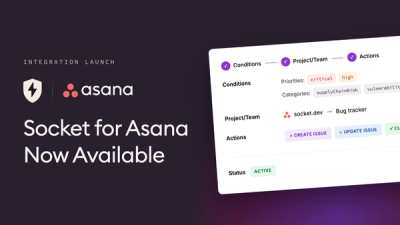
Socket for Asana Is Now Available
Create and manage Asana tasks directly from Socket alerts, with manual task creation, automated ticketing rules, and two-way sync.
By Jeppe Hasseriis - Aug 25, 2026
@decionis/langchain
Advanced tools
Gate any LangChain.js tool or LangGraph.js node on a signed Decionis Decision Dossier.
@decionis/langchainGate any LangChain.js tool call or LangGraph.js node on a signed Decionis Decision Dossier. The agent picks the tool; Decionis decides whether the call is allowed to fire — and records every verdict as a verifiable proof artifact.
npm install @decionis/langchain @decionis/sdk @langchain/core
Mirrors decionis-langchain
for Python: same shadow → enforce rollout, same ?source=langchain_agent
verify-URL attribution, same per-tool short-circuit semantics.
LangChain agents can be jailbroken, prompt-injected, or hallucinated into firing tools that move money, change pricing, send refunds, or delete data. Wrapping the tool with Decionis means:
APPROVE / REJECT / REVIEW / ESCALATE), the agent identity,
the call arguments, and a public verify URL.DecionisGateRefusal) carrying the dossier id; the
caller's audit log keeps the proof.import { createDecionisNodeSdk } from "@decionis/sdk";
import { DecionisGateTool } from "@decionis/langchain";
import { DynamicStructuredTool } from "@langchain/core/tools";
import { z } from "zod";
const sendRefund = new DynamicStructuredTool({
name: "send_refund",
description: "Issue a refund. Idempotent on customer_id + amount + day.",
schema: z.object({ customer_id: z.string(), amount_usd: z.number() }),
func: async ({ customer_id, amount_usd }) => "refund_id-abc",
});
const decionis = createDecionisNodeSdk({
baseUrl: "https://api.decionis.com",
apiKey: process.env.DECIONIS_API_KEY!,
});
const gatedRefund = DecionisGateTool.wrap({
innerTool: sendRefund,
client: decionis,
orgId: process.env.DECIONIS_ORG_ID!,
decisionType: "refund_execution",
siteBaseUrl: "https://decionis.com",
});
await agent.bindTools([gatedRefund]);
When the LLM picks send_refund, Decionis evaluates first. On APPROVE the
inner tool runs and the result is returned. On REJECT / REVIEW /
ESCALATE (configurable) the wrapper throws DecionisGateRefusal carrying
the dossier id, reason codes, and a public verify URL the LLM can read and
the operator can forward.
import { StateGraph, END } from "@langchain/langgraph";
import { decionisGateNode } from "@decionis/langchain";

const graph = new StateGraph<MyState>({
  /* channels */
});
graph.addNode("plan", planNode);
graph.addNode(
  "gate",
  decionisGateNode({
    client: decionis,
    orgId: process.env.DECIONIS_ORG_ID!,
    decisionType: "refund_execution",
    siteBaseUrl: "https://decionis.com",
    extractCall: (state) => ({
      toolName: state.proposedTool as string,
      toolArgs: state.proposedArgs as Record<string, unknown>,
    }),
  }),
);
graph.addNode("execute", executeNode);
graph.addNode("refuse", refuseNode);

graph.addEdge("plan", "gate");
graph.addConditionalEdges("gate", (s) => (s.decionis as { outcome: string }).outcome, {
  allowed: "execute",
  blocked: "refuse",
});
graph.addEdge("execute", END);
graph.addEdge("refuse", END);
The node writes a JSON-serializable record under state.decionis so the
graph stays checkpointable and the conditional edge can branch on allowed
or blocked.
Same pattern as the Python wrapper and the GitHub Action: ship in shadow first, review the verdict distribution, then flip to enforce.
The end-to-end PLG funnel — pick a surface → install in shadow → watch verdicts → flip — is walked at decionis.com/shadow-mode?surface=langchain_js.
DecionisGateTool.wrap({
  innerTool: sendRefund,
  client: decionis,
  orgId,
  decisionType: "refund_execution",
  shadowMode: true, // ← every verdict recorded; inner tool always runs
});
In shadow mode the gate never throws — even on REJECT — so existing
agent behaviour is unchanged. Verdicts still flow into the dossier ledger so
the rollout team can grade policy fit before enforcing.
| Option | Default | Purpose |
|---|---|---|
client | required | DecionisDecisionExecutor from createDecionisNodeSdk(...). |
orgId | required | Decionis org id (UUID). |
decisionType | required | Canonical decision type — usually the workflow key (e.g. refund_execution). |
workflowKey | decisionType | Override when the workflow key needs to differ from the decision type. |
blockOutcomes | ["REJECT","REVIEW","ESCALATE"] | Outcomes that short-circuit the wrapper. Pass ["REJECT"] to let review verdicts through with the dossier recorded. |
shadowMode | false | Record verdicts but never throw / never route to blocked. |
siteBaseUrl | undefined | Base URL used to build a public verify URL (/verify/decision-dossiers/<id>?source=langchain_agent&sig=<dossier_sha256>). |
actor | { type: "ai_agent", framework: "langchain_js" } | Extra actor metadata (model, session id, user id) merged into the dossier context. |
onDecision | undefined | Observer callback (GateResult) => void. Exceptions inside it never break the gate. |
shadowMode: true is the only switch that lets the inner tool run on
a blocking verdict; the default never silently passes a REJECT. Locked
by tests.DecionisGateRefusal.verifyUrl is the same artifact link Slack / Teams /
LinkedIn unfurl with the OG card from
/api/og/verify/[id]. Forward it to a reviewer
when you want the proof one click away.@decionis/sdk (workspace)@langchain/core ≥ 0.3 (peer)@langchain/langgraph is not required to use decionisGateNode —
the factory returns a plain state => Promise<state> callable, so LangGraph
stays an optional runtime dependency.FAQs
Gate any LangChain.js tool or LangGraph.js node on a signed Decionis Decision Dossier.
We found that @decionis/langchain demonstrated a healthy version release cadence and project activity because the last version was released less than a year ago. It has 1 open source maintainer collaborating on the project.
Product
Create and manage Asana tasks directly from Socket alerts, with manual task creation, automated ticketing rules, and two-way sync.

Security News
Open VSX has removed three extension IDs from its malicious-extension list as the legitimate publishers they impersonated move to claim the names for themselves.

Product
Socket’s PHP and Composer support is now in Beta for all customers, with PHP reachability analysis generally available.