

Product
PHP and Composer Support Is Now in Beta
Socket’s PHP and Composer support is now in Beta for all customers, with PHP reachability analysis generally available.
By Trevor Norris, Benjamin Barslev - Aug 21, 2026
@decionis/presence-auth
Advanced tools
Server-side Presence auth hooks for Auth0, Clerk, Okta, Entra, PingOne, and Supabase: risk-based step-up and assurance that replaces always-on MFA, over the Presence /v1/check API.
packages/presence-auth (npm: @decionis/presence-auth) is the E-commerce & auth channel from
the ecosystem roadmap (docs/27): server-side hooks that gate a login or
sensitive action on a Presence disposition — the MFA-replacement motion. It is a thin adapter over
POST /v1/check (docs/32); the full contract is docs/37 in the repository.
The sign-in page runs the Presence widget, which mints a browser Session Token. Your
auth hook holds the tenant API secret (server-side only), passes that token to POST /v1/check,
and enforces the answer:
/v1/check | Decision | Auth outcome |
|---|---|---|
PASS | allow | Login proceeds — no second factor |
CHALLENGE / STEP_UP | step_up | Require a second factor |
DENY | deny | Block the login |
It fails closed: a missing token or an unreachable Presence API yields step_up, so an outage
hardens login rather than locking users out. Presence decides; the hook only reacts.
// Auth0 Action: store the tenant secret as the PRESENCE_API_SECRET Action Secret.
const { createPresenceAction } = require("@decionis/presence-auth/auth0");

exports.onExecutePostLogin = createPresenceAction({
  apiHost: "https://presence.decionis.com",
  apiSecret: event.secrets.PRESENCE_API_SECRET,
});
createPresenceAction(config) returns an onExecutePostLogin(event, api) handler. It reads the
Session Token from event.request.body.presence_token (override with tokenFrom), derives
accountAgeDays from event.user.created_at, then drives the Action API: allow returns, deny
calls api.access.deny("presence_denied"), and step_up calls api.multifactor.enable(provider)
(default "any", override with mfaProvider). A login with no Session Token requires MFA.
Clerk has no server hook that halts a session mid-flow, so the guard returns a decision your own
backend enforces (in clerkMiddleware, a server action, or a route handler after auth()):
import { createPresenceGuard } from "@decionis/presence-auth/clerk";

const guard = createPresenceGuard({
  apiHost: "https://presence.decionis.com",
  apiSecret: process.env.PRESENCE_API_SECRET!,
});

const { decision, requiredProof } = await guard({
  token: formData.get("presence_token")?.toString(),
  intent: "payment.checkout",
  context: { amount: 5000, currency: "USD" },
});
if (decision === "deny") throw new Response("Forbidden", { status: 403 });
if (decision === "step_up") return redirectToStepUp(requiredProof);
| Export | Entry | Contract |
|---|---|---|
createPresenceAction | @decionis/presence-auth/auth0 | Auth0 onExecutePostLogin(event, api) handler driving allow / deny / MFA |
createPresenceGuard | @decionis/presence-auth/clerk | guard({ token, intent?, context? }) → { decision, disposition, requiredProof? } |
createOktaInlineHook | @decionis/presence-auth/okta | Okta Token Inline Hook responder: proceed+claim / error deny / step-up |
createEntraTokenHook | @decionis/presence-auth/entra | Entra onTokenIssuanceStart extension: annotate presence_* claims (see below) |
createPingOneHook | @decionis/presence-auth/ping | PingOne DaVinci HTTP-connector decision endpoint { decision, disposition } |
PresenceCheckClient | @decionis/presence-auth | Provider-neutral POST /v1/check client (fail-closed) for a bespoke integration |
decisionFor | @decionis/presence-auth | Disposition → allow / step_up / deny mapping |
Beyond the consumer Auth0/Clerk hooks, the package ships inline-hook handlers for the enterprise
IdPs (docs/39): the IdP calls a Presence-provided handler
during a privileged auth event, and the handler delegates to /v1/check. Each is framework-agnostic
((request) => { status, body }), verifies a configured shared secret, and fails closed:
import { createOktaInlineHook } from "@decionis/presence-auth/okta";

const hook = createOktaInlineHook({ apiHost, apiSecret: process.env.PRESENCE_API_SECRET!, secret });
const { status, body } = await hook({ headers: req.headers, body: req.body });
Mapping is faithful to each platform: Okta Token Inline Hooks deny via an error (no MFA
command, so step-up is deny or annotate); Entra onTokenIssuanceStart can only annotate
tokens (presence_verified + presence_disposition claims — Conditional Access blocks); PingOne
returns a decision a DaVinci flow branches on. Distinct from the platform-side
Okta connector (docs/17), which runs inside Presence.
The tenant secret is server-side only — never shipped to a browser; the browser holds just the
short-lived Session Token. The disposition is authoritative and computed by the Presence API from
adverse-only evidence, so a fabricated "clean" client gains nothing. check fails closed on transport
error, non-2xx, malformed body, unrecognized disposition, or timeout (timeoutMs, default 4s).
Vitest (Node), against mocked fetch: pnpm --filter @decionis/presence-auth test — request shape
and tenant-secret header, every disposition, all fail-closed paths (including abort), the Auth0 Action
outcomes, the Clerk guard's decision mapping, and each IdP inline hook (bad-secret 401, per-provider
response mapping, fail-closed missing token).
Lockstep 0.x npm line (docs/23) with subpath exports (.,
./auth0, ./clerk, ./okta, ./entra, ./ping) and no runtime dependencies — Node's global
fetch only. Consumer Shopify/Firebase listings and the enterprise Salesforce/ServiceNow plugins are
the planned follow-on for these channels.
FAQs
Server-side Presence auth hooks for Auth0, Clerk, Okta, Entra, PingOne, and Supabase: risk-based step-up and assurance that replaces always-on MFA, over the Presence /v1/check API.
The npm package @decionis/presence-auth receives a total of 32 weekly downloads. As such, @decionis/presence-auth popularity was classified as not popular.
We found that @decionis/presence-auth demonstrated a healthy version release cadence and project activity because the last version was released less than a year ago. It has 1 open source maintainer collaborating on the project.
Product
Socket’s PHP and Composer support is now in Beta for all customers, with PHP reachability analysis generally available.
Product
Socket is bringing experimental protection to Firefox, scanning 97,000+ extensions in Mozilla's official directory for malware and risky updates.
Research
/Security News
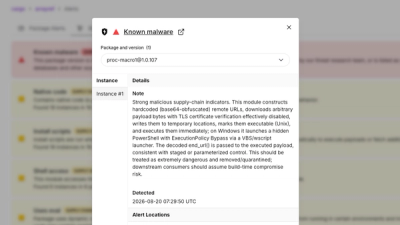
Three compromised Rust crates pulled in a malicious dependency that downloaded and executed cross-platform malware during Cargo builds.