
Research
/Security News
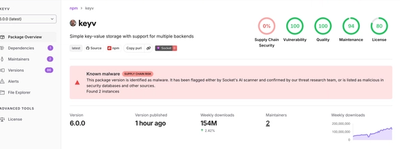
Popular npm Packages in the keyv and Cacheable Namespaces Compromised in Active Supply Chain Attack
Popular npm packages keyv and cacheable compromised.
By Socket Research Team - Aug 04, 2026
@designscan/extractor
Advanced tools
URL → design tokens → (next) DESIGN.md. This is step 1 of the roadmap:
the extraction engine. It runs locally, needs no API key, and is the only
"real software" part of the whole business.
Lives at
packages/extractorin the DesignScan (pnpm) monorepo. Run workspace commands from the repo root (pnpm extract stripe.com) or locally from this directory.
URL
 └─ Playwright (headless Chromium) renders the live page, waits for hydration
     └─ reads getComputedStyle from every visible element (shadow DOM included),
        then physically hovers the buttons to observe their :hover shift
         └─ normalize.ts clusters the raw CSS into a clean token profile:
            background / text / primary / primary-hover / border /
            muted-surface colors, the site's declared error/success/warning/
            info status colors, palette, font families, font-size scale,
            spacing scale, radius scale, shadows, container max-width +
            the @media breakpoints the page really reshapes at
             └─ outputs a DesignProfile JSON
# one-off, no install (the `designscan` package is a thin alias for this one)
npx designscan stripe.com --md --out stripe.DESIGN.md

# or install the CLI / library
npm i @designscan/extractor
npx playwright install chromium   # one-time (drives headless Chromium)
// as a library
import { extract, normalize, generate, preview } from "@designscan/extractor";
const profile = normalize(url, await extract(url));
const md = generate(profile); // spec-valid DESIGN.md
pnpm install                      # from the repo root
pnpm --filter @designscan/extractor exec playwright install chromium  # one-time
pnpm build                        # tsc -> dist (the publishable build)
Run from the repo root (no -- needed — pnpm forwards flags straight through):
# print JSON to stdout + a summary to stderr
pnpm extract stripe.com

# save the profile
pnpm extract linear.app --out out/linear.json

# emit a Google-format DESIGN.md instead of profile JSON
pnpm extract stripe.com --md --out out/stripe.DESIGN.md

# or pick another format: w3c (W3C Design Tokens JSON — Style Dictionary,
# Tokens Studio, …) | css (paste-ready CSS custom properties)
pnpm extract stripe.com --format w3c --out out/stripe.tokens.json
pnpm extract stripe.com --format css --out out/stripe.tokens.css

# pick a theme: light (default) | dark | both
pnpm extract linear.app --theme dark --md --out out/linear.dark.DESIGN.md

# both = merge light + dark into one DESIGN.md (parallel *-dark tokens)
# dark first emulates prefers-color-scheme; if the page stays light it tries
# the common gates (<html class="dark">, data-theme, data-color-mode) and
# records which one the site really uses
pnpm extract vercel.com --theme both --md --out out/vercel.DESIGN.md

# --preview = also emit a self-contained HTML proof sheet beside the file
# (out/vercel.preview.html) rendering every token; --theme both adds a toggle
pnpm extract vercel.com --theme both --md --preview --out out/vercel.DESIGN.md

# slow site? raise the per-navigation timeout (default 45000ms)
pnpm extract some-slow-site.com --md --timeout 90000

# watch the browser work
pnpm extract vercel.com --headful
Load failures (unreachable host, timeout, a site refusing automated browsers) exit non-zero with a short, actionable message rather than a raw stack trace.
designscan mcp runs the extractor as an MCP
server over stdio, exposing one tool — get_design_tokens(url, format?, theme?, timeoutMs?) — so an agent can pull live tokens for any URL mid-task
("restyle this app like stripe.com"). format matches the CLI:
md (default, DESIGN.md) | w3c | css | json.
// e.g. Claude Code: .mcp.json
{
  "mcpServers": {
    "designscan": {
      "command": "npx",
      "args": ["-y", "@designscan/extractor", "mcp"]
    }
  }
}
Extraction-quality warnings (bot challenge, near-empty render) ride along in the tool result, so the agent knows when not to trust the tokens.
| File | Role |
|---|---|
src/extract.ts | Playwright launch + in-page computed-style collection |
src/normalize.ts | Clusters raw values into token scales + role heuristics |
src/resolve.ts | Shared role/level/scale resolution (one source of truth for generate + preview) |
src/generate.ts | DesignProfile → Google-format DESIGN.md (YAML + prose) |
src/agentNotes.ts | Deterministic "Notes for your coding agent" section (contrast/heading/font guidance) appended to the DESIGN.md |
src/preview.ts | DesignProfile → self-contained HTML proof sheet (--preview) |
src/color.ts | rgb/hex parsing, luminance, saturation, neutral test |
src/types.ts | RawObservations and DesignProfile shapes |
src/formats.ts | DesignProfile → W3C Design Tokens JSON / CSS custom properties (+ shared emit()) |
src/mcp.ts | designscan mcp — MCP server over stdio (get_design_tokens tool) |
src/cli.ts | designscan <url> command |
DesignProfile JSONDesignProfile → DESIGN.md (Google spec: YAML
front-matter + prose) via --md. Token mapping + heuristic prose done;
passes the official @google/design.md linter with 0 errors
(pnpm lint:designmd). Theme selection via --theme light|dark|both;
both merges light + dark into one spec-valid file (parallel *-dark
tokens + variants). (LLM-refined prose/rationale moved to Step 4.)--preview): a self-contained,
offline proof sheet that paints every resolved token — color swatches,
type specimens at real px/weight, spacing/radius/shadow samples, and the
six components — inside neutral chrome, with a Light/Dark toggle when a
distinct dark theme exists. Resolves the same roles/levels/scales as the
generator (via resolve.ts), so it can't drift from the DESIGN.md.agentNotes.ts): every DESIGN.md now ends
with a Notes for your coding agent section — deterministic, per-extraction
instructions derived from this profile's actual numbers (heading hierarchy
vs. muted text, sub-AA body contrast, brand-font fallback, primary-button
contrast, shape/spacing rhythm). The insight: the file is always consumed by
an AI agent, so we compute the semantic calls here (no LLM, no API key) and
let the user's agent apply them. Optional LLM-refined prose is still future.npx ... add <brand> CLI + per-brand SEO pagesprefers-color-scheme. Sites that gate theme on a
class/localStorage toggle (not the media query) won't switch, so --theme dark/both returns the light palette; both detects this and emits a
light-only file with an honest note rather than fabricating a dark theme.Color parsing now handles the full modern range — rgb/hex/hsl/hwb/
oklab/oklch/lab/lch/color()/color-mix() — all converted to sRGB.
FAQs
URL -> design tokens -> DESIGN.md. The extraction engine.
We found that @designscan/extractor demonstrated a healthy version release cadence and project activity because the last version was released less than a year ago. It has 1 open source maintainer collaborating on the project.
Did you know?

Socket for GitHub automatically highlights issues in each pull request and monitors the health of all your open source dependencies. Discover the contents of your packages and block harmful activity before you install or update your dependencies.
Research
/Security News
Popular npm packages keyv and cacheable compromised.

Security News
A misconfiguration gave three Anthropic models internet access, and one, believing it was in a simulation, shipped a credential-stealing package to PyPI.

Security News
/Company News
Socket has joined the new Composer and Packagist sponsorship program as a launch sponsor, supporting the team that keeps PHP's package ecosystem secure.