

Product
PHP and Composer Support Is Now in Beta
Socket’s PHP and Composer support is now in Beta for all customers, with PHP reachability analysis generally available.
By Trevor Norris, Benjamin Barslev - Aug 21, 2026
@developerz.ai/ai-claude-compat
Advanced tools
Claude-Code-style agent primitives for the Vercel AI SDK: FS/bash tools, an <env> system-context block, a subagent-as-tool factory, and .claude/ skills/agents loading.
Claude-Code-style agent primitives for the Vercel AI SDK.
Build coding agents on the AI SDK with the tool surface and conventions you
already know from Claude Code — cwd-scoped filesystem / edit / search / bash
tools, an <env> system-context block, a subagent-as-tool factory,
and .claude/ skills + agents loading — all provider-agnostic (works with
any AI SDK model: OpenAI, OpenRouter, Anthropic, local, …).
npm install @developerz.ai/ai-claude-compat ai
The AI SDK gives you tool() and agents, but not the opinionated tool surface
that makes a coding agent useful: a Read with a line window, an Edit that
does exact-string replacement, a Bash that streams, a Grep/Glob pair, and
a way to keep every path safely inside a working directory. This package ships
those, shaped like Claude Code's, so you can stand up an agent in minutes.
Everything is scoped to a cwd and path-guarded (resolveInside) — a tool
can't read or write outside the root you give it.
import {
  readFileTool, writeFileTool,   // Read (offset/limit window) + Write
  editFileTool, multiEditTool,   // exact-string Edit + batched MultiEdit
  bashTool, multiBashTool,        // one shell command / an ordered sequence, scoped to cwd
  globTool, grepTool,             // file glob + content search
} from '@developerz.ai/ai-claude-compat';

const cwd = process.cwd();
const tools = {
  read:      readFileTool({ cwd }),
  write:     writeFileTool({ cwd }),
  edit:      editFileTool({ cwd }),
  bash:      bashTool({ cwd }),
  multiBash: multiBashTool({ cwd }),
  grep:      grepTool({ cwd }),
  glob:      globTool({ cwd }),
};
Pass tools straight into a generateText / streamText call or an
Agent/ToolLoopAgent.
bashTool/multiBashTool block until the command exits, so they can't hold a
dev server open. backgroundProcessTools does: it spawns bash -c … without
awaiting, returns a process id immediately, and lets the agent tail output, kill
one process, or kill them all on teardown. The caller owns lifecycle — keep
the returned manager and call killAll() when the run ends, or processes leak.
import { backgroundProcessTools } from '@developerz.ai/ai-claude-compat';

const { manager, backgroundBash, bashOutput, killBash, listBackground } =
  backgroundProcessTools({ cwd });

const agentTools = { ...tools, backgroundBash, bashOutput, killBash, listBackground };
// agent: backgroundBash("npm run dev") -> { id }
//        bashOutput(id) -> new stdout/stderr since last poll, running, exitCode
//        killBash(id)
try {
  await agent.generate({ prompt: 'start the dev server and check it serves /health' });
} finally {
  manager.killAll(); // teardown — nothing else guarantees the server is stopped
}
bashOutput is incremental (like Claude Code's BashOutput): each call returns
only the bytes produced since the last call. Buffers are capped (256 KiB/stream by
default); past the cap the oldest bytes are dropped and truncated is set.
Browser/CDP automation is intentionally out of scope — drive a browser with a
dedicated MCP server (e.g. Playwright MCP), not from this library.
createSubagent wraps the boilerplate of a ToolLoopAgent (model + tools +
instructions + a step-count stop condition); composeSystemPrompt assembles the
instructions as your coding style + a role prefix + an <env> block (cwd,
platform, OS, runtime, date).
Structured output is delivered by a terminal submit tool (function calling),
not response_format: json_schema — some OpenAI-compatible providers ignore the
latter. Build the submit tool with a concrete Zod schema; the agent stops when it
calls submit. Read the validated result back with submittedOutput, or drive the
whole run through runWithSchemaRetry, which corrects a botched submit in-conversation
before giving up.
import { openai } from '@ai-sdk/openai';
import { tool } from 'ai';
import { z } from 'zod';
import {
  composeSystemPrompt,
  createSubagent,
  runWithSchemaRetry,
} from '@developerz.ai/ai-claude-compat';

const OutputSchema = z.object({ summary: z.string() });

const worker = createSubagent(
  {
    model: openai('gpt-5'),
    tools,
    systemPrompt: composeSystemPrompt(
      claudeMd,                         // coding-style signal from the target repo
      'You implement one task and report the diff, then call submit.',
      process.cwd(),                    // → <env> block
    ),
    // A concrete schema so the AI SDK infers the tool's param type.
    submit: tool({
      description: 'Submit the finished result (the OutputSchema).',
      inputSchema: OutputSchema,
      execute: async (out) => out,
    }),
    maxSteps: 40,
  },
  /* defaultMaxSteps */ 25,
);

// Typed, never throws: { ok: true, value } | { ok: false, reason: 'no-submission' | 'invalid', … }.
// runWithSchemaRetry re-prompts the same agent (default 2 retries) if the model botches the schema.
const result = await runWithSchemaRetry(worker, OutputSchema, 'Implement the task.');
if (result.ok) console.log(result.value.summary);
Expose worker to a parent agent as a tool to get the isolated-context,
focused-prompt subagent pattern: https://ai-sdk.dev/docs/agents/subagents.
.claude/ skills & agentsDiscover and parse the Claude-Code .claude/ directories of a project (markdown
import { claudeDirs, loadSkills, loadAgents } from '@developerz.ai/ai-claude-compat';

for (const dir of claudeDirs(process.cwd())) {
  const skills = await loadSkills(dir);   // SkillDefinition[]
  const agents = await loadAgents(dir);   // AgentDefinition[]
}
| Export | What it is |
|---|---|
readFileTool, writeFileTool | Read (offset/limit window) + Write, cwd-scoped |
editFileTool, multiEditTool, applyEdit | Exact-string Edit, batched MultiEdit, pure edit helper |
bashTool | Run one shell command, cwd as initial dir; returns stdout/stderr/exitCode |
multiBashTool | Run an ordered sequence of commands; stops at the first non-zero exit |
backgroundProcessTools, ProcessManager | Non-blocking background commands (dev servers): start / tail output / kill / killAll |
globTool, grepTool, globToRegExp | File glob + content search |
composeSystemPrompt, createSubagent | System-prompt composer + subagent-as-tool factory |
submittedOutput, runWithSchemaRetry, formatSubmitIssues | Typed submit-tool extraction + schema-mismatch retry kernel |
envBlock | Render the <env> system-context block from EnvInfo |
loadSkills, loadAgents, claudeDirs | .claude/ discovery + parsing |
parseFrontmatter, asString, asStringArray | YAML-frontmatter helpers |
resolveInside | Path guard — resolve a path and assert it stays inside a root |
Types are exported alongside each value (ReadFileInput, BashOutput,
SubagentConfig, EnvInfo, SkillDefinition, …).
ESM only. Runs unchanged on Node ≥ 20, Bun, and Deno ≥ 1.40. Peer dep: ai
(AI SDK v6). No Anthropic SDK — "Claude-compat" refers to the conventions, not
the provider.
The shell tools (bashTool, multiBashTool) target Linux. They spawn
bash -c …, so they need a POSIX bash on PATH — they are not supported
on native Windows (use WSL) and are only best-effort on macOS. The pure
filesystem/edit/search tools are platform-neutral, but the package as a whole is
developed and tested on Linux; treat anything else as unsupported.
~/.bashrc)Commands run via a non-login, non-interactive bash -c with BASH_ENV
scrubbed. That is deliberate: a login/interactive shell would source
/etc/profile and ~/.bashrc, which often cd away and would defeat the
cwd lock. The consequence:
rbenv/asdf shims, and any binary already on the
PATH of the process that launched the agent, are inherited (the child gets
process.env). If you can run ruby/node from the shell you start the agent
in, the agent can too.nvm, and anything that exists only as a
function defined in ~/.bashrc, is not loaded. Source it yourself inside
the command (source ~/.nvm/nvm.sh && nvm use && …) or put the resolved
binary on PATH before launching.MIT · part of developerz-ai/ai-task-master
FAQs
Claude-Code-style agent primitives for the Vercel AI SDK: FS/bash tools, an <env> system-context block, a subagent-as-tool factory, and .claude/ skills/agents loading.
The npm package @developerz.ai/ai-claude-compat receives a total of 2,480 weekly downloads. As such, @developerz.ai/ai-claude-compat popularity was classified as popular.
We found that @developerz.ai/ai-claude-compat demonstrated a healthy version release cadence and project activity because the last version was released less than a year ago. It has 2 open source maintainers collaborating on the project.
Product
Socket’s PHP and Composer support is now in Beta for all customers, with PHP reachability analysis generally available.
Product
Socket is bringing experimental protection to Firefox, scanning 97,000+ extensions in Mozilla's official directory for malware and risky updates.
Research
/Security News
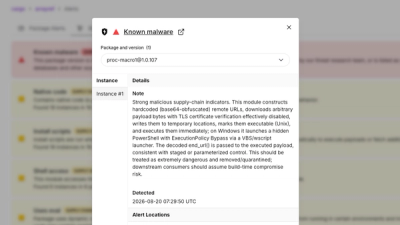
Three compromised Rust crates pulled in a malicious dependency that downloaded and executed cross-platform malware during Cargo builds.