@diagrammo/dgmo-mcp
Turn a conversation into a real diagram — without leaving your AI tool.



This MCP server gives Claude (and any MCP-compatible AI tool) the ability to render
sequence diagrams, flowcharts, ER diagrams, C4 architecture, gantt charts, and 40+
other chart types from concise text markup — then hand the result off to a full
editor for refinement. Ask for a diagram in chat; get a real one back.
What you can do
Ask in plain language — "diagram the auth flow as a sequence", "chart the Q3 plan as
a gantt", "draw our services as a C4 diagram" — and Claude writes the markup and
renders it. The markup stays readable and diffable:
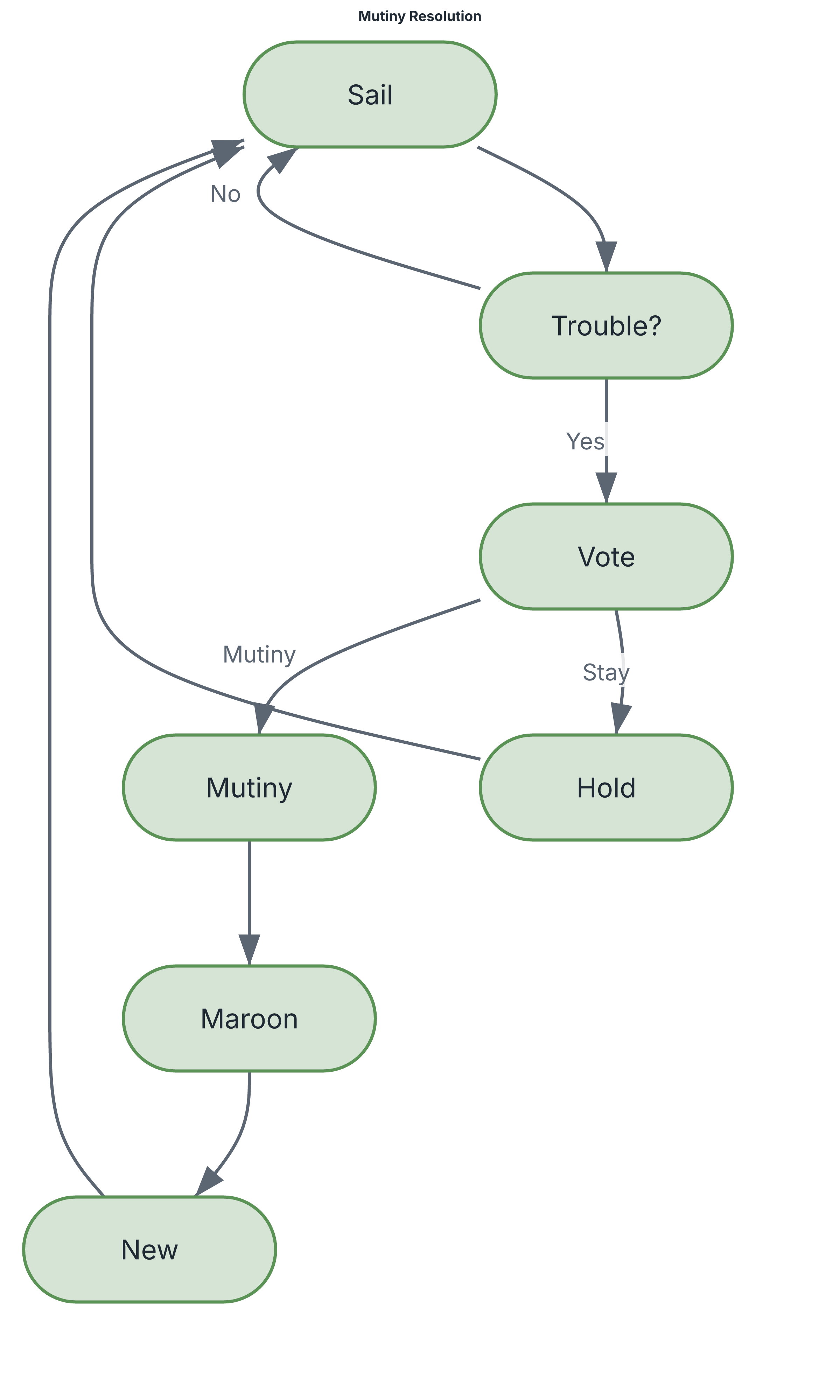
flowchart Mutiny Resolution
direction-tb
[Sail] Set sail under the captain
{Trouble?} Discontent in the crew?
{Vote} Crew vote called
[Mutiny] Seize the ship
(Sail) -> (Trouble?)
(Trouble?) -Yes-> (Vote)
(Vote) -Mutiny-> (Mutiny)
→ renders to the flowchart above. All rendering happens locally — no diagram data
leaves your machine.
Tools
render_diagram | Render DGMO markup to SVG or PNG |
preview_diagram | Render one or more diagrams and open an HTML preview in the browser |
generate_report | Build a polished multi-section HTML report with ToC and optional source |
list_chart_types | List all supported chart types |
get_language_reference | Get DGMO syntax documentation for accurate generation |
share_diagram | Get a shareable diagrammo.app URL — hand your diagram to the web editor |
open_in_app | Open the diagram straight into the Diagrammo desktop app for editing |
The last two are the bridge out of chat: a diagram Claude generates becomes something
you can refine, restyle, and embed — see below.
Beyond the MCP server
The MCP server is one entry point into Diagrammo — a whole
ecosystem built on the same DGMO markup. Generate in chat, refine in a real editor,
embed anywhere:
- diagrammo.app — the desktop app.
open_in_app drops an
AI-generated diagram straight into it, with live preview, palettes, and export.
- online.diagrammo.app — a full editor in the
browser, zero install.
share_diagram URLs open right here.
- Docs integrations — drop DGMO fenced code blocks into your docs site:
remark-dgmo,
astro-dgmo,
docusaurus-plugin-dgmo,
fumadocs-dgmo.
- Obsidian — the Diagrammo Diagrams community plugin renders DGMO in your vault.
- CLI —
npx @diagrammo/dgmo file.dgmo -o out.png, or install via Homebrew.
One markup, everywhere. A diagram you generate here renders identically in the
app, in your docs, and in Obsidian — because they all speak DGMO.
→ Try it free at diagrammo.app
Setup
Easiest — one command
Install the dgmo CLI and let it wire everything up:
npm install -g @diagrammo/dgmo
dgmo install
dgmo install configures each detected assistant non-interactively and points it at dgmo mcp, so there's no separate package to install or prompts to answer. Target one surface with dgmo install claude-code (or codex, claude-desktop, …).
Manual configuration
Prefer to edit configs yourself? Point any MCP client at the server via npx (no global install needed):
Claude Code — .claude/settings.local.json; Claude Desktop — ~/Library/Application Support/Claude/claude_desktop_config.json:
{
  "mcpServers": {
    "dgmo": {
      "command": "npx",
      "args": ["-y", "@diagrammo/dgmo-mcp"]
    }
  }
}
If you have the dgmo CLI installed, { "command": "dgmo", "args": ["mcp"] } works too. Restart the client after saving — the tools appear automatically.
Privacy
All rendering is local. Your diagram markup and the images it produces never leave
your machine, except when you explicitly call share_diagram (which encodes the diagram
into a diagrammo.app URL). See the privacy terms.
Dev hub (AI-tuning tools)
pnpm hub
One command, one server, one browser tab. The hub opens a tabbed shell over the
three AI-tuning dev tools — switch between them with the top tabs, no separate
ports or commands to remember:
- Trigger tuning — edit the phrase/concept vocabulary that drives
suggest_chart_type, score prompts live, save back to triggers.json.
- LLM judge — judge chart-type descriptions against prompts with
claude -p.
- Guidance studio — author the per-type styling guidance the server
delivers (the
<!-- TIPS --> blocks in dgmo's language-reference.md, sliced
into get_language_reference): pick a type, edit how the AI is told to style
it, run a prompt against a committed dataset fixture (so inputs never move
between runs), and see the generated DGMO + rendered image side by side. The
picker doubles as a coverage bar; "Compare 3×" renders no-guidance vs your
tips for a by-eye check; Save validates and writes back to
language-reference.md.
These tools are dev-only and never bundled into the published server. (The
standalone pnpm harness and pnpm studio scripts still run a single tool each
if you ever want one in isolation.)
Contributing & releases
Development setup and the release workflow live in CONTRIBUTING.md.
License
MIT