
Research
/Security News
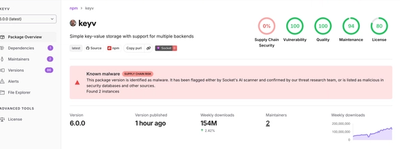
Popular npm Packages in the keyv and Cacheable Namespaces Compromised in Active Supply Chain Attack
Popular npm packages keyv and cacheable compromised.
By Socket Research Team - Aug 04, 2026
@dmzagent/skill-builder-mcp
Advanced tools
MCP server that lets coding agents (Claude Code, Cursor, Codex, etc.) search the skill-builder registry and auto-install skills and their dependencies
An MCP server that connects coding agents — Claude Code, Cursor, Codex, and any other MCP-compatible tool — to the skill-builder registry. Agents can search the registry and auto-install skills (resolving meta-skill dependency trees) directly into the current project.
// One line in your MCP config — no global install needed:
{ "command": "npx", "args": ["-y", "@dmzagent/skill-builder-mcp"] }
| Tool | What it does | Writes files? |
|---|---|---|
skill_search | Search/browse the registry with filters and sorting | No |
skill_info | Full details + markdown body for one skill (no download counted) | No |
skill_suggest | Autocomplete skills, tags, authors, categories | No |
skill_taxonomy | Categories / tags / authors / types with counts | No |
skill_install | Install a skill (+ dependencies for meta skills) into the project | Yes |
skill_install writes the files each tool expects:
CLAUDE.md under a ## <name> heading (re-installs are skipped via a hidden <!-- skill-id --> marker).AGENTS.md..cursor/rules/<slug>.mdc with frontmatter.<slug>.md + a <slug>.json manifest in output_dir.With target: "auto" (the default), the server detects the right one from the
project (.cursor/, .claude/, CLAUDE.md, AGENTS.md, or env) and falls
back to file.
All configuration is via environment variables — all optional:
| Variable | Default | Purpose |
|---|---|---|
SKILL_API_URL | https://skills.dmzagent.com/api | Registry API base (a bare site URL is fine; /api is appended). |
SKILL_TOKEN | (none) | Bearer token; only needed to see your own private/draft skills. |
SKILL_PROJECT_DIR | server cwd | Default project root that installs write into. |
SKILL_TARGET | (auto-detect) | Force the install target: claude | codex | cursor | file. |
Most clients launch the server with the project as its working directory, so installs land in the right place automatically. If yours doesn't, set
SKILL_PROJECT_DIRor passproject_dirtoskill_install.
Add it from the project root, or drop the config into .mcp.json:
claude mcp add skill-builder -- npx -y @dmzagent/skill-builder-mcp
// .mcp.json
{
  "mcpServers": {
    "skill-builder": {
      "command": "npx",
      "args": ["-y", "@dmzagent/skill-builder-mcp"]
    }
  }
}
// .cursor/mcp.json (project) or ~/.cursor/mcp.json (global)
{
  "mcpServers": {
    "skill-builder": {
      "command": "npx",
      "args": ["-y", "@dmzagent/skill-builder-mcp"]
    }
  }
}
# ~/.codex/config.toml
[mcp_servers.skill-builder]
command = "npx"
args = ["-y", "@dmzagent/skill-builder-mcp"]
Launch this command and speak MCP over stdio:
npx -y @dmzagent/skill-builder-mcp
Optionally pass env vars, e.g. SKILL_TARGET=cursor SKILL_PROJECT_DIR=/path/to/project.
1. skill_search { "query": "literature review", "type": "meta" }
2. skill_info   { "skill": "@kmd_ai/paperdistillery-orchestrated-literature-to-briefing-pipeline" }
3. skill_install{ "skill": "@kmd_ai/paperdistillery-orchestrated-literature-to-briefing-pipeline" }
   → resolves the dependency tree and installs every required skill for the detected tool.
Use dry_run: true on skill_install to preview exactly which files would be
written before committing.
This package lives in the skill-builder-landing monorepo.
npm install
npm run build --workspace packages/mcp        # tsc → dist/
node packages/mcp/dist/index.js --help        # sanity check
npx @modelcontextprotocol/inspector node packages/mcp/dist/index.js   # interactive testing
The registry data model and types mirror the Worker API; like the other
packages in this repo, the MCP server keeps its own copy of the types and the
install logic (adapted from packages/cli) so the published package is
self-contained.
This server is published to the official MCP Registry
under the domain-based name com.dmzagent/skill-builder-mcp. The registry only stores
metadata (in server.json); the package itself lives on npm.
Publishing is automated by .github/workflows/publish-mcp.yml,
which runs on a version tag and both publishes to npm and lists in the registry.
The com.dmzagent namespace is proven by an apex TXT record on dmzagent.com. Generate an
Ed25519 key pair locally — the private half is a CI secret, never committed:
openssl genpkey -algorithm Ed25519 -out mcp-key.pem
# public key (base64) -> terraform var mcp_registry_public_key:
openssl pkey -in mcp-key.pem -pubout -outform DER | tail -c 32 | base64
# private key (hex) -> the MCP_PRIVATE_KEY GitHub secret:
openssl pkey -in mcp-key.pem -noout -text | grep -A3 'priv:' | tail -n +2 | tr -d ' :\n'
Then:
mcp_registry_public_key in
terraform/mcp-registry.tf, so the deploy.yml
terraform apply publishes the TXT record on the next push to main — no local
terraform needed. (Override the var in tfvars to rotate the key.)MCP_PRIVATE_KEY (the hex private key) and NPM_TOKEN (npm publish token).# bump packages/mcp/package.json + server.json to the new version, commit, then:
git tag v1.0.1 && git push origin v1.0.1
To publish manually instead of via CI, from packages/mcp:
npm publish --access public                       # to npm first (registry verifies it)
mcp-publisher login dns --domain dmzagent.com --private-key "$MCP_PRIVATE_KEY"
mcp-publisher publish                              # reads server.json
MIT
FAQs
MCP server that lets coding agents (Claude Code, Cursor, Codex, etc.) search the skill-builder registry and auto-install skills and their dependencies
We found that @dmzagent/skill-builder-mcp demonstrated a healthy version release cadence and project activity because the last version was released less than a year ago. It has 1 open source maintainer collaborating on the project.
Did you know?

Socket for GitHub automatically highlights issues in each pull request and monitors the health of all your open source dependencies. Discover the contents of your packages and block harmful activity before you install or update your dependencies.
Research
/Security News
Popular npm packages keyv and cacheable compromised.

Security News
A misconfiguration gave three Anthropic models internet access, and one, believing it was in a simulation, shipped a credential-stealing package to PyPI.

Security News
/Company News
Socket has joined the new Composer and Packagist sponsorship program as a launch sponsor, supporting the team that keeps PHP's package ecosystem secure.