
Product
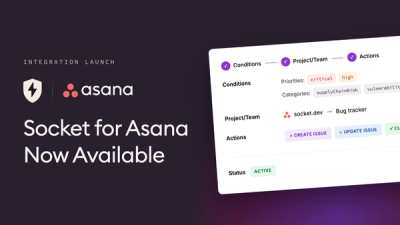
Socket for Asana Is Now Available
Create and manage Asana tasks directly from Socket alerts, with manual task creation, automated ticketing rules, and two-way sync.
By Jeppe Hasseriis - Aug 25, 2026
@dodomain/react
Advanced tools
Official React bindings for DoDomain — a hook (and drop-in button) around the @dodomain/connect modal widget.
Official React bindings for DoDomain — a hook (and a drop-in button)
around the @dodomain/connect modal widget.
Pairs with @dodomain/node, which mints the
session token on your server.
📖 Guide with runnable examples: dodomain.io/docs/react-sdk · all docs: dodomain.io/docs.
npm install @dodomain/react
# or: pnpm add @dodomain/react · yarn add @dodomain/react
Peer dependency: react >= 18. The only runtime dependency is @dodomain/connect itself —
this package is a thin layer of glue (~1KB), the widget is not bundled twice, and both
stay zod-free.
import { useDoDomainConnect, MOUNT_BLOCKED } from "@dodomain/react";

function ConnectDomainCard({ token }: { token: string }) {
  // token comes from your server: POST /api/v1/sessions via @dodomain/node
  const { open, isOpen } = useDoDomainConnect({
    token,
    onVerified: ({ domain }) => console.log("connected:", domain),
    onClose: ({ state }) => {
      if (state !== "verified") keepTheConnectDomainPromptVisible();
    },
    onError: (err) => {
      // The iframe never mounted (host CSP, network, content blocker):
      // same session, full page instead.
      if (err.code === MOUNT_BLOCKED) location.assign(err.hostedUrl);
    },
  });

  return (
    <button onClick={open} disabled={isOpen}>
      Connect your domain
    </button>
  );
}
Or, when all you need is a trigger, the unstyled drop-in:
import { DoDomainConnectButton } from "@dodomain/react";

<DoDomainConnectButton token={token} onVerified={() => refetch()} className="btn">
  Connect your domain
</DoDomainConnectButton>;
The widget's own API is imperative — showDoDomain() opens a modal iframe over the page and
returns a close handle — so the honest React shape is a hook that owns that handle's
lifecycle. Beyond forwarding the call, the hook guarantees:
useCallback needed.open() while already open is a no-op; a double-click can't
stack two backdrops.onClose still fires with the
last-known state) instead of orphaning a full-screen iframe. StrictMode-safe.useDoDomainConnect(options) → { open, close, isOpen }options is exactly the widget's
ShowDoDomainOptions:
| Option | Type | Notes |
|---|---|---|
token | string | Required. Session token (dd_sess_…) from POST /api/v1/sessions. |
baseUrl | string | DoDomain origin. Defaults to https://app.dodomain.io. |
theme | "light" | "dark" | Pass the theme your page is rendering so the sheet matches it. |
onVerified | (detail: { domain?: string }) => void | Fires when the domain verifies. |
onClose | (detail: DoDomainCloseDetail) => void | Fires on every dismissal, with the session's last-known state. |
onError | (detail: DoDomainWidgetError) => void | Fires when the flow fails to load or reports a session error. |
loadTimeoutMs | number | Load-handshake timeout before the embed counts as failed. Default 15000. |
Returns:
| Field | Type | Notes |
|---|---|---|
open | () => void | Opens the modal with the current render's options. No-op while open. Browser-only — call it from an event handler. |
close | () => void | Dismisses programmatically (fires onClose, like the widget's handle.close()). |
isOpen | boolean | Whether the modal is currently mounted. |
The error/close vocabulary (MOUNT_BLOCKED, DoDomainWidgetError, DoDomainCloseDetail,
DoDomainSessionState, ShowDoDomainOptions) is re-exported from @dodomain/connect, so
this package is the only import a React app needs. The widget's own README documents the
semantics — origin-checked messages, the MOUNT_BLOCKED hosted-URL fallback, and the
frame-src https://app.dodomain.io CSP requirement all apply unchanged.
<DoDomainConnectButton {...options} />A plain unstyled <button type="button"> wired to the hook. Extra props: children (label,
defaults to "Connect your domain"), className, disabled. It disables itself while the
modal is open.
See src/index.ts for the implementation.
FAQs
Official React bindings for DoDomain — a hook (and drop-in button) around the @dodomain/connect modal widget.
We found that @dodomain/react demonstrated a healthy version release cadence and project activity because the last version was released less than a year ago. It has 1 open source maintainer collaborating on the project.
Product
Create and manage Asana tasks directly from Socket alerts, with manual task creation, automated ticketing rules, and two-way sync.
Security News
Open VSX has removed three extension IDs from its malicious-extension list as the legitimate publishers they impersonated move to claim the names for themselves.
Product
Socket’s PHP and Composer support is now in Beta for all customers, with PHP reachability analysis generally available.